
Ever gone through an online training program about which you retained little recollection afterward?
This is a typical educational issue that occurs in modern educational systems and training systems.
Organizations put in a lot of time and resources into developing learning content. However, in an experience that consists of only slides, recorded videos, and traditional online courses, many learners struggle to maintain their engagement.
PwC’s research suggests that pupils who trained with VR were up to four times quicker to complete their training than pupils in the classroom and that they had significantly greater confidence when applying what they learned as a result of their training. The findings point to a crucial shift that’s taking place in both education and enterprise training.
Rather than just information, companies are seeking to develop more engaging learning experiences that help get a person “in the zone” to focus, engage, and retain the knowledge.
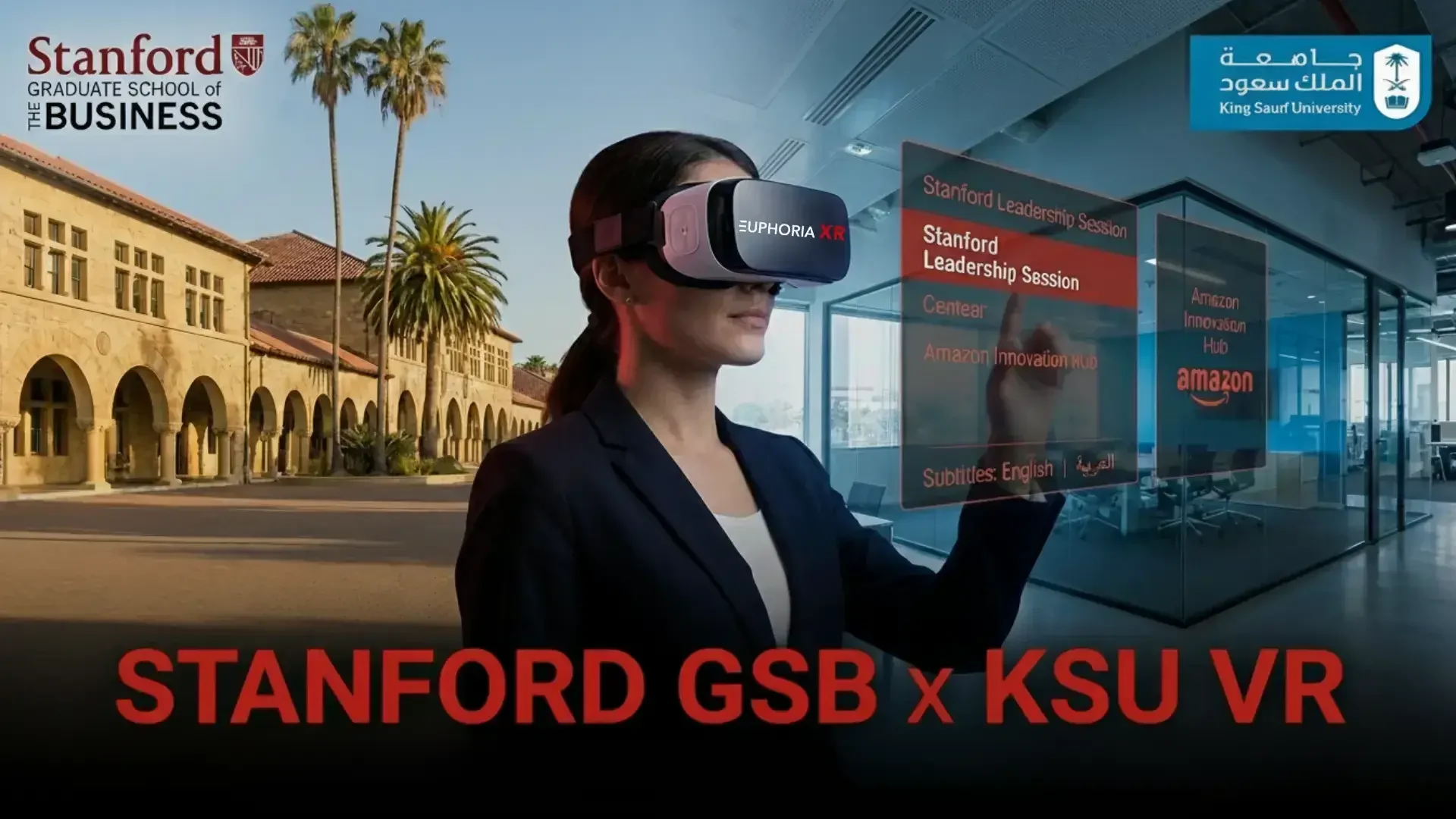
When creating the interactive 360° VR training experience for KSU, this was the challenge for EuphoriaXR to immerse themselves in real academic and corporate learning environments to be able to access Stanford and Amazon.
This led to a VR training solution that would render executive education more accessible, engaging, and scalable through the power of 360 VR training.
What Was the Stanford GSB and KSU 360 VR Training Experience?
The Stanford GSB and KSU 360 VR training experience was an immersive learning platform where participants could engage in learning or working environments through a VR experience.
Users walked into a 360-degree space, able to explore the perimeter space in conjunction with a guided educational experience on a flat screen.
The experience included:
360-degree video learning
Guided instruction
Multilingual subtitles
Interactive playback controls
Simple lesson navigation
Hardware support
User onboarding
Technical assistance
This made education in a virtual world more engaging and enjoyable through VR training as opposed to education as it is usually conducted online these days.
Core Components of the Experience
| Component | Purpose |
|---|---|
| 360° Video | Creates a Presence Inside the Learning Environment |
| Guided Instruction | Provides Structure and Focus |
| Multilingual Subtitles | Improves Accessibility |
| Playback Controls | Gives Learners More Control |
| Navigation System | Makes Learning Easier to Follow |
| Onboarding Support | Simplifies Adoption |
The Challenge: Making Executive Education More Accessible and Engaging
There are lots of executive education courses that are beneficial to the students, but chances are they have to conduct the education from a specific location. The learner who is not there may lack what is essential to facilitate those learning experiences: the setting, context, and engagement.
While traditional online learning is a means of extending reach, it does not faithfully reproduce the sense of ‘being there’. While learners can view a lecture or presentation from any location, many miss out on the personal environment, the vibe of the lecture or presentation, and the real-world context that underlines the deeper meaning.
Making education content available online was no challenge for KSU; it was a requirement. Balancing the benefits of being physically present in the world’s best academic and business settings with accessibility for increased learners was the challenge.
The solution needed to:
Expand access as well as the space of training locations and classrooms.
Ensure the authenticity of authentic environments for real learning.
Increase the “sense of being” for distance students
This boosts engagement over classroom/traditional video learning.
Allow access to diverse users by support for ease of learning elements
Provide a scalable environment in which the experience could be reused
KSU was looking for more than a recorded video library to meet these needs. It required an immersive learning solution to get the learners closer to the experience.
Want to build an immersive VR education experience?
Why did EuphoriaXR use 360 VR Training for This Learning Experience?
This project was not intended to be a fully simulated virtual world.
Rather, the aim was to make the real-life academic and corporate learning environments come to the learner.
This was a distinction that formed the entire development approach
The authentic learning context, the real conversation, the real place of learning, and the experience were valuable. Instead, EuphoriaXR opted to shoot these locations in 360-degree videos to present them in an immersive way using VR training technology.
This way, the learners were able to see how education will be from a natural perspective without the manual manipulation of the phase. This method provided the learners with the opportunity to participate in and learn about the learning environment in its natural form rather than its manipulated form. To avoid a static camera angle, they can window-shop around the space and see its surroundings, making them more likely to engage with the learning space.
Why Was 360 VR Training the Right Choice?
Through its fusion of physical 360 experiences and personalized training, subtitles in multiple languages, and interactive playback control, EuphoriaXR developed an immersive VR learning experience that was both realistic, accessible, and engaging.
This was especially important for the executive education program. It was not the goal to create a classroom environment. It was intended to get the students to experience the learning environment face-to-face, in order to give them a deeper sense of being present in the learning than they can achieve when learning within a digital space.
This led to the development of 360 VR training being the perfect base for offering a more immersive learning environment for KSU’s clientele.
As a top VR development company, EuphoriaXR creates immersive learning and training solutions for universities and companies.
How did EuphoriaXR develop the Interactive VR Training Experience?
The VR training experience was created by EuphoriaXR, taking real academic and corporate settings and making them into a learning platform with all learning done in a set 360-degree format. The aim was to make it an experiential, exemplifiable, and accessible learning experience for KSU learners.
Understanding the Learning Objective
The first step was to gain knowledge of what KSU wished learners to experience. The emphasis was on providing learners with opportunities for learning in high-value academic and occupational settings, instead of having to attend the place where the events are taking place.
The experience was built by EuphoriaXR on engagement, accessibility, retention, and ease of use.
Capturing Real Academic and Corporate Environments
For EuphoriaXR, the key to capture was 360-degree video to provide real learning spaces. This contributed to maintaining the authenticity of the environment.
Learners could turn around rather than look from a set position and were more likely to be here, even within the classroom activity.
Structuring the Experience Around Guided Learning
The content was made understandable in its learning progression. This facilitated the learners taking the training step by step.
With guided learning, users did not have to roam around aimlessly during the 360 VR training experience.
Adding Multilingual Subtitle Support
The teaching content was translated into subtitles and multilingual support, which improved the learning comprehension of students from all backgrounds.
This greater accessibility made it easier for users to understand academic and professional dialogue.
Building Reactive Playback Controls
In addition to this, EuphoriaXR provided the learners with playback controls to pause, replay, and go through the lessons at their own speed.
This provided their users with greater control compared with the standard video training and made it easier to review.
Creating a Simple Interface for Easy Navigation
The interface was kept as minimal as possible and allowed pupils to move between lessons without confusion.
This is necessary because the platform has to facilitate; it does not have to overload the user with complicated controls.
Supporting Hardware Setup and Onboarding
EuphoriaXR also assisted in setting up the VR headsets, onboarding, and technical guidance.
This enabled KSU to run the VR training smoothly in a real (educational) setting, from setting it up to getting the learners to adopt it in the classroom.
What Made the Experience Interactive?
This experience was offered as an active video lesson. EuphoriaXR integrated 360-degree environments, guided training, playback controls, and easy-to-navigate navigation to deliver a more interesting training experience.
Learners had opportunities to learn about their surroundings, chose the way they accessed content, and progressed through lessons as they desired. Because of these features, it created a greater sense of presence/participation than with traditional online learning.
Interactive elements included:
360-degree viewing
Guided learning pathways
Multilingual subtitle options
Reactive playback controls
Simple lesson navigation
All these features combined made the project a VR-based training experience, instead of a simple video course.
360 VR Training vs Traditional Training Videos
Although traditional training shows give somebody access to information, they might not generate the feeling of experiencing the environment, which is essential for supporting learners feel in the learning scene.
This 360 VR training enables learners to become a part of the setting for a more engaging and immersive learning experience.
| Traditional Training Videos | 360 VR Training |
|---|---|
| Fixed Camera Angle | 360-Degree Environment |
| Passive Viewing | Immersive Viewing Experience |
| Limited Environmental Context | Real-World Surroundings Visible |
| Less Learner Control | Interactive Playback and Navigation |
| Lower Sense of Presence | Greater Sense of Presence |
KSU wanted to use 360 VR training to prepare students for in-person learning, as that was currently happening.
Key Features of EuphoriaXR’s VR Training Experience
The key to the success of the KSU project was the ability to smoothly blend the immersive 360-degree content with practical learning features, which further enhanced accessibility, engagement, and usability. The website was not just meant for the purpose of viewing photos in VR space but was built to help users navigate, understand, and interact with content more effectively. Every aspect was an individual contributor to the engaging and accessible VR training programme experience.
360-Degree Video Learning
This experience featured a 360° video recording of real school and workplace environments. This enabled the learners to explore “from various angles,” an eventual more immersive and “present” experience.
Guided Instruction
It was organized in guided learning pathways to lead the learner to follow the training in a clear and organized manner. This kept learners focused throughout the experience on the learning goals.
Multilingual Subtitles
Multilingual subtitles enhanced the accessibility of the film, facilitating the understanding of it by students from varied language backgrounds. This helped to provide wider reach in the training experience and support a diverse audience.
Reactive Playback Controls
Learners could control the playback of the content and pause, replay, or review content whenever they needed to do so. This allowed for a variety of learning styles and gave users the ability to have a personalized learning experience.
Easy Lesson Navigation
Lesson navigation was simple on the platform, allowing users to navigate through it in a non-confusing manner. The interface used was streamlined, making training intuitive and easier to use.
Hardware and Onboarding Support
EuphoriaXR also ensured support for hardware setup and onboarding. This led to rapid uptake and effective use by learners and institutions from the outset of using the VR learning experience.
Looking to launch a custom VR experience? Hire VR developers from EuphoriaXR to bring your vision to life.
Outcomes of the KSU and Stanford 360 VR Training Project
The KSU and Stanford 360 VR training project team showcased that “It is possible to create an interesting and engaging learning experience using immersive technology”. The use of real-world settings and suggested learning activities enabled a more interactive application of the e-learning process than conventional Internet-based sessions.
Key outcomes included:
More students engaged in 360-degree experiences and engagement.
Accommodations to facilitate remote learning
Optimised learning experiences through guidance and instruction
Accessibility improvement of content with multilingual subtitles.
Allow the user to control playback and enjoy the flexibility of these.
Scalable delivery at institution/universities/ trainings and schools.
The project demonstrated that 360 VR training has the potential to allow access to high-value learning in places, without losing the sense of an actual learning environment.
How Can Universities and Enterprises Use Similar VR Training Experiences?
KSU methodology can be adapted to a variety of learning and instruction settings, including those of other educational and corporate training programs. Hiring 360 VR training will enable companies to get closer to real environments and experiences, enabling better engagement, accessibility, and learning outcomes.
Executive Education
The 360 VR training can be used for both lecture and workshop delivery as well as industry-based training to provide knowledge to professionals who are unable to attend, within business schools and executive education providers.
University Training Programs
Universities can enable academic programs, workshops, guest lectures, research demos, and specialised training to have a truly immersive experience.
Corporate Learning and Development
VR training can be utilized for employee training, employee skills development, and knowledge transfer in a more engaging way for organizations.
Employee Onboarding
New employees can use 360 VR training to get to know the workplace before going in-person, to understand the staff dynamics or organizational culture, and to learn about company processes.
Leadership Training
Immersive working environments may be utilized in leadership development programs to help participants gain insights from genuine business cases, discussions, and work environments.
Remote Professional Development
Access to high-quality learning experiences at all levels for professionals, facilitating ongoing learning for distributed teams.
Safety and Compliance Training
Employers can utilize 360-degree worlds to train workers on workplace processes, safety, and compliance in a simulated environment before working in real-world situations.
360 VR Training vs Fully Simulated VR Training
While both types of training have their merits, their goals are different.
The 360 VR training uses a 360-degree video format to create realistic environments for users to immerse themselves in, whereas fully simulated VR training involves users becoming part of a computer-generated simulated environment where they interact and practice hands-on.
| Traditional Training Videos | 360 VR Training |
|---|---|
| Fixed Camera Angle | 360-Degree Environment |
| Passive Viewing | Immersive Viewing Experience |
| Limited Environmental Context | Real-World Surroundings Visible |
| Less Learner Control | Interactive Playback and Navigation |
| Lower Sense of Presence | Greater Sense of Presence |
In the case of the KSU project, the decision was made to use 3D VR training since the project was to get learners to real academic and Corporate environments. Preserving the authenticity of the original learning spaces was very important, and a fully simulated experience was not necessary, as it came to them to understand that the value lay within forming an understanding of the spaces that had to be preserved.
For organizations requiring learners to see, do, and understand actual environments, 360VR training is frequently the best option. If the task or procedure must be executed, or if learners need to be in the shoes of the person, full (or virtual) simulation may be the preferred choice.
Why Choose EuphoriaXR for Immersive Learning and VR Training?
The effectiveness of a VR experience is not solely dependent on the technology of VR. The emphasis must always be on a thorough comprehension of learning goals, user engagement, accessibility, and content delivery.
With EuphoriaXR, it is possible for organizations to create immersive, practical, easy-to-use educational and training experiences. Whatever it takes to enhance the ways people learn, be it concept development, creating 360-degree content, platform design, onboarding, or support for platform deployment.
Organizations pick out EuphoriaXR because of its expertise in:
360-degree VR reports
Immersive learning of solutions
Virtual reality education systems
Educational and employer packages
User-centered enjoy layout
Deployment and onboarding support
By combining technical knowledge with learning-focused design, EuphoriaXR allows universities and organisations to create training stories that are both impactful and scalable.
Best Practices for Building a 360 VR Training Experience
Building a powerful 360 VR training experience requires more than shooting content in a 360-degree layout. The most successful tasks combine strong learning objectives, intuitive design, accessibility functions, and a clear implementation approach. Organizations trying to create impactful immersive learning experiences need to focus on the following best practices:
Define clean, gaining knowledge of targets before selecting the generation
Capture actual environments when context is important to the final results of learning
Structure content around guided getting to know as opposed to passive viewing
Include multilingual subtitles and accessibility capabilities
Give learners control via playback and navigation options
Keep the user interface easy and intuitive
Support onboarding and hardware setup to improve adoption
Continuously acquire feedback and optimize the enjoyment
By specializing in learning outcomes and user experience, organizations can create 360 VR training applications that are enticing, scalable, and powerful.
Ready to convert education with VR? Let’s talk about your next immersive learning experience.
Final Thoughts
The KSU and Stanford 360 VR education venture demonstrates how immersive technology could make instructional experiences more accessible and attractive. By combining real-world environments, guided coaching, multilingual subtitles, playback controls, and intuitive navigation, EuphoriaXR created a VR education experience that enables learners feel greater linked to the content material whilst increasing get right of entry to to great education and expert development opportunities.
Frequently Asked Questions (FAQs)
What is 360 VR training?
360 VR education uses 360-degree video to immerse inexperienced persons in a real environment through a VR headset or a well-matched tool. Learners can look around the gap in preference to watching from one constant camera angle.
How is 360 VR training different from normal video learning?
Normal video learning shows one constant view. 360 VR training lets newcomers enjoy the total environment around them, which creates a more potent sense of presence and context.
What made the KSU and Stanford VR training experience interactive?
The KSU and Stanford VR training provides protected 360-degree viewing, guided guidance, multilingual subtitles, playback controls, and easy lesson navigation. These functions helped inexperienced users comply with the content and manage how they moved through the education.
Why is immersive learning useful for universities?
360 VR education became appropriate because the task centered on actual academic and corporate learning environments. The purpose was to preserve the authenticity of those areas while making them accessible to extra freshmen.
Can companies use virtual reality training for employee development?
Multilingual subtitles helped novices from different language backgrounds understand the educational content more easily. This made the experience more accessible and simpler to follow.
Why choose EuphoriaXR for interactive VR training?
EuphoriaXR supported the assignment with 360-degree content improvement, guided studying layout, playback controls, subtitle help, simple navigation, hardware setup, onboarding, and technical support.
![Top 50 (CTA) Call to Action Synonyms That Drive ROI & Conversions [+ Examples] - Euphoria XR](https://sample.noumanmahmood.net/wp-content/uploads/2026/02/Top-50-CTA-Call-to-Action-Synonyms-That-Drive-ROI-Conversions-Examples-Euphoria-XR-1024x576.webp)