What if there was a trail that taught?
Not through a board.
Not through a long brochure.
Not with the help of a manual, which may or may not be read.
However, the communication would be made via a telephone.
A person treads a true pathway. They touch their phone to their surroundings. They aim the device at their surroundings. All of a sudden, they can get to know local wildlife. They can enter the Edwards Aquifer. They can determine how a recharge zone works. Learning takes place in the place.
This is the power of AR learning apps.
People most frequently get information from traditional learning. Provides them with an experience because of AR. Encourages learning to experience conception visually, with their hands, by exploring, and to understand.
That’s why adaptive AR in education is gaining in significance. Studies indicate that AR can boost student engagement, facilitate active learning, and enhance the understanding of complex concepts using visual and interactive elements. Students in AR demonstrated higher performance on the post-test than students who used the traditional teaching methods in a 2025 Scientific Reports study.
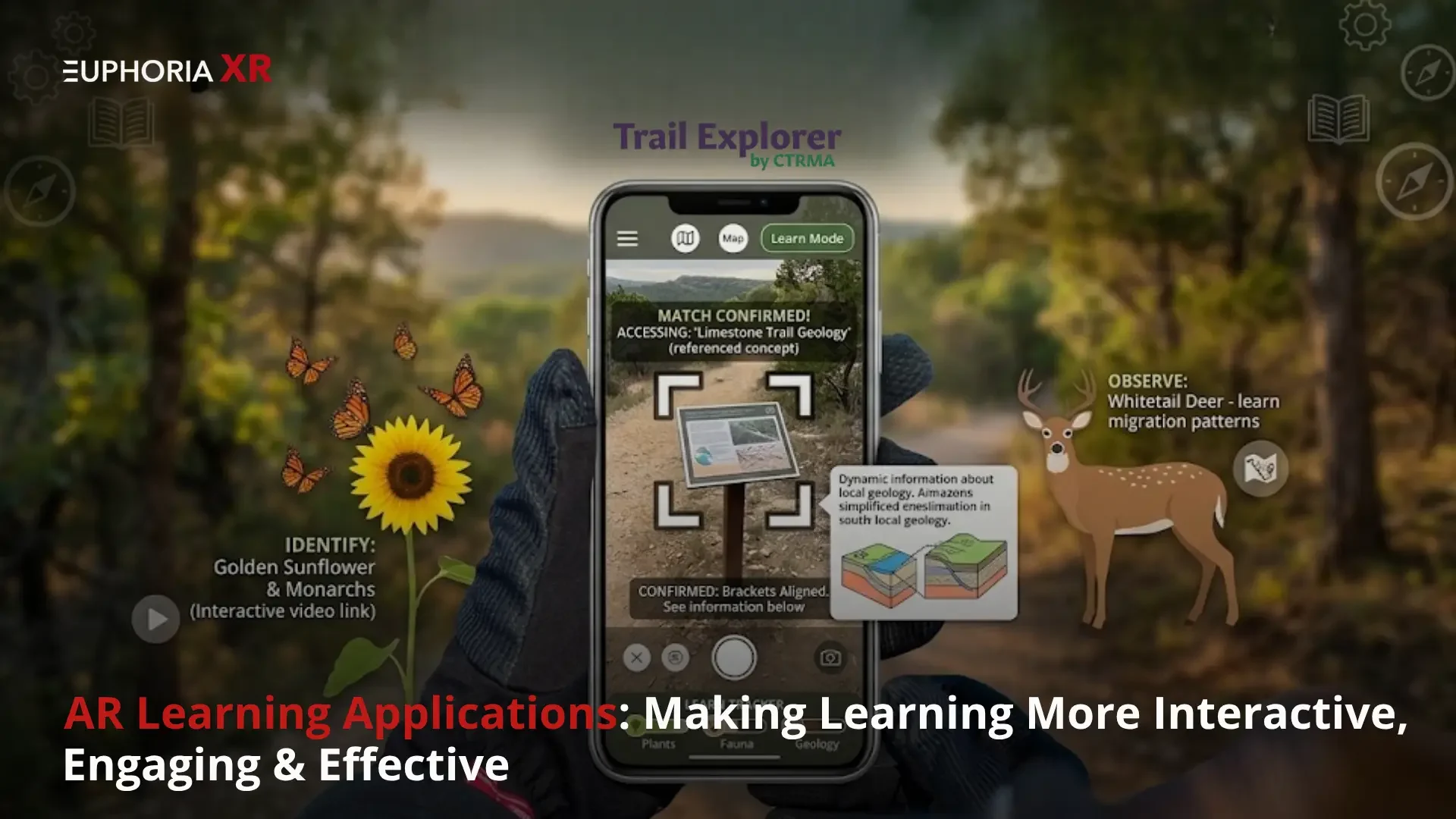
A good illustration of this is the augmented reality education app, Trail Explorer by CTRMA, developed by EuphoriaXR. Based in Austin, the project converts an outside walking trail into an interactive educational experience of the local environment, the Edwards Aquifer, wildlife, and sustainable building.
What Are AR Learning Applications?
AR learning applications are digital applications that enable learners to interact with digital information overlaid on the physical world through augmented reality.
Put simply, AR enables learners to view digital objects, animations, labels, stories, or instructions on top of the real world around them.
According to IBM, AR is the way digital information is augmented and integrated into the real-time world of the user, with digital content making multiple superpositions onto the real world.
An AR learning application that can operate on:
One student may take a picture of a plant and have the parts of the plant identified on the screen. The museum visitor can scan an artefact and view its history. A mobile AR learning app should enable a trail visitor to perceive about himself or herself surrounding by the environment.
This is what makes AR educational apps different than normal learning apps. They don’t have to learn inside a screen. They relate digital learning to the real world.
Why do traditional learning experiences often fail to Engage Users?
Typical learning experiences are ineffective due to over-content. Learners are expected to read, view, and listen to content, but not engage. This is difficult to maintain attention, especially with topics that are complex, visual, and/or part of the real world.
Static Content Does Not Always Hold Attention
Although static information can explain some things, it is not necessarily designed to make things interesting. Facts are provided in signs, brochures, pdf, and even plain videos, but seldom with an invitation to dig deeper. AR learning apps address this issue by converting it into interactive learning experiences.
Complex Subjects Are Hard to Explain Without Visual Context
Some topics are easier to comprehend when they are written as well as spoken. When it comes to science concepts, environmental systems, historical information, technical processes, and infrastructure, there’s often a need for a context that can be visualized. An augmented reality education app can reveal hidden layers, moving parts, and real-world examples in a manner that is easier to understand.
Learners Need Experience, Not Just Information
Learning is best achieved through the opportunity to interact with what one is learning. Learners are not interested in merely reading about a place, object, or process but rather in exploring it through an AR learning application, resulting in more real-life, memorable, practical learning.
How Do AR Learning Applications Make Learning More Interactive?
The AR learning application involves digital content within real-world situations to make education more interactive. Learners can move, explore, tap, scan, and experience info rather than just eat it. That means augmented reality in education can be used in schools, trails, museums, public spaces, and training spaces.
They Turn Real Places Into Learning Environments
AR education apps can transform physical spaces into interactive classrooms. A trail, museum, park, campus, or workplace can be part of the lesson. This enables students to gain an understanding of the topic in the same context as the experience is being conducted.
They Help Users See What Is Usually Hidden
There are important ideas that are not apparent. The AR Education App allows users to display underground systems, interiors of structures, wildlife activity, previous scenes, or other environmental interactions. This helps to “see, understand, and remember” complex subjects.
They Make Learning Active Instead of Passive
AR learning apps inculcate the habit of participation in the lesson. They can interact with information, follow prompts, and explore scenes as we start them. They can discover information step by step. This active learning model allows learners to remain more engaged with the material than with static content.
They Connect Digital Content With Real-World Context
The best learning using AR integrates information with the real environment around the user. AR does not separate the lesson from the location; it brings both. This helps the learning to be useful, relevant, and memorable.
Case Study: Trail Explorer by CTRMA
Trail Explorer by CTRMA is an excellent case study on how an AR learning application can be used to create an interactive learning experience from a real-world location. Created by AR Learning and developed by EuphoriaXR, the mobile AR learning app enabled the residents to immerse themselves in the local wildlife and do their part to understand and conserve the Edwards Aquifer, as well as the environmental history of State Highway 45 Southwest.
The Challenge
Austin, Texas, has built its State Highway 45 Southwest through a sensitive green environment. The project crossed near the Edwards Aquifer recharge area, where the need for public education was paramount. CTRMA and WSP considered that it was necessary to provide a better explanation of the local environment, sustainable construction practices, and wildlife around the trail than could be achieved with static signs or printed material.
The Goal
To design an interactive learning experience to engage residents as they rode along the trail. What was required for the app was not a passive learning experience, but the help of the user to understand the environment with visual, mobile, and location-based AR content.
The AR Learning Application Solution
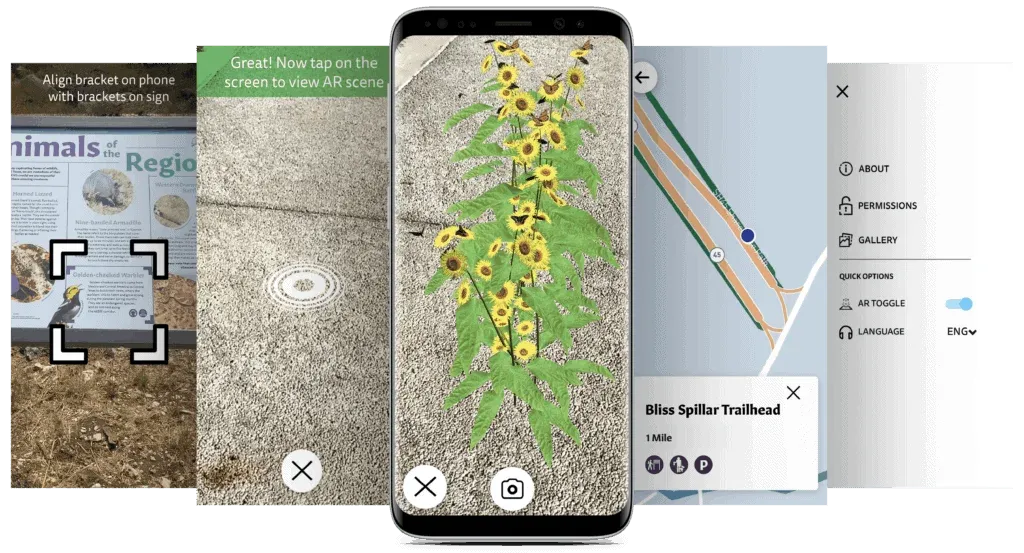
Trail Explorer is an iOS / Android mobile AR education application developed by EuphoriaXR. Users could enjoy the trail virtually and make it more informative and entertaining for them than it was in reality. Users would be able to interact with electronic content, view the surrounding ecosystem, and gain knowledge on major environmental issues directly from their phones.
What Could Users Learn Through the App?
The Trail Explorer AR learning application allowed users to learn about the surrounding wildlife, the Edwards Aquifer, recharge areas, and how sustainable design is important in a sensitive area like the Edwards Aquifer. These topics were easier to understand because they created an experience and visual learning for the app to use in the environment.
Why does this case study matter?
This case study is important as it indicates that AR learning applications are not restricted to classrooms. They can be used to facilitate outdoor education, public awareness, environmental education, and community participation. Trail Explorer illustrates how an augmented reality education application can truly enrich our experiences of real places by allowing our users to see, explore, and understand the messages about the place that surrounds them.
Key Features of a Strong AR Learning Application
The only thing that a successful AR learning app requires is visual appeal. It should be purposeful with simple navigation, useful and interactive, and have a smooth technical setup. Each feature should convey a concept as quickly as possible and give the learner the fascination they need throughout the learning process.
Clear Educational Objective
All AR learning applications should have a definite learning target. This will help to keep everything on focus and let users know what they are going to learn from it.
Outlines the primary learning outcomes
Ensures AR content is on target for the theme or subject material
Helps avoid unnecessary features
Has a more measurable effect
Enables users to have a better understanding
Interactive Storytelling
The AR learning app has a clear flow with interactive storytelling. It will assist the user to complete the lesson in a step-by-step manner rather than through largesse.
Helps users move through the process
Enables learning to be more natural
Capitalizes on the magic of information to create a journey.
Maintains users’ interest and enthusiasm.
Transforms complex concepts into simple ideas
Real World Integration
The best use of AR is when there are digital elements that interact with the real world. This enables the user to study in an environment related to the topic.
Links learning to authentic locations
Makes learning more practical
Shows improvement in context and understanding
Provides engaging opportunities to learn outdoors and in different places
Makes physical contexts more learning environments
Mobile Accessibility
A mobile AR learning app needs to be accessible on smartphones and tablets. This makes the app easier to use for more people, without the need for any special equipment.
Works on familiar devices
Offers easier options for distributing, making learning easier
Supporting schools, museums, trails, and public spaces
Reduces hardware barriers
Supporting you in expanding user reach and adoption
User Experience Design
As a good user experience design, the app should be simple and easy to use. Users should not be misled about what they should tap, scan, and explore.
Analytics and Optimization
Organizations use analytics to gain insights into how users engage with the AR learning application. Over time, it will be easier to enhance content, features, and the content of the learning journey as a whole.
Tracks user engagement
Identifies the parts used more frequently
Supplies answers to the question of what went wrong
Supports content improvement
Improves the application on startup
Benefits of AR Learning Applications
AR learning applications change education to be more active, visual, and memorable. These modes of engagement enable users to go beyond the passive reading or viewing of information to explore it in a hands-on way. This makes learning more easily understood and more real-life.
Better Engagement
Applications of AR learning involve users in participating in learning. Rather than just reading or watching, they have the opportunity to explore, engage, and discover information through the app.
Encourages active participation
Holds attention for longer
Demonstrates ways to make lessons more interesting to students
Encourages experiments and hands-on learning
Takes control of media content exposure
Stronger Knowledge Retention
Memories of experiences will outlast simple information. AR offers the three components of visuals, movement, and interaction, along with context, thus assisting the user in remembering the learned content more easily.
Makes learning more memorable
Supports visual understanding
Relates information to action
Offers people ways to remember key ideas
Produces more powerful learning opportunities
Easier Understanding of Complex Topics
Certain topics need to be clarified with text alone, but it isn’t. AR educational applications can demonstrate hidden systems, moving parts, visual examples, and more that make complex ideas more accessible.
Simplifies abstract ideas
Visually reveals hidden layers
Supports the explanation of science and environmental issues
Enables convenient, easy, and simple technical learning and development.
Converts complex ideas into concrete experiences
More Memorable Learning Experiences
The resulting augmented reality learning experience is more personal and more like a stimulus for interaction than a regular lesson. The users can see the subject, explore and interact with it, instead of just receiving information from it.
Enhances emotional memory
Increases the sense of immersion in lessons
Gives users a unique experience
Demonstrates greater enthusiasm for the subject matter
Differentiates learning activities
Better Connection Between People and Places
AR learning apps can associate information with reality in the user’s surroundings. This makes the learning more relevant as there is an understanding of the topic in the location where it’s going to be understood.
Transforms places into learning environments
Supports place-based learning
Develops greater knowledge about the surroundings
Incorporates local context and supplies helpful information to users.
Increases the amount of learning that could take place in public spaces
Where Can AR Learning Applications Be Used?
AR learning applications can be deployed anywhere information needs to be more visual, interactive, and understandable. These help users to learn through their own experiences rather than through passive content and are beneficial in any classroom, public building, museum, park, training centre, or workplace.
How does EuphoriaXR build AR Learning Applications?
EuphoriaXR utilizes educational strategy, creative storytelling, user experience design, AR development, backend support, and analytics to create AR learning applications. The very first step is to identify the audience, learning objective, context, and environment in which the app will be developed. The team will then develop the content flow, storyboards, scripts, interface design, and AR interactions. As a result of their development, EuphoriaXR also enables the deployment of the AR learning app, integration with databases, maintenance of the application by the school, tracking of engagement in the application, and optimization of the application for real users to ensure its smooth operation.
Why Choose EuphoriaXR for AR Learning Applications?
By offering powerful tools such as AR animations, interactive quizzes, and immersive scenarios, EuphoriaXR empowers organizations to develop AR learning content that is not just visually stunning but also informative, functional, and straightforward to use. In the CTRMA case study, The Trail Explorer, users get to learn about the Edwards Aquifer, recharge zones, construction practices, and wildlife using mobile AR to explore a true outdoor trail.
We craft comprehensive AR learning units, rather than just AR visuals.
We are an interdisciplinary team that brings a combination of educational experiences to the real world.
We develop AR Learning Apps for mobile devices, iOS & Android.
We go from strategy, UX design, AR development, the back-end systems, to analytics.
We can make learning more interactive for schools, museums, parks, government agencies, businesses, and other enterprises.
We develop simple-to-use, easy-to-understand AR education applications, based on clear learning goals.
Final Thoughts
Incorporating AR into learning apps can make learning more interactive, visual, and real-world oriented. The users can not only read and view the information but can also experience it on an immersive level. CTRMA’s Trail Explorer case study demonstrates an AR learning app for mobile devices and how a physical trail can be a fun and interactive education. AR learning applications are a great opportunity for organizations that want to help people (students) make knowledge easier to learn and remember.