
TL;DR
Virtual reality is going to be a stable, but not explosive, situation in the next 5 years. New lighter-sized headsets, enhanced graphical capabilities, improved hand tracking, increased mixed reality capabilities, lighter headsets, AI-assisted content creation, and more enterprise VR usage will help VR better. But VR can’t be fully mainstream until it’s less expensive, more comfortable, offers more real-world applications of its technology, and more content is available.
Have you ever experienced VR and wished, “This is cool, but everyone isn’t doing it yet?”
It is the true VR that is being implemented in the world.
VR feels futuristic. It can get you into the game, the classroom, the hospital, a training room, and a digital world. But it has its drawbacks, too. Headsets really cost a lot of money. However, some users don’t feel at ease. Even vested users can’t imagine adding even a single use case to the daily use of the VR.
What can be expected from virtual reality in the next 5 years, then?
There is no easy answer in the form of hype. VR is not dying. It is also no surprise to be named the next smartphone overnight. VR’s future is assured, practical, and intimately tied to AR, MR, AI, spatial computing, and business training.
What Is the Future of Virtual Reality in the Next 5 Years?
In the next 5 years, practical growth will dominate ideas regarding the future of virtual reality.
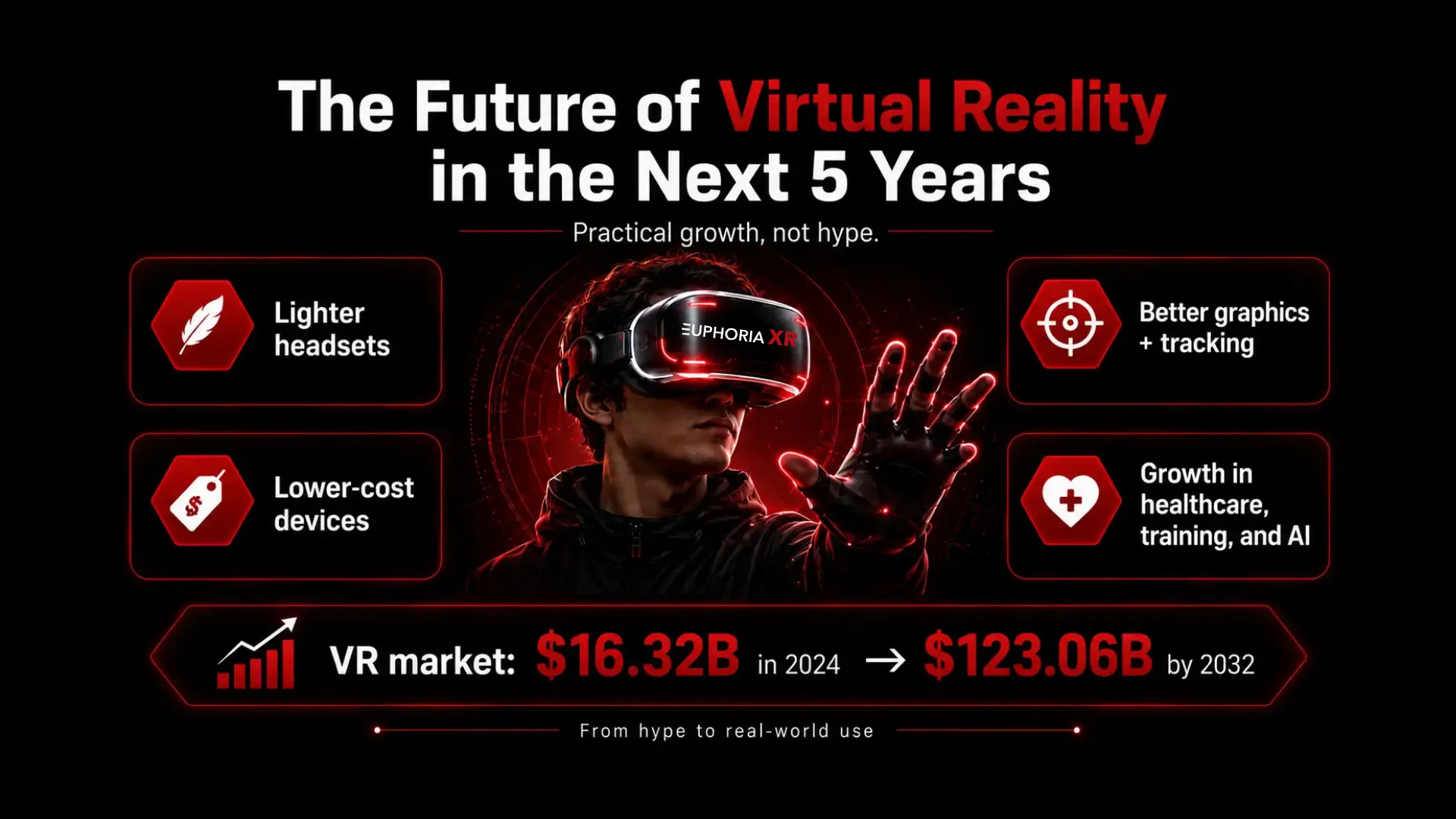
VR is going to be improved in games, training, health, education, industry, design, and simulations. However, it could be limited even for regular users.
The VR future trends that will be the strongest are:
Better VR headset future with lighter devices
Chances are you’ll discover a lower-cost VR headset.
This will deliver text rendition, higher graphic quality, and advanced processing.
Increased Body motion/Improved 6DOF VR
Improved hand tracking and eye tracking
Additional hope for more syncopated features.
A greater number of enterprise VR solutions and VR training solutions.
Fundamentally, more cases for AI and virtual reality.
Increase VR simulation training.
More VR games and mods that are hybrids.
Market Research backs this up and suggests further growth of VR is possible. According to Fortune Business Insights, during 2024, the virtual reality market was valued at USD 16.32 billion and is expected to reach USD 123.06 billion by 2032.
So, VR would not be a failure in the future. Slow progress from the hype to actual usage.
The Current State of Virtual Reality
The benefits of virtual reality are greater than they’ve ever been in the past few years.
Today’s headsets are equipped with more modern displays. Tracking feels smoother. Stand-alone devices are more convenient to use. Mixed reality will surely be getting better, too. Meta Quest 3S, for instance, is proposed to be a less expensive VR headset that goes for USD 299.99.
However, there are obstacles to be faced in this VR state.
There are lots of folks who like to try out VR. Its use decreases on a daily basis. It is here that the VR industry is coming up with a deficiency.
Is VR Dying or Growing?
VR is growing, but not as quickly as people thought. It is not dying. It’s now getting into the hands of users and out of the hype cycle.
Market study inevitably indicates that the market for Virtual Reality is still growing strongly. Fortune Business Insights forecasts that AR/VR is going to expand at a compound annual rate of 44.54% until 2034, reaching USD 441.51 billion. Meanwhile, real users speak up that they are still hesitant to adopt VR because of the cost of the headsets, comfort, and lack of “must-have” content.
VR’s use in enterprise VR, VR training solutions, healthcare, education, simulation, AR, MR, and spatial computing is likely to thrive in the future as VR solutions address real-life problems.
To put it simply, VR is alive and well. It is increasing gradually and developing its usefulness.
Will Virtual Reality Become Mainstream in the Next 5 Years?
Virtual reality is likely to be more prevalent in the following five years, but probably won’t be fully mainstream yet.
VR must now become affordable, more comfortable and lightweight, have improved content, and have more common use cases to be a staple everywhere. Lots of people still regard VR as a form of gaming, fitness, training, or a whim of tech fanatics, a view that seems to be mistaken, as VR is no longer just for gaming, but also for fitness, training, and tech lovers.
A larger change might be related to AR, MR, and smart glasses technology. Daily wearable immersive tech could grow faster than pure VR headsets, as IDC predicts that sales will break through 13,6 million smart glasses per year by 2026 and reach up to 27,3 million per year by 2030.
VR will get accepted, though AR and mixed reality will get more prevalent in everyday life first.
Is VR Still Worth It in 2026?
The short answer is yes, VR still has value in 2026, as long as there is a specific need for it.
VR has value when it comes to training an army, fitness or healthcare training, gaming, education, design, real estate walkthroughs, simulation, and training for enterprises. If a person is only interested in trying it at one specific time and has no use for it going forward, it may not benefit him or her.
Rather than “Is VR the future?” the real question is how VR will be integrated into the future.
The more important question is what VR does better than a normal screen?
VR is awesome when it enables someone to rehearse, learn, move, or experience a better version of what is played out on a flat screen.
Why VR Growth May Be Slower Than Market Forecasts Suggest?
Although the VR market does appear to be growing, that may be just the tip of the iceberg due to cost, comfort, content, and day-to-day use concerns.
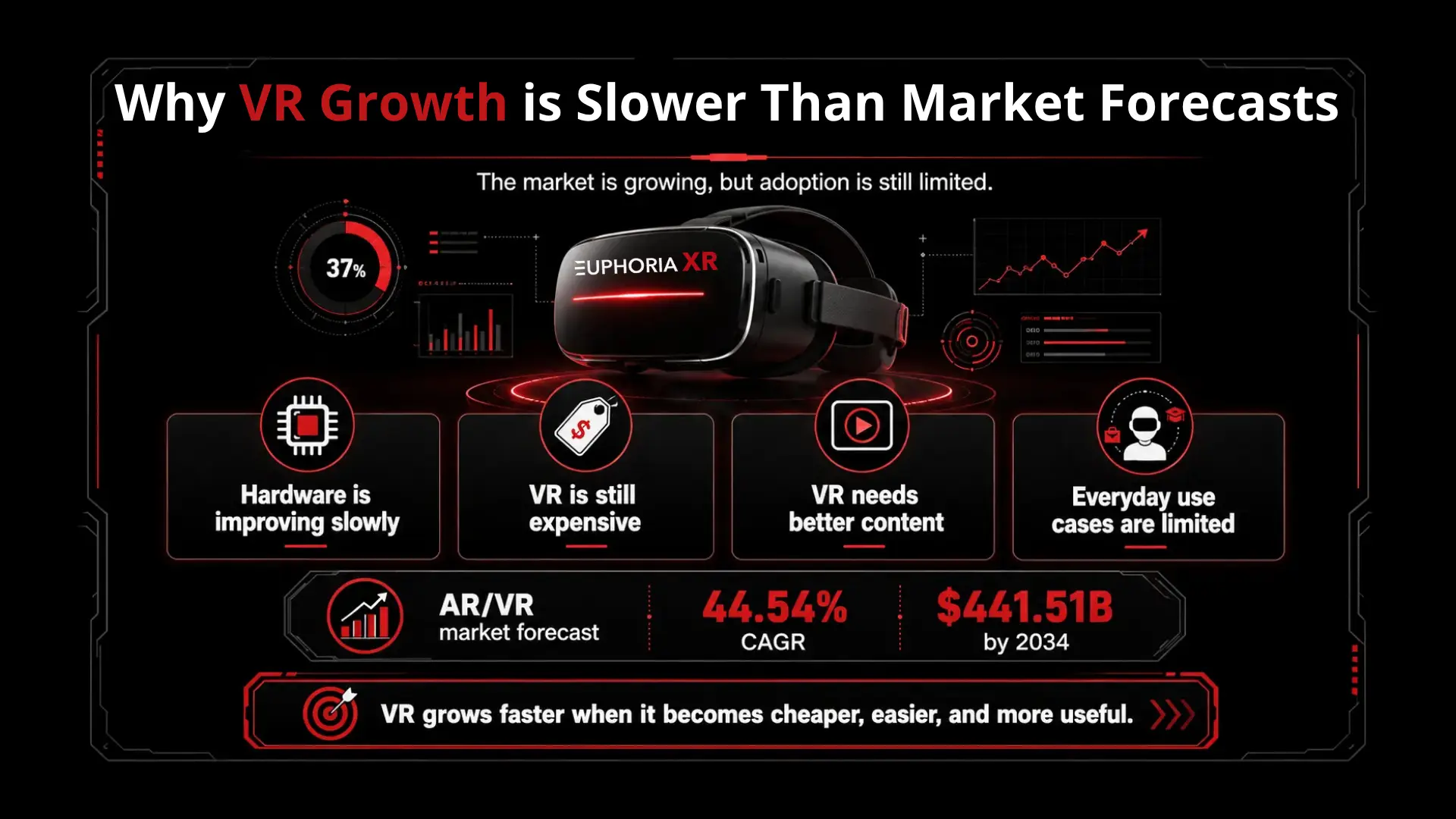
There is high growth, as shown in market reports. Fortune Business Insights forecasts that AR/VR is going to expand at a compound annual rate of 44.54% until 2034, reaching USD 441.51 billion. However, users are cautious. There were also a lot of people on the Reddit thread who are not optimistic about VR’s growth, saying the technology is not ready to be adopted by the masses, as current headsets, games, and use cases aren’t that impressive.
VR is expanding. But that’s not mainstream yet, and before it goes that way, it must get cheaper, more convenient, and more beneficial.
Hardware Is Improving, But Not Fast Enough
VR Headsets are improving. Now they have greater screens, more powerful chips, improved tracking capabilities, and other features related to mixed reality.
However, various users still wish for the headsets to be lighter in weight, more comfortable, and easier to wear for extended sessions. All graphical abilities are good in a headset, but if it is heavy or fatiguing, people won’t use it on a daily basis.
This is why the improvement of VR hardware is important. The only thing that won’t stop VR from being adopted is the absence of hardware.
VR Is Still Expensive for Many Users
The cost is still a problem, though.
While there might be great value VR headsets on the market, it can feel expensive to use one. Some users will require better straps, a powerful PC, and maybe some games and/or apps for the headset.
For casual users, this will pose a single question:
Do I plan to use it a lot, and is it worth my money?
Unless there is a good, reasonable reason for people to use VR daily, it will remain a niche product and an expensive addition to their devices.
VR Needs Better Content
VR must use apps and play games.
A lot of people have been youthful from the outset, but they are not set on purchasing a headset just because it’s good. They purchase it when something is interesting and helpful to do within it.
Good VR content should be presented through:
Hand movement
Body movement
6DOF VR
Physics
Spatial sound
Natural interaction
Real presence
This is why it’s hard to make VR games that are native. Their on-screen and in-game experiences are not to be enjoyed the same way as an ordinary game in a headset. They must be able to move, manipulate the body, hands, and space in a meaningful manner.
Users on Reddit also noted that a lot of VR mods don’t fully take advantage of the 6DOF headsets since they are more concerned with just looking around, rather than interacting.
VR Still Needs Better Everyday Use Cases
VR is good, but not necessarily needed daily yet.
Phones are used every day. Laptops are used specifically for work. Using TVs for entertainment purposes. VR has a way to go before it sees better sense of usage.
Might grow faster if used by humans for:
Work
Fitness
Learning
Training
Design reviews
Virtual meetings
Medical simulations
Entertainment
VR will continue to expand when it can be more effective in alleviating real-world issues than a typical screen could be.
Will VR Improve Over the Years?
Yes, VR will become better as the years go by. Improvements are expected to be most significant with regard to better headsets, better graphics, hand-tracking, eye-tracking, mixed reality, AI, and good VR simulations
VR will not improve by taking one approach. This will get better as hardware, software, content, and UX get better.
Better Headsets
VR Headsets are likely to be lighter, thinner, and more comfortable in the future.
Users would like to wear the device for a longer time without getting tired. This results in improved straps, improved lenses, reduced heat output, more battery life, and increased ease of use.
The power of the VR headset is not the sole thing that makes the best VR headset. It will appear straightforward to use.
Better Graphics and Processing Power
More eye-catching content will create a more realistic VR experience.
This is important because the screen is near the eyes and can irritate them. Unprofessional graphics will pop out of the content and tear it away from the reader’s focus.
By enabling more processing power, the following areas can benefit:
Sharper worlds
Smoother movement
Better lighting
More realistic avatars
Stronger simulations
Improved Mixed Reality Overlays
However, graphics are not enough. VR should also be given more interaction and substantial content.
Better Hand Tracking and Eye Tracking
VR could seem much more natural by incorporating hand tracking and eye tracking.
Users can gesture/swipe, view, and touch objects without pushing numerous buttons.
This can help in:
VR gaming
VR training
VR in healthcare
VR in education
Product design
Virtual meetings
Eye tracking can also be useful for performance, as the more detailed the display of the headset can display where someone is looking, the more useful it is.
Better Mixed Reality Features
One of the potential future trends of VR could very well be mixed reality.
MR makes digital objects visible in the real-world. This helps to make immersive tech more functional in everyday life.
Examples include:
A virtual screen on your real desk
A 3D product model on a table
A fitness trainer who is in your room.
A guideline for training on actual gear
Medical image within a medical space.
That is where AR, MR, and smart glasses, as well as spatial computing, could play a part in the future of VR.
Better VR Content and Simulations
VR simulations might have the chance of growing quicker than typical consumer VR, however, since they resolve clear issues.
They can experience and practice a task in VR before actually completing it in real life. Ideal for health, safety training, education, aviation, manufacturing, and corporate training.
In a study on soft skills, PwC discovered that VR learners become trained 4 times quicker than those in the classroom. In the soft skills training study, PwC has seen that VR learners can get trained 4 times faster than classroom learners. It also determined that the cost of VR training was 52 percent lower when compared with classroom training at 3,000 learners.
That’s why VR simulation training and enterprise VR can be a large component of the future of the VR industry.
Related: https://sample.noumanmahmood.net/top-virtual-reality-innovations-2026/
The Future of Virtual Reality (VR) Gaming
VR games will be better, but maybe not any time soon. VR Mods & hybrid games might want to develop faster, while native VR game titles could take a bit more time.
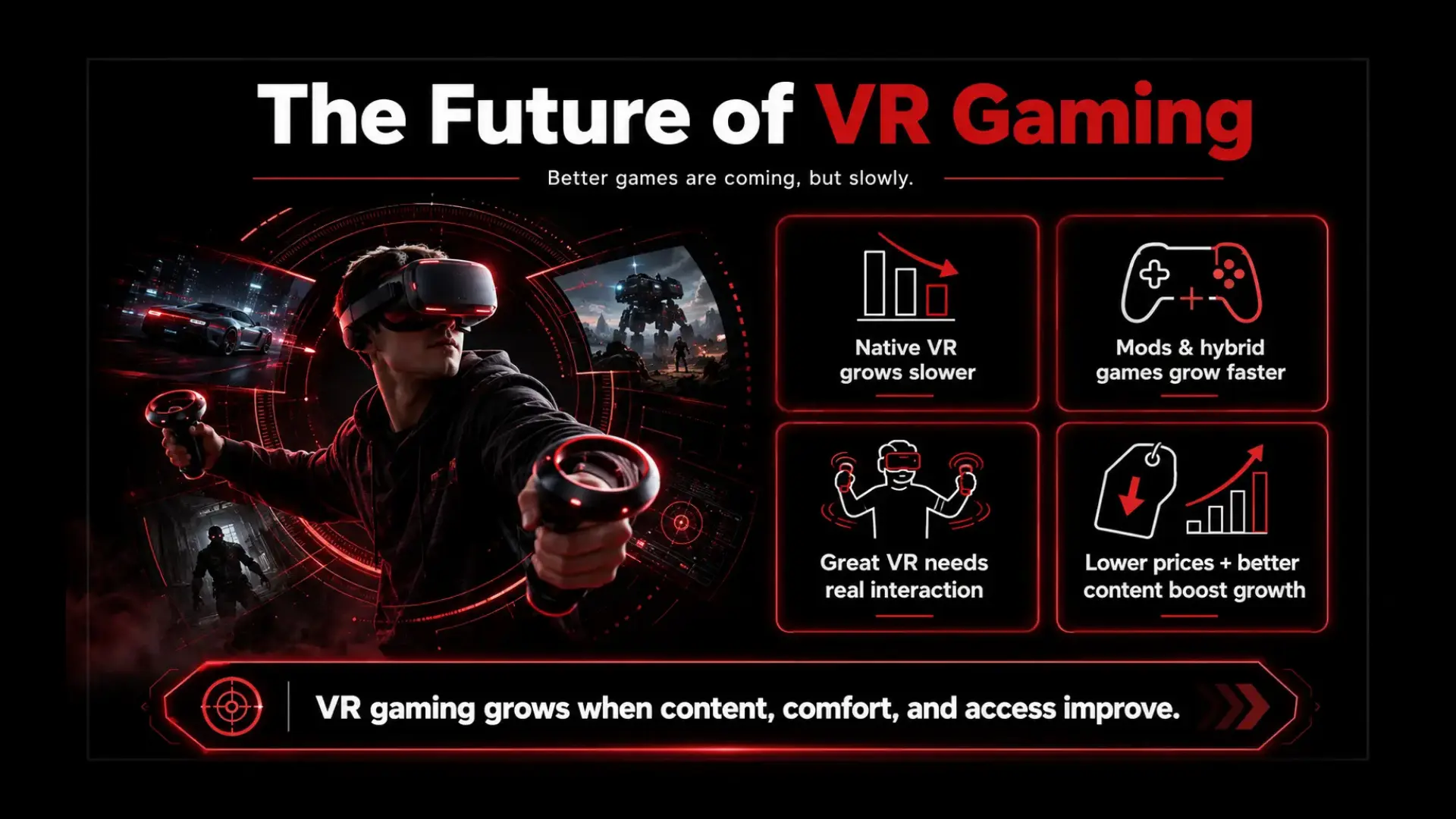
Gaming remains one of the greatest reasons why people buy VR headsets. However, there is a problem with VR gaming. Gamemakers require more players for the games they offer. Users want to get better games ahead of the purchase of headsets.
This helps to create a milder oscillation in the market.
Native VR Games May Struggle for a While
There are native VR games designed specifically for VR.
They may be strong, however can be tricky to construct. Developers need to consider comfort, movement, controls, physics, and motion sickness.
They count among a relatively small readership in the PC, console, or mobile gaming sphere, as well. This presents a significant challenge for games of Native VR, naturally designed for big-budget releases.
That’s where native VR games will start to take their time to grow without the adoption of big headsets significantly rising.
VR Mods and Hybrid VR May Grow Faster
VR mods and hybrid VR games could be more aggressively growing in the short-term.
A VR Mod is a “mod” that will make a 2D game into a VR game. A hybrid VR game is a game that is compatible with normal monitors, as well as VR headsets.
It can be helpful if the developer isn’t required to create a game for VR from scratch.
Hybrid VR is suitable for most of the following:
Racing games
Flight games
Horror games
Adventure games
Simulation games
Exploration games
In addition, Reddit users also hoped that modified and hybrid VR games would work better in the future than the native VR games.
Good VR Games Need More Than Headset Support
A great VR game is supposed to allow the player to explore and navigate the environment around them.
It should make the players feel as if they are a part of the world.
The following are necessary for a successful VR game:
6DOF movement
Hand interaction
Object grabbing
Physics
Spatial audio
Natural aiming
Real scale
Comfort-focused movement
VR isn’t just the ubiquitous virtual screen. It’s a method of playing not the same.
Will VR Make a Comeback in Gaming?
VR could make a return in terms of gaming if there’s better content and easier access.
The turnaround could be due to:
Lower headset prices
Better standalone graphics
More VR mods
More popular VR games
More official VR modes
Better social VR worlds
AI-assisted VR game development
VR games don’t seem like they’ll be taking the place of PC or console games any time soon. If they’re not able to do that through a flat screen, though, it can make the gamer’s experience a greater one.