
How would you like your business to save money on operating costs, boost productivity, and still know that you can support more clients without having to add more employees to your team?
That’s why AI is considered a top priority for companies throughout the U.S. in 2026.
Cities are being increasingly subjected to the challenge of labor expenses, declining profits, and growing customer expectations. Meanwhile, however, executives are being challenged to “do more with less. AI is rising to the occasion, however, as a solution to the challenge of repetitive tasks, enhanced decision-making, and optimized processes for businesses.
With recent industry reports pointing to ongoing advancement in the adoption of AI within US businesses, as they transition from experimentation and measurable progress toward tangible business results, there now seems to be significant growth on the horizon. With further advancements on the horizon, there is every reason to believe that AI’s adoption in US businesses continues to grow. Even the most basic questions about whether or not companies should adopt AI have been tackled and answered. The question is: how fast can they do it to remain competitive?
In this article, we will delve deeper into the ways AI is helping businesses lower their operating expenses in 2026 and what trends are influencing these choices for adopting AI and the insights businesses should have to make the most of the return on investment.
The State of AI Adoption in US Businesses
AI is now a fundamental element of businesses today.
From customer service to software development, logistics management to financial analysis, all domains are sharing how organizations leverage AI for streamlined processes and enhanced efficiency. Whether it’s in customer service, software development, logistics, or finance, AI is helping organizations to streamline processes and boost efficiency.
AI Adoption Statistics and Market Growth
AI is no longer in the future for US businesses. It has changed from a school subject tool to a tool that is used in business every day. In 2026, companies adopt AI to streamline their processes, mitigate human work, and enhance their departments’ decision-making.
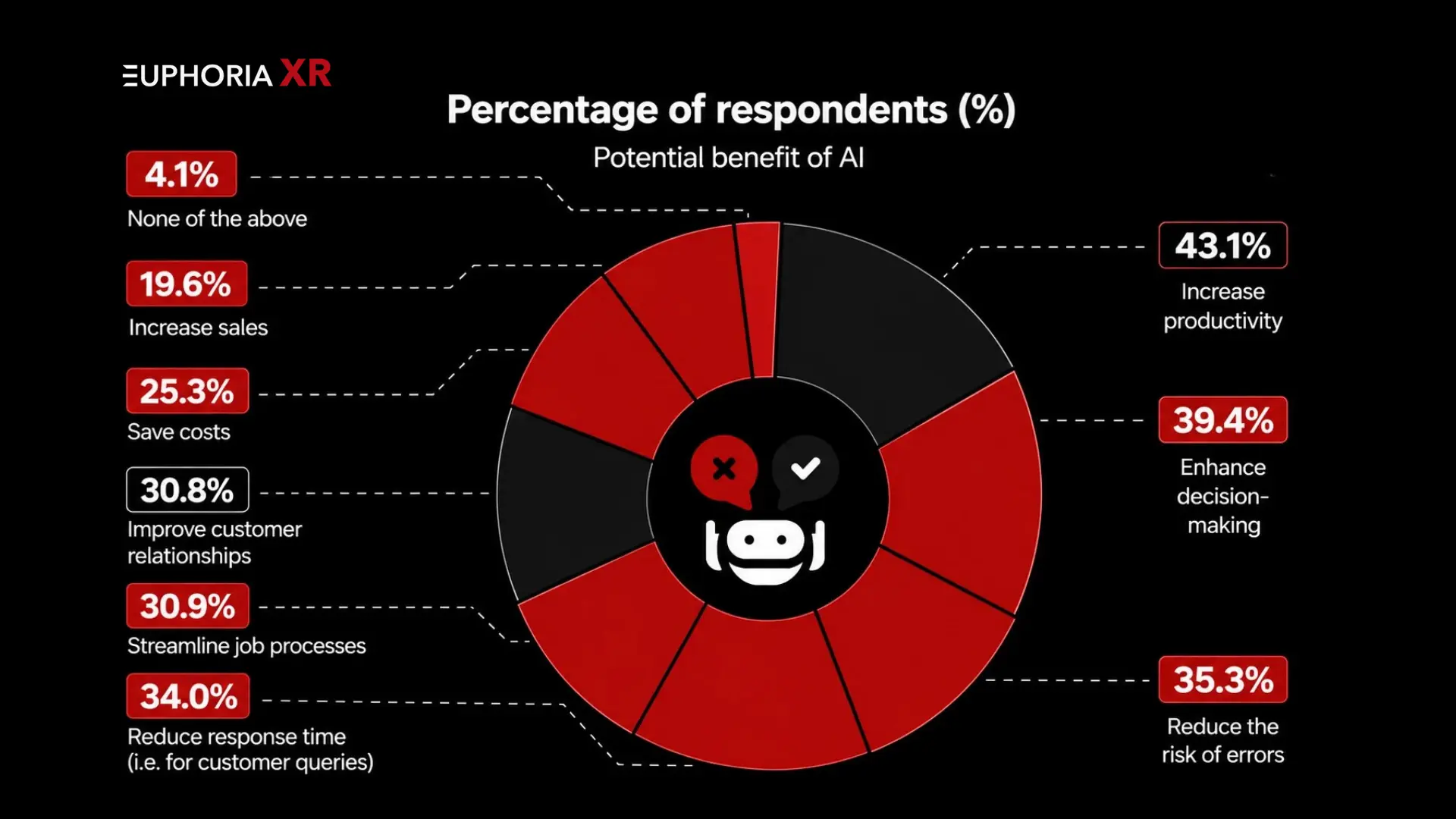
As per the latest industry statistics, there’s significant growth in the use of AI. Higher rates of businesses transitioning from AI testing to actual implementation.Increased adoption of AI by businesses from testing to actual use. AI has had applications and impact in customer service, financial processing, operations, software development, logistics, and even marketing.
| AI Market Insight | What It Shows |
|---|---|
| 78%+ Organizations Use AI in at Least One Business Function | AI Is Now Mainstream |
| 65%+ Executives Plan to Increase AI Investment | Businesses Expect Stronger ROI |
| $1.8 Trillion Projected Global AI Market by 2030 | Long-Term AI Growth Remains Strong |
| 60%+ Businesses Report Productivity Gains | AI Is Improving Daily Work Output |
AI is becoming more easily accessible as its growth is occurring. It isn’t a project huge companies have to undertake to benefit from it. They can now apply AI tools, their own custom AI software, AI agents, and AI automation platforms to answer practical issues within their companies.
Why Are Businesses Investing in AI Now?
A business’s rising costs alongside escalating consumer needs are driving the investment in AI by U.S. companies. Each team must perform at a level where it would be more efficient and effective to do so, with fewer resources, and with a faster reaction time and speed of decision-making.
AI steps in to meet demands in large companies.AI is filling this gap in large companies. It can analyze data, automate repetitive tasks, and assist employees with quicker information. Excessively scaling by hiring more people to handle new workloads can be enhanced by introducing AI in the existing Team.
An AI agent can, for instance, respond to FAQs by a support team. AI is another tool that can help a finance team to read through the details of an invoice. AI tools can be a big help for a software development team to test their code quickly. In both instances, AI saves time on repetitive tasks and increases general productivity.
Industries Leading AI Adoption
A few industries are integrating AI quicker, owing to sizeable data, client requests, or complexity.
| Industry | How AI Is Commonly Used |
|---|---|
| Healthcare | Patient Scheduling, Imaging Support, and Administrative Automation |
| Finance | Fraud Detection, Forecasting, and Customer Support |
| Manufacturing | Predictive Maintenance and Quality Control |
| Retail | Inventory Planning and Product Recommendations |
| Logistics | Route Planning and Warehouse Optimization |
| Technology | Software Testing, Code Support, and Product Automation |
These industries are a prime example of the rapid adoption of AI and its impact. The value AI can create increases as the work is repetitive or data-intensive.The more repetitive or data-intensive the work, the more value AI can create.
Ready to reduce operating costs with AI? Learn about AI solutions tailor-made for your business dreams.
Why Has AI Become a Cost Reduction Strategy in 2026?
Companies look for AI as a cost reduction tool as they realize they must manage costs while sustaining their growth. It streamlines repetitive tasks, boosts productivity, and reduces manual delays for faster decision-making in businesses.
Rising Labor Costs
The cost of hiring, training, wages, and employee turnover is increasing. AI can relieve this burden by taking care of recurring tasks, such as data entry, reporting, scheduling, and initial customer support.
Pressure to Improve Operational Efficiency
Businesses desire quicker procedures and fewer mistakes. The role of AI in enhancing efficiency is twofold: by eliminating slow manual tasks, teams can complete their day-to-day tasks more efficiently.
Demand for Faster Decision-Making
Business leaders must be able to access timeliness to remain competitive. AI processes vast amounts of data in a matter of seconds, whereas humans may take hours or days to complete such tasks.AI will make better decisions on large data sets before they can become an expensive problem for companies.
Need for Scalable Business Operations
Workload is growing as businesses scale. Businesses can handle more customers, more data, and more processes with AI; neither the cost of those processes expands as fast as the number of customers grows, nor does the cost of handling the data grow at the same rate as customer data, for the reasons outlined above.
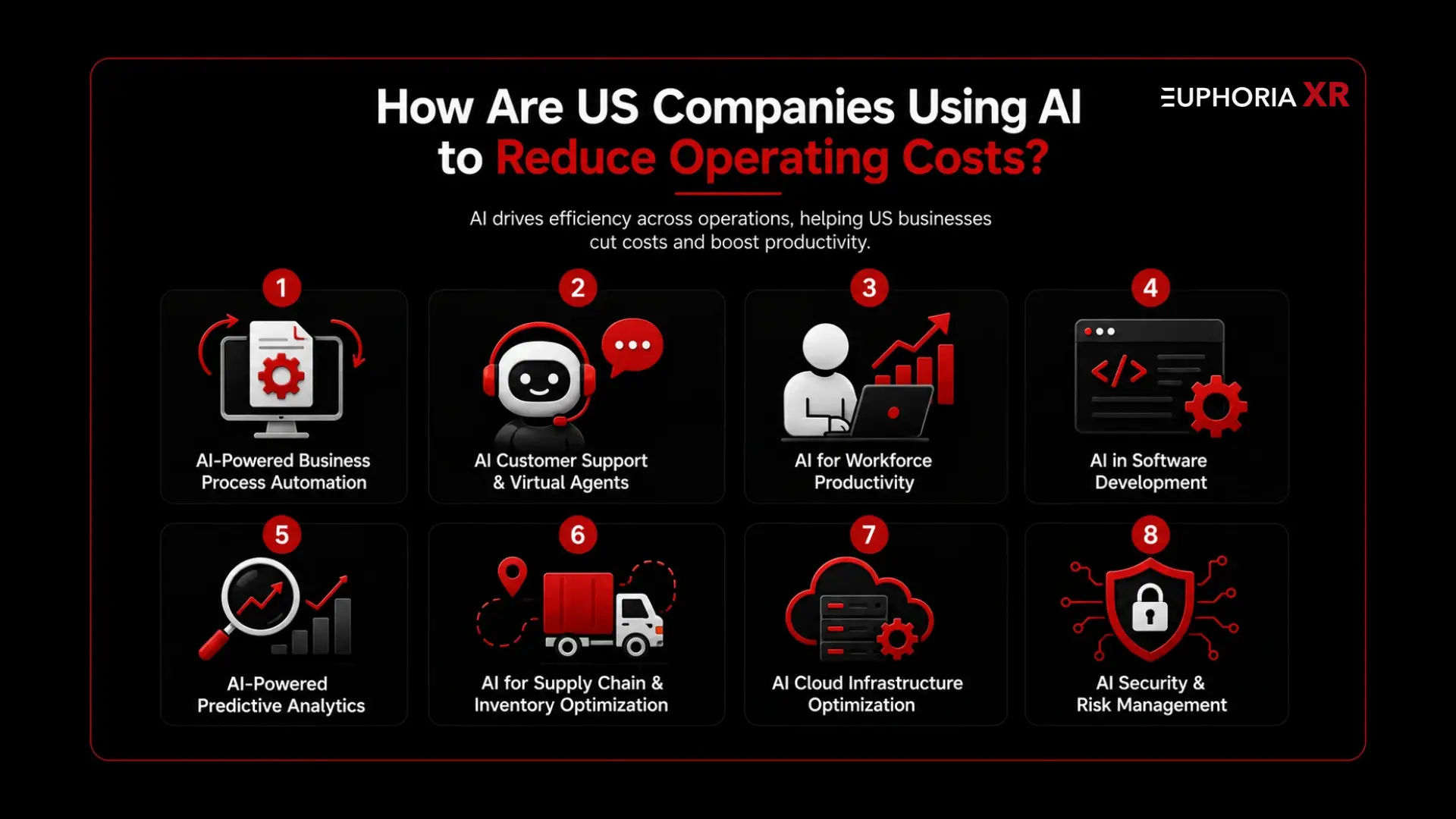
How Are US Companies Using AI to Reduce Operating Costs?
AI is transforming how businesses operate and eliminating inefficiency for U.S. companies. AI isn’t being used in just a single function; it’s utilized across a range of functions where there is measurable cost savings or a productivity multiplier.
AI-Powered Business Process Automation
One of the most prevalent uses of AI in business is process automation. Process automation is one of the most common uses of AI in business, as it can directly reduce the administrative load and enhance working operations.
Routes outbound invoices, documents, approvals, and compliance reports.
Saves time and mitigates human effort, enabling speed and accuracy enhancements.
Reduces employees’ workload from repetitive to higher-value activities.
AI Customer Support and Virtual Agents
AI has been adopted by customer support teams to deal with basic enquiries and to assist customers whenever they need it, without hiring more support staff.
Addresses frequently asked customer queries using chatbots/ virtual assistants.
Delivers support for hours of the day and night, but not higher workload.
Optimizes response times and minimizes support workloads.
AI for Workforce Productivity
AI is helping companies to get their employees to work more efficiently, not replace them.
Supports report preparation, content development, meeting summarization, and research.
Saves repetitive paperwork time.
Guides the team in thinking strategically, creatively, and in terms of decisions.
AI in Software Development
AI is rebuilding the software development lifecycle, from design and coding to testing and maintenance, and is helping organizations save on costs and speed. The field of software development is undergoing a radical transformation, with AI helping to streamline the entire process from design, coding, testing to maintenance, and boosting cost savings and speed-to-market.
Supports code generation, testing, debugging, and documentation of code.
Accelerates the development cycles and enhances developer productivity.
Reduces the resources needed for software maintenance and updates.
AI-Powered Predictive Analytics
Predictive analytics can assist businesses in making informed and intelligent choices as it can reveal patterns and predict future outcomes.
Enhances the ability to forecast demand and plan resources.
Supports risk mitigation activities that prevent operations from being negatively affected.
Minimizes the loss of resources from under-prediction and over-prediction of business.
AI for Supply Chain and Inventory Optimization
To manage costs and service levels, organizations have come to focus on supply chain efficiency.
Predicts future inventories based on patterns of demand.
Improves routes and methodologies for delivery and logistics.
Eliminates overproduction, stockouts, and shipping costs.
AI Cloud Infrastructure Optimization
Companies have been investing in AI to optimize their cloud infrastructure as spending increases in the cloud. Businesses have been investing in AI to optimize their cloud infrastructure while spending in the cloud continues to grow.
Analyzes expenses and uncovers avoidable expenditures.
Seamlessly scales computing resources up and down as needed.
Improves performance while reducing cloud operating costs.
AI Security and Risk Management
The repercussions of online security breaches can be very costly and operational. Predictive detection and proactive monitoring are among the ways in which AI contributes to bolstering an organization’s security position.
Detects suspicious activity continuously.
Enables automated threat response and fraud prevention.
Reduces the risk of costly security breaches and downtime.
Key AI Business Predictions for 2026
While AI adoption is evolving into a routine process, companies are no longer just observing and experimenting with what it can do, but turning their attention to creating long-term value instead. Organizations will follow a few trends in the enterprise AI strategy in 2026.
Organizations Will Prioritize Measurable AI ROI
Organizations are becoming more discerning in their use of AI and demand tangible ROI from its application.
AI projects will be judged on their cost savings and productivity gains.
Organizations will be aware of use cases that can yield a measurable business impact.
ROI will start playing a crucial role when it comes to investing in AI.
AI Agents Will Become Standard Business Tools
AI agents are transforming from mere tools to smart digital assistants for engaging in more complex business processes.
Configure workflows, customer interaction, and operations.
Empower staff with automated repetitive tasks.
Start to become a common part of enterprise tech stacks.
The Rise of the AI Generalist Workforce
With the implementation of AI systems and tools, the workforce is transforming, and workers must now learn to collaborate with this technology.
AI skills, in addition to domain skills, will be appreciated by organizations.
Workers will leverage AI to work more productively and efficiently.
AI literacy will be a key skill in the work environment.
Responsible AI Will Become a Competitive Requirement
Companies will emphasize ethical, secure, and transparent use of AI in their operations.
More emphasis on good governance.
Data confidentiality will continue to be a key focus area.
AI systems with trustworthiness will enhance customer trust.
AI Orchestration Platforms Will Replace Isolated Tools
Gone are the days of siloed applications and solutions, and instead, organizations are adopting integrated AI ecosystems.
There will be a suite of AI assistants that will be coordinated from centralized platforms.
Companies can get smoother operation of inter-departmental systems.
Systems will be unified to ensure greater scalability and efficient operations.
AI Will Drive Sustainability and Resource Efficiency
AI is increasingly being adopted by companies to help with their business performance and sustainability efforts.
Uses energy and resources efficiently.
Minimizes waste in operations and through supply chains.
Helps achieve long-term environmental and cost reduction goals.

Looking for a trusted AI consulting company? Discover how EuphoriaXR enables groups to automate workflows, improve performance, and free up measurable ROI with custom AI solutions.
Benefits Businesses Are Seeing From AI Cost Optimization
Companies that take AI (artificial intelligence) steps are seeing an impact and visible ROI. In addition to the cost savings, AI has contributed to the agility, productivity, and competitiveness of businesses in today’s rapidly evolving market.
Lower Operational Expenses
The primary advantage of AI is the cost-saving capabilities it offers. Automation of repetitive tasks and optimization of resource allocation can cut down on administrative costs, prevent inefficiencies, and make everyday tasks easier to handle in businesses.
Increased Productivity
Employees utilize AI to get more done with less time and effort. AI can take over repetitive tasks like data processing, reporting, and information retrieval, freeing up time for teams to concentrate on strategic initiatives, problem-solving, and customer engagement. This results in greater output elasticity while keeping the number of labourers in the process unchanged.
Faster Decision-Making
Modern corporations generate large amounts of data every day. AI analyzes this information quickly and identifies valuable insights that assist quicker and more knowledgeable decision-making. As a result, businesses can respond more efficiently to marketplace adjustments, consumer needs, and operational challenges.
Improved Customer Experience
AI allows businesses to offer faster, more personalised customer interactions. From digital assistants and shrewd chatbots to predictive insights, AI helps companies deliver steady support and higher client reports while retaining operational performance.
Greater Scalability
As businesses grow, operational complexity will regularly increase. AI lets groups scale strategies, manage larger workloads, and guide more clients without proportionally growing expenses. That establishes an extra sustainable route toward long-term growth.
Best Practices for Successful AI Cost Optimization
While AI offers great possibilities for fee discount, undertaking significant outcomes calls for a strategic approach. Companies that concentrate on making plans, execution, and continuous improvement can be extra a hit at getting the most from their AI investments.
Start With High-Cost Processes
The initial step for businesses should be to determine ways that they spend a significant amount of time, resources, or hard management costs. High-value regions are an opportunity to deliver better ROI for your investment, and in doing so to build momentum for general adoption of AI.
Set Clear ROI Metrics
The key to an AI project is that measurable goals have to be built. Establishing clear performance metrics beforehand, like cost savings, productivity gains, shortened processing times, or enhanced customer service, should be defined. This enables performance to be compared and the arguments for further investment to be put.
Ensure Data Quality
To generate comprehensive results, AI systems must be based on accurate and reliable data. If data is of poor quality, predictions can be inaccurate, and automation won’t work. Implementing data management practices is vital for organizations to ensure that their AI solutions are correct and operating as intended.
Maintain Human Oversight
While AI can manage numerous responsibilities, there are still instances wherein human input is vital in strategic planning and complex scenarios. Oversight creates accuracy, accountability, and alignment with the goals of a commercial enterprise, and minimizes risks of capacity.
Scale AI Gradually
In the initiative to adopt AI, individual organizations often report greater impacts by beginning with specific AI projects. Organisations are not always succeeding in implementing Ambient Intelligence throughout their organisations from the start, but are often making their impact by starting small with specific AI projects. Once some success is achieved, the approach can be rolled out in other services as teams become confident and proficient in using AI tools.
Continuously Monitor Performance
AI optimization doesn’t happen overnight; it’s a gradual process! To get the most out of their machines and the business, it is often necessary for organisations to review machine performance, compare the progress to the desired targets, and adjust the machine settings as required.
Common Challenges Businesses Face When Implementing AI
AI can bring about savings and efficiencies on an unprecedented scale, but it also presents some challenges in implementation. While it is true that many agencies do not succeed with technology, it is only half of the story; other issues involving data, tactics, people, and even expectations can make or break an agency’s success. Understanding those challenges early can assist groups in creating a more successful AI adoption method.
| Challenge | Impact on Business |
|---|---|
| Poor Data Quality | Inaccurate or Incomplete Data Can Reduce AI Performance and Lead to Unreliable Outcomes. |
| Employee Resistance | Teams May Hesitate to Adopt AI if They Are Unfamiliar with the Technology or Concerned About Changing Roles. |
| Integration Complexity | Connecting AI Solutions with Existing Systems and Workflows Can Require Significant Planning and Technical Expertise. |
| Security and Compliance Concerns | Organizations Must Ensure Data Privacy, Regulatory Compliance, and Protection Against Potential Security Risks. |
| Unrealistic ROI Expectations | Expecting Immediate Results Can Lead to Disappointment, as AI Often Requires Time, Optimization, and Continuous Improvement to Deliver Full Value. |
Companies that step up to those challenges in a proactive way are far more likely to successfully implement AI and make the most out of the investments in the future.
From AI automation and smart dealers to predictive analytics and custom software, EuphoriaXR helps agencies turn AI into actual commercial enterprise results.
Wrapping Up
Artificial intelligence is reworking how US companies reduce operating costs in 2026. AI can handle automation, customer support, deliver chain optimization, cloud optimization, and cybersecurity solutions, and assist corporations to operate quicker, cheaper, and more effectively. The ones who are driving the best results are the groups that have their aims clear, their data robust, and a realistic strategy for implementation. With AI’s ongoing evolution, organizations that utilize it successfully can be more robust and competitive in terms of efficiency, scaling, and so forth.
Frequently Asked Questions (FAQs)
How does AI reduce operating costs?
AI can cut operating expenses in distinctive ways, along with automating tedious responsibilities, optimizing workflows, assisting allocation, and minimizing manual errors. This permits companies to gain more with their assets and boost productivity.
Which industries benefit most from AI automation?
AI automation looks best for industries that traverse the mountains of information or repetitive workflows. These cover customer support, e-commerce, logistical activities, retail, production, economic services, and healthcare.
What is the average ROI of AI implementation?
ROI depends on an implementation approach, an enterprise, and a use case. The benefits of using AI are well documented in many cases, with massive gains in productivity, efficiency, and cost savings when it is properly used and contributing to the business’s goals.
Can small businesses use AI for cost optimization?
Yes. The reach and value of AI tools have made them accessible for small groups to handle repetitive tasks, streamline operations, enhance customer service, and decrease overhead expenses without necessitating great investments in technology.
What are AI agents in business operations?
AI agents are intelligent software programs able to carry out tasks, make choices, and communicate with customers with little to no human involvement. These are utilized by corporations for their customer support, workflow automation, data manipulation, and overall performance development.
How much does AI implementation cost in 2026?
The cost of implementing AI varies greatly depending largely on the variety of the mission, business requirements, customizations required, and possible integrations. Others utilize AI packages that are pre-made by the vendor, and some companies add value by developing in-house AI solutions engineered to address specific business goals and operational hurdles.