TL;DR
The divide between the AI adoption gap and real business value is the gap between those businesses that are using AI technologies and those businesses that are becoming truly productive from AI. Although extensive use of AI has become commonplace in businesses, most are still weak in three areas: integration with AI workflow, employee training, and tracking ROI from AI use. But how access to AI relates to the real issue is that the real problem isn’t access to AI. The true difficulty is in doing it
The term Artificial Intelligence is on the lips of almost every company nowadays.
There are plenty of tools and tools using ChatGPT, Copilot, Gemini, AI agents, chatbots, and automation.
However, this is the problem.
Accessibility of most companies is AI.
Not many people understand the proper implementation of AI within the workplace.
This is the reason some people believe that the gap in the adoption of AI is larger than it actually is.
According to a new report by McKinsey, 88 percent of organizations are utilizing AI in a minimum of one enterprise capability, but a massive majority have not broadly expanded AI throughout their enterprise.
Therefore, the use of AI is prevalent enough.
However, there is still not a high maturity of AI.
Everyone Wants AI, But Most Businesses Are Not Ready for It
AI is part of many business organizations due to the pressure they are feeling.
They don’t want to be late to or behind the class. They don’t wish the competitors to move quickly. They don’t want to lose out on the past of a significant change.
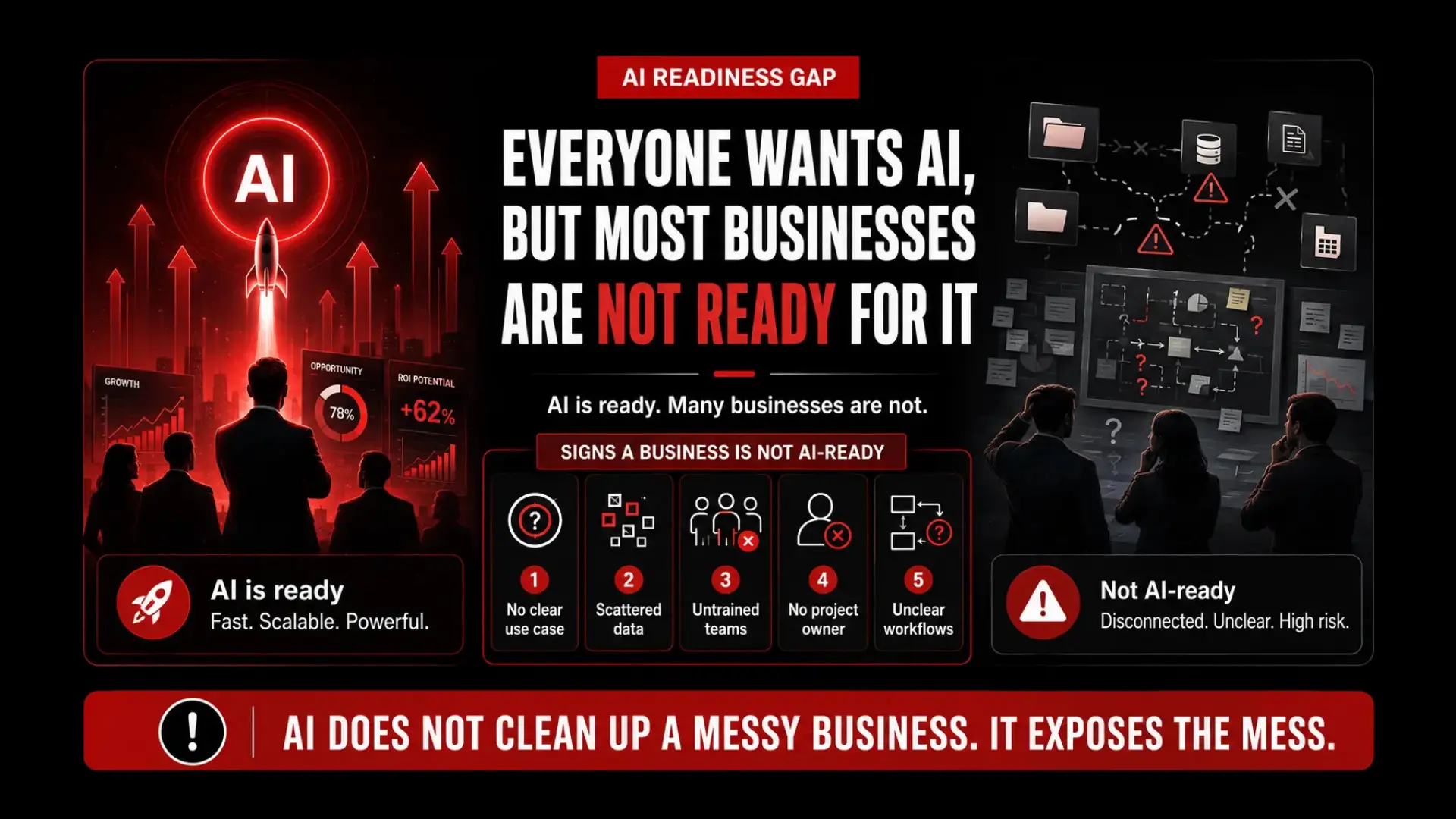
Owning up to a desire for AI isn’t sufficient reason to be AI-ready.
AI readiness is about having all the necessary resources: people, data, processes, and governance to utilize AI securely and effectively.
A variety of challenges continue to plague many enterprises, such as data and information silos, weak data governance, talent shortages, difficulty keeping up with systems complexity, and distrust of autonomous systems, says IBM. It also states that the ability of AI is outpacing the ability of an organisation.
Here’s the explanation of the difference.
AI is ready.
Many businesses aren’t.
When is not a good time to do this? A business typically isn’t AI-ready when:
There’s no obvious application of AI that this would be used for.
Its data is spread out and disorganized.
Staff are not qualified
No one is responsible for the AI project
The flow of activities is not explained.
There are no review rules
By the terms of what was achieved, success is not measured.
AI is no mess clean-up agent.
Typically reveals the evidence of a mess.
The Real Gap Is Not Access to AI. It Is Understanding AI
AI is available to most companies.
That part is easy.
It’s the “where” of this AI that’s difficult.
Here lies the starting point of the AI literacy gap.
Many leaders request something like AI agents, AI chatbots, AI automation, or AI integration, but they are not aware of what each should be solving for.
This is something that companies can request when they need a cleaner process of CRM, not that they need an AI agent.
Another might require a chatbot, while a different one will require enhanced support ticket routing.
One might request automation with AI when they don’t have an asset management process in place at this point.
This is why the first question must NOT be:
How to leverage AI?
However, the real question is:
What task is slow, expensive, repetitive, or complicated to do at this point?
Vaporizing AI from hype and bringing it as a business strategy is the question.
Leaders Know AI Is Important, But Not How to Use It
There are a lot of senior leaders who know not only that AI matters, but that it really matters a lot.
However, they might not be able to discern what qualifies as a good AI use case.
This results in weak decisions made for the buyer.
Common mistakes include:
Acquisition by others (competitors) is the reason for purchasing AI.
Choosing tools based on impressive demos
Relying on Artificial Intelligence to be able to replace entire teams.
Automating unclear processes
Ignoring data quality
Skipping employee training
I’m unable to keep up with the value of AI for business.
It’s one of the key challenges to implementing AI.
It wouldn’t always be the proper time to start with an AI tool.
This should begin with a business issue.
Teams Use AI Casually, Not Strategically
Lots of workers are already utilizing AI.
They utilize it to compose email messages, record notes, write down summary notes, develop content ideas, and compose responses, research material, or rewrite reports.
This is useful.
However, it’s not the same as enterprise AI adoption.
Adopting enterprise AI implies that the business has a defined workflow that it uses AI.
That should answer that system:
What should be done instead of AI?
What is acceptable in terms of tools?
What data is available to share?
What does one do if one’s AI comes up with a ‘conclusion’?
How to evaluate the quality?
What are the measures of the ROI of AI?
Otherwise, this randomness would persist in the use of AI.
Individuals use AI as they remember.
They stop if it feels confusing.
The business does not accrue the regular benefit.
Why Does AI Adoption Look Bigger Than It Really Is?
AI adoption is perceived to be larger due to many businesses considering the use of basic tools as a successful adoption. However, the adoption of AI in small-scale applications is significantly different from its integration into everyday business operations. When the customer experience, speed, cost, and decisions or workflows are impacted by AI, it is a sign of real adoption.
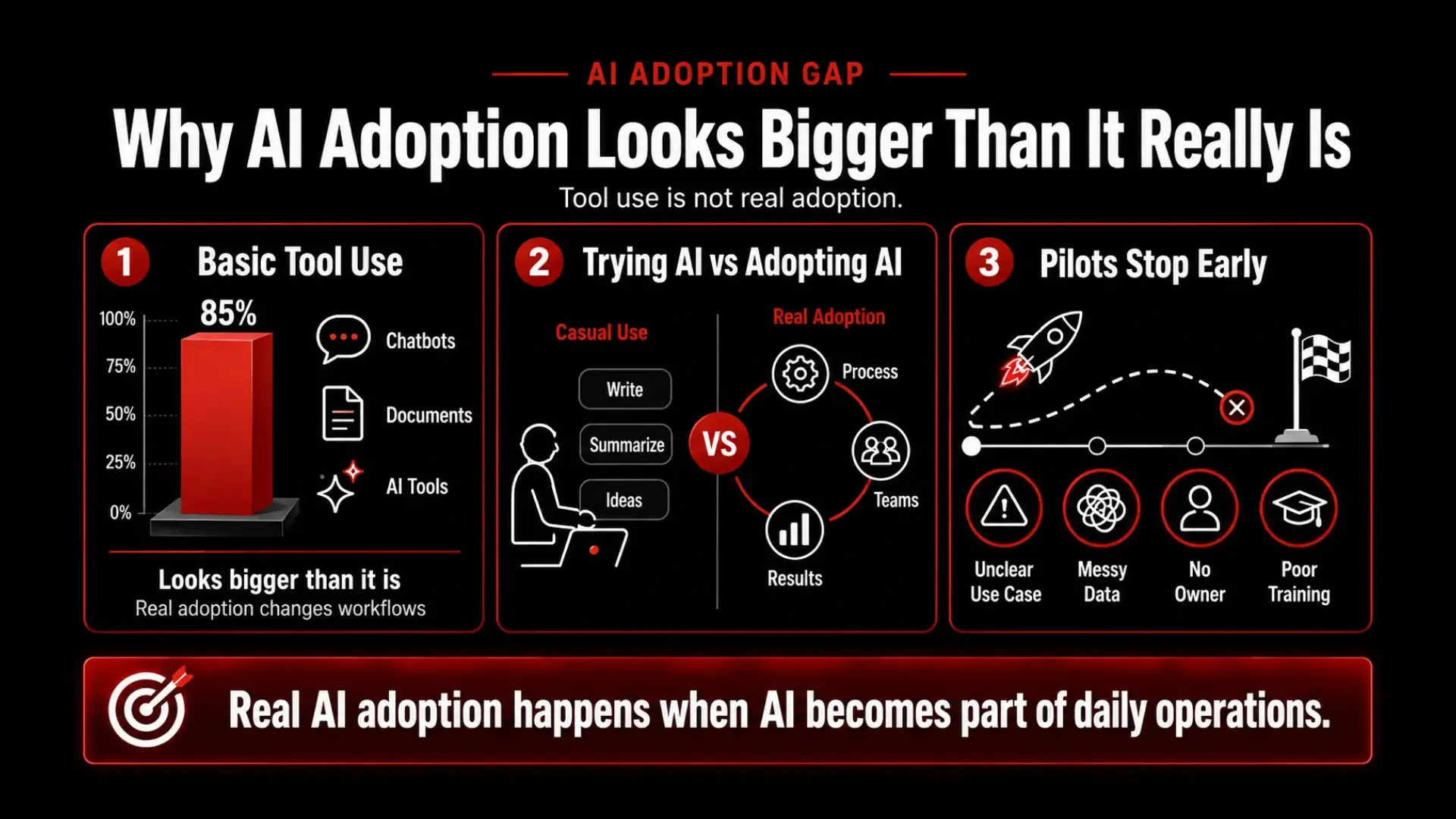
Trying AI Tools Is Not the Same as Adopting AI
When working with AI, employees experiment with prompts, summary notes, or any type of AI tool when writing content. Best practices for implementing AI. The company has started the adoption of AI, with appropriate processes, use cases, and teams that have been trained and have measurable results. There’s a casual use. The other one is business transformation.
AI Pilots Often Never Become Real Systems
A lot of times, an AI project starts with enthusiasm and ends before or after the demo or pilot. This typically occurs because the use case is not properly defined, data is not clean, there’s a lack of training among the team, or no one is responsible for the rollout. Pilot is only important after it becomes a repeatable system.
The AI Agent Hype Is Making the Gap Wider
An AI agent is being sold to people as if it’s going to have the ability to run full business processes without them. But, in fact, most businesses are not equipped for that kind of automation. These agents are only capable of functioning as they must with robust workflows, clean data, human checks, and appropriate constraints.
AI Agents Need Clear Workflows
AI agents are most effective when dealing with specific and repetitive tasks. They could assist you with support tickets, CRM updates, reports, document search, follow-up, etc. However, if a business process is not defined, that will result in an AI agent that gives unclear and inconsistent answers.
A Wrapper Is Not the Problem. A Weak Use Case Is
Many AI tools are dubbed ‘wrappers, ‘ but the term is not limited to something to be despised. If you have a problem you need to solve in the business, it could be useful to use a simple AI wrapper. Simple or complex is not the issue; the important point is. The question is whether it adds value that is detectable to the business?
Why So Many AI Projects Fail After the Demo?
Typically, AI demos display the ideal situation. Real implementation will reveal mixed, uncertain, inadequate, and hidden data, unclear workflows, inadequate training on its implementation, hidden costs, and inadequate ownership of the system. That’s why many business endeavors with AI seem particularly promising, but turn sour once launched.
Poor Data Quality
The key to AI is good data. The result that the AI gives will not be good if there is outdated, incomplete, scattered, and inaccurate data. To invest in additional AI tools, businesses have to ensure their data is accurate, consistent, and accessible. If businesses are set to invest in more AI tools, they must first guarantee that their data is clean, organized, and usable.
No Clear ROI
Businesses fail their AI projects when they don’t set goals and expectations. AI ROI can manifest itself as time savings, cost reduction, faster speed, a greater amount of sales, or an improvement in a customer’s experience. AI turns into experimentation, rather than an asset of business, when there is no defined area to work in.
No Team Training
The issue with using AI is when the leadership knows what they want to do, but the team does not know how to utilize the tools. Training prompts, checking outputs, data security, and AI workflows for employees. If the user isn’t trained to use AI, their use of it remains haphazard.
Where AI Actually Works in Business?
The things in which AI excels are clear, repeatable, and measurable tasks. It can assist in customer support, sales follow-up, marketing research, use for internal knowledge search, reporting, finance checks, and in service desk support. Best use cases are usually simple, but painful tasks that occur frequently.
How Can Businesses Close the AI Adoption Gap?
To bridge the gap between businesses and AI adoption, a business can begin with one clearly defined issue and work out the steps in a workflow, follow data to verify its quality, pick a specific problem for narrower AI implementation, train employees, ensure humanity is still at the end of it, and measure results from the start. The key to adoption is that AI should be realized practically, not hastily.
Key takeaways
The AI adoption gap is not just some “do we have access or not” thing. It’s more about whether businesses can take AI tools and make them turn into actual, measurable business value, in practice.
AI adoption can look much larger than it really is. Partly because a lot of companies are only testing, poking around with tools, rather than embedding AI into everyday workflows.
Saying “we tried ChatGPT” or “we used AI agents or chatbots” is not the same as real AI adoption in business. It sounds similar, sure, but it’s not really the same level or the same outcome.
Lots of AI pilots flop. The big reason is they begin with excitement and hype, instead of starting from a clear use case, making data clean, training teams, and setting a way to measure ROI before anyone gets too deep into it.
In business, AI agents can be helpful, but only when the workflow is defined, the information is dependable, and people still stay in the loop.
Bad AI data quality is one of the most common causes of results that are weak, wrong, or simply unreliable. And it keeps showing up, time after time.
AI ROI should be spelled out before implementation. Businesses should already know what AI is supposed to save, improve, reduce, or increase, not guess later.
Team training is a huge piece of AI readiness. Without it, employees use AI in a kind of random way, and the business ends up with inconsistent results, which is basically the opposite of adoption.
The organizations that win with AI probably won’t be the ones using the most tools. They’ll be the ones with the clearest, most focused AI adoption plan.
Real AI adoption starts with one clear business problem, a mapped workflow, clean data, trained people, human review, and business outcomes you can actually measure.
Final Thoughts: AI Adoption Is Easy. AI Execution Is Hard.
While integration with AI tools is easily accessible, real adoption of AI requires planning. Businesses require understandable and streamlined procedures, clear information, educated staff, human oversight, management, and numbers that mimic value. The outcome of this competition will not be firms that have the greatest number of artificial intelligence applications. They’ll be the ones to apply AI most clearly and make it that much more meaningful.
Frequently Asked Questions (FAQs)