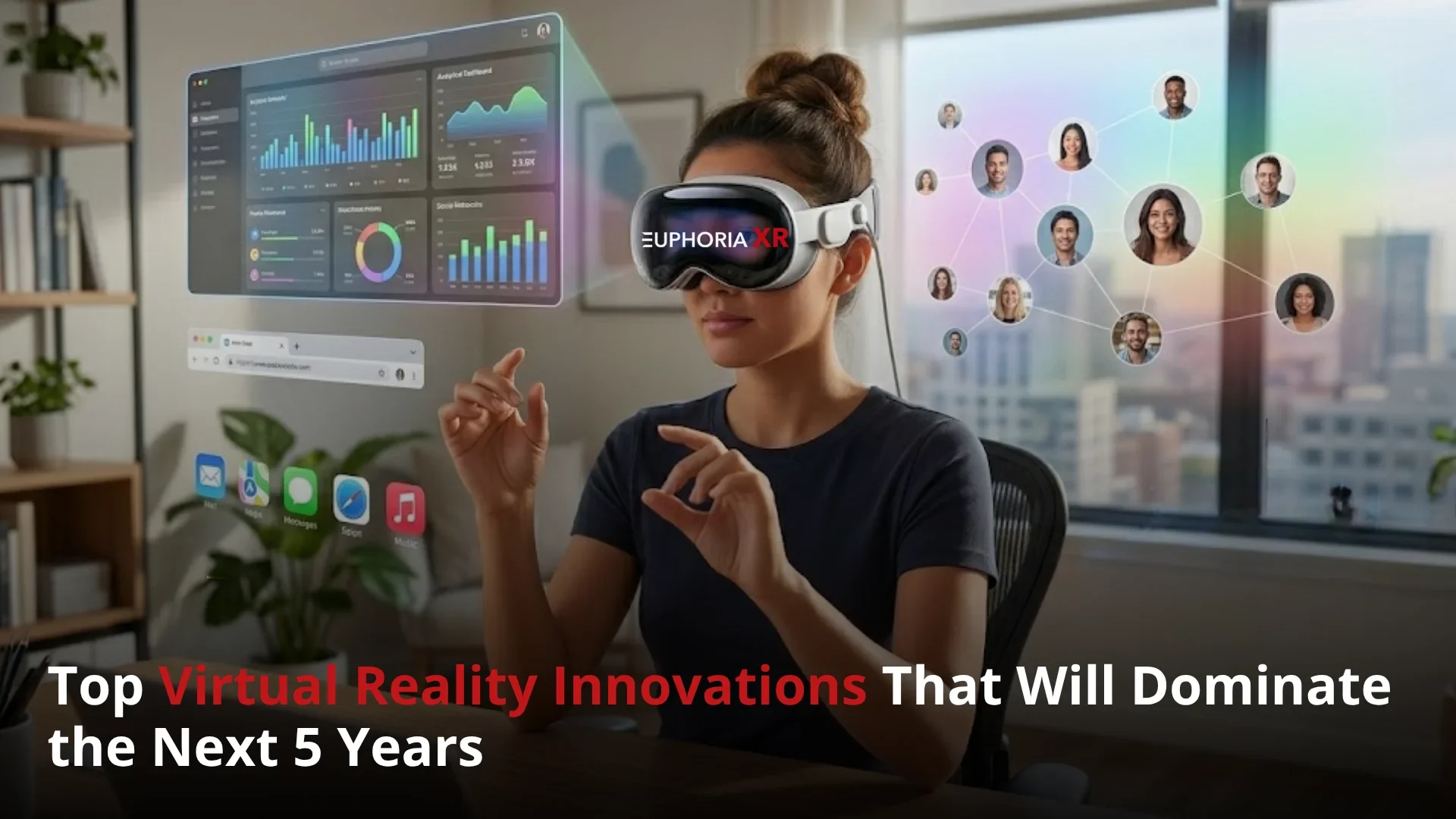
Virtual Reality isn’t just for devices and futuristic experiments anymore. It is fast becoming one of the most significant technologies shaping how we work, learn, shop, train, communicate, and enjoy digital content.
The global virtual reality industry is projected to reach more than $58 billion in the coming years, Statista reports. These big tech giants, such as Meta, Apple, Google, and Microsoft, are making substantial investments in VR technology, spatial computing, and the immersive landscape.
The next five years will see the entire landscape of virtual reality transform from its place in the confines of the lab or gaming room into the real world.
VR future technology is advancing at a speedy pace, from digital reality-powered environments for collaboration and training in the fitness area to AI-driven virtual worlds.
This manual consists of the most outstanding VR trends of 2026 and the future, the numerous industries embracing VR technology, and the matters corporations can count on from the future of VR studies.
What Is Virtual Reality and Why It Matters in 2026?
Virtual Reality is a digital technology that generates 3D worlds that people can engage with and explore through VR headsets, movement monitoring, sensors, and interactive systems.
VR generation takes the user into reality itself, as opposed to standard displays.
VR is now used for:
The era has grown a lot beyond the world of gaming.
How has VR technology evolved from gaming to enterprise innovation?
The initial VR systems were primarily for entertainment purposes. Most experiences cost a lot, were quite large, and were of low performance.
It is not the same VR technology nowadays.
VR is now being leveraged in the business world for:
One of the major VR trends going on today is enterprise adoption.
The difference between VR, AR, MR, and XR
There are lots of misunderstandings about immersive technology, as the phrases sound similar.
Let’s take a simple look at that:
These technologies are coming together to create linked immersive ecosystems, facilitated by means of spatial computing.
Why is immersive technology adoption accelerating globally?
There are several reasons why VR has been picking up so much steam:
Lower headset prices
Faster internet and cloud computing
Better graphics hardware
AI integration in immersive systems
Increased remote collaboration
Strong enterprise demand
New devices, consisting of Apple’s Vision Pro and Meta’s Quest 3, drove the general public’s interest in the next generation of VR.
The Current State of the VR Market
Virtual Reality is no longer viewed as a “new” concept. Currently, it is on the verge of transitioning into real business use.
Traditionally, VR has been thought of in terms of games. All that is soon changing. VR is utilized in a variety of one-of-a-kind fields these days for training, fitness, schooling, product design, telework, and client experience.
VR is gaining traction because the technology is becoming increasingly practical, more affordable, and more accessible. VR is shifting forward, thanks to higher headsets, faster networks, artificial intelligence, spatial computing, and wearable gadgets.
VR Adoption Statistics and Market Growth
VR technology is becoming in demand for both consumer and business markets. Industry reports indicate that AR and VR have been growing in strength since businesses invest in advanced training, simulations, VR collaboration, and customer experience.
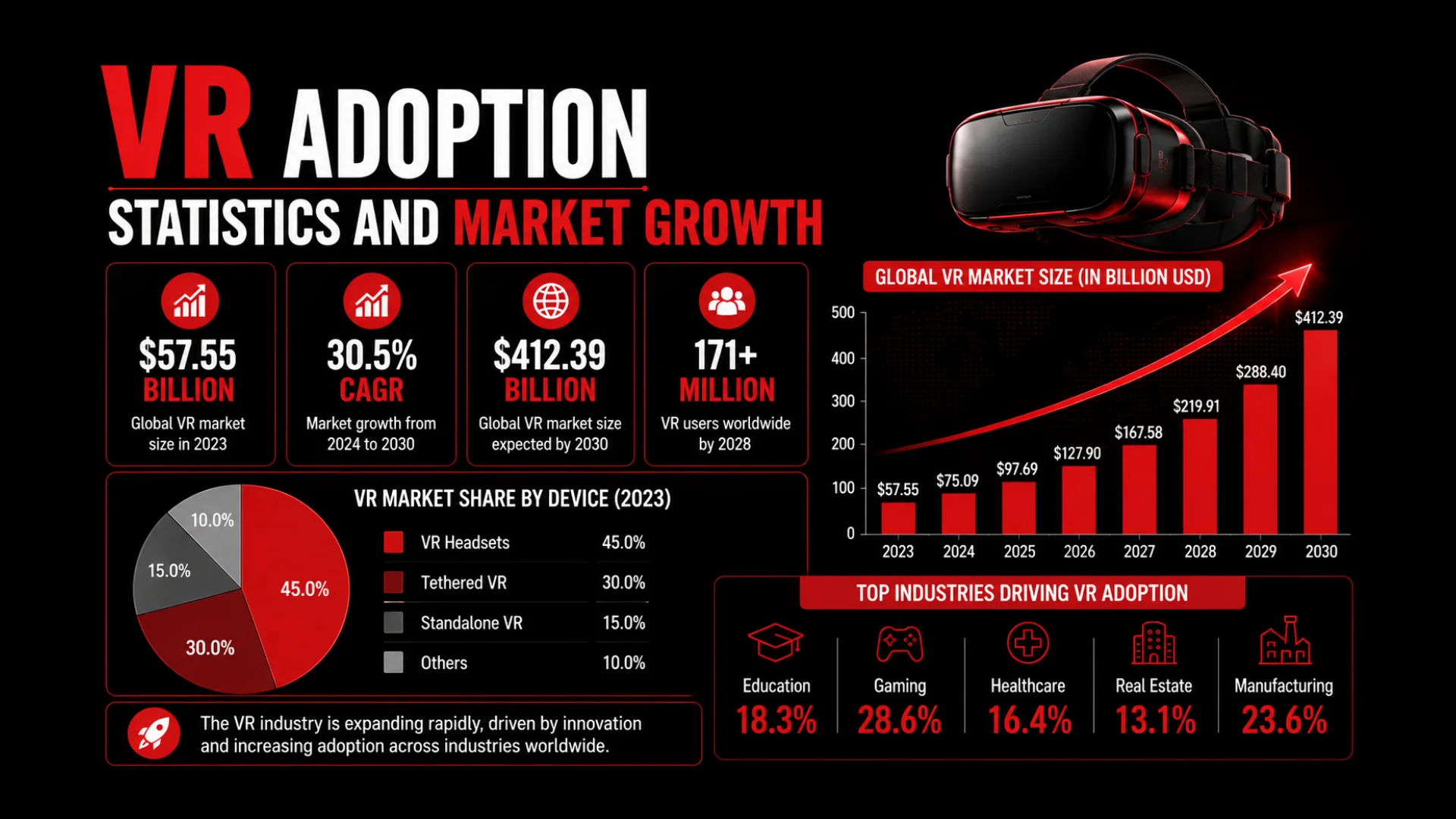
Several reasons are readily apparent that are enabling this growth:
As the technology develops, VR headsets are becoming lighter and greater value-powerful.
Businesses require more secure and speedy training techniques. Companies require more secure and quicker training.
The smartness of virtual environments is being enhanced by AI.AI is helping to make virtual environments smarter.
Digital interaction is becoming more natural with spatial computing. Spatial computing is bringing a more natural and immersive experience to digital interaction.
There is a need for improved collaboration between remote teams.
Industries wish to cut down the expenses associated with actual prototypes and training setups.
This is where VR’s just not fun anymore. It is fast becoming a viable tool for solving business problems.
Consumer Vs Enterprise VR Expansion
Virtual Reality is emerging in both consumer and enterprise markets, and differs in its use in both cases.
The primary use of VR is entertainment and personal experiences for consumers. Enterprise VR is all about productivity, training, operations, and business efficiency.
This trend towards enterprise adoption is one of the largest VR trends that will impact the future of immersive technology. VR technology is now being adopted by businesses as a viable way of enhancing efficiency, cutting costs, and creating safe training environments.
The impact of AI, spatial computing, and wearable devices
VR technology is becoming more powerful via the integration of AI, spatial computing, and wearable devices.
AI enables VR systems to react in more intelligent ways. It can generate virtual worlds, lead people, customize training, and drive realistic virtual characters. This facilitates creating a more organic VR experience.
Spatial computing permits digital systems to understand what is going on in the physical world around the user. It permits virtual items to respond to physical spaces, hand gestures, eye movements, and body posture. This is important due to the fact that the future of VR is going to be more than just about getting into a virtual world. It will also relate to the combination of virtual content into real areas.
Wearable devices have additionally been advancing rapidly. Current XR devices and/or headsets are getting lighter, more comfortable, and easier to apply. VR makes progress in the direction of regular use with higher displays, hand tracking, free movement, and sensors.
It’s a combination of these changes that indicate VR’s direction. VR will evolve into the next level of smarter, more usable, and more business-relevant VR.
Top VR Trends Dominating 2026
VR technology is on the verge of new levels. It is getting lighter, smarter, and more practical and useful for daily business and consumer uses, and more realistic.
It’s not just about the enhanced graphics; the largest VR trends in 2026 also encompass other elements. They’re more about creating virtual experiences that are more accessible, easier to create, and more impactful in the real world.
Affordable VR Hardware and Lightweight Headsets
VR headsets are becoming smaller, lighter, and less expensive. This is one of the primary factors that make VR adoption increasing.
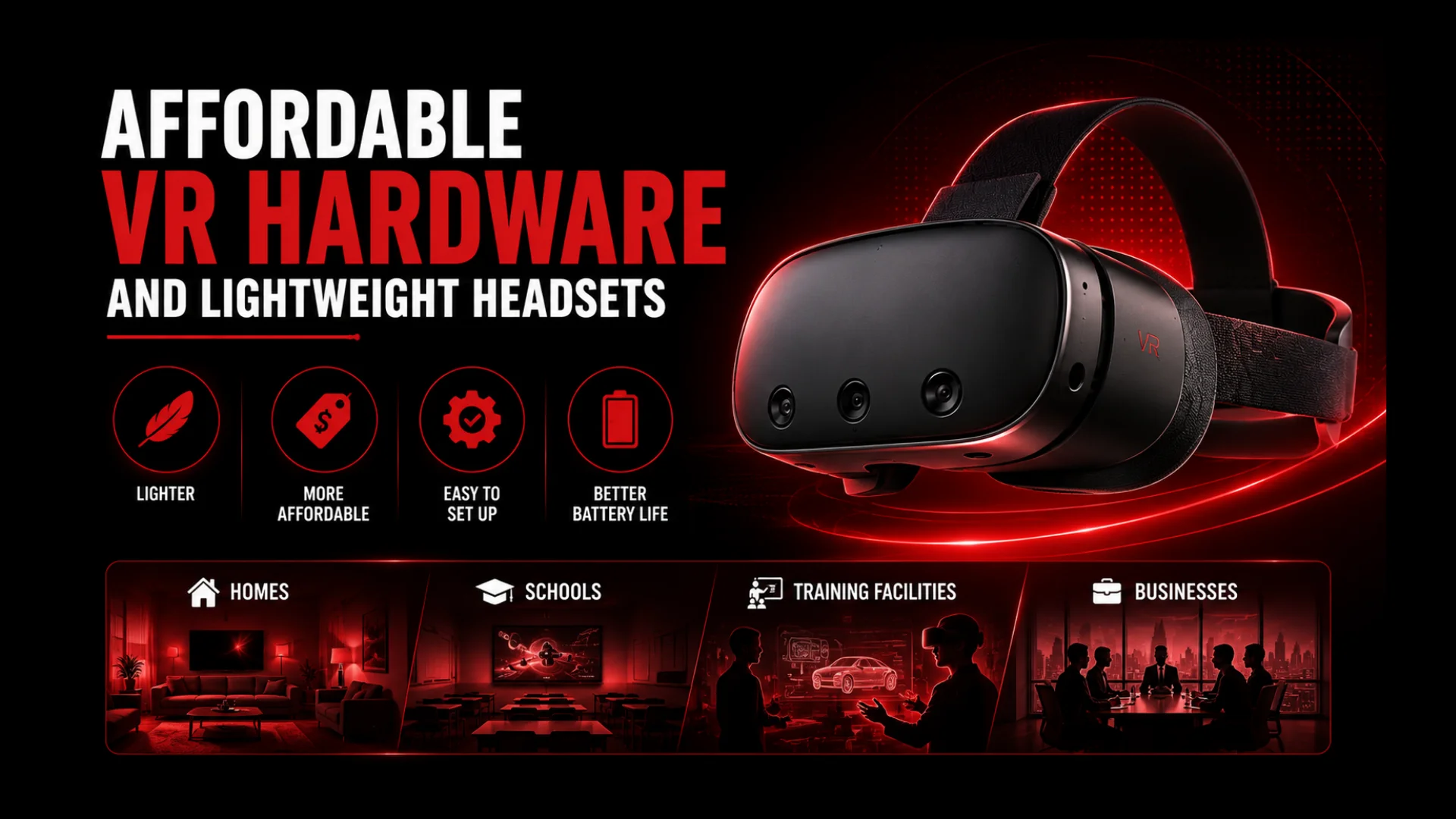
Previous VR headsets were cumbersome, luxurious, and hard to wear for extended periods of time. The newer gadgets are user-friendly and simpler to install. They also provide for a better screen, hand tracking, wireless capabilities, and better battery life.
This brings VR into the real world of homes, schools, training facilities, and businesses.
AI-Powered VR Experiences and Generative Content Creation
AI is playing an increasing role in VR future technologies. It assists developers in developing virtual worlds more quickly and produces more individual user experiences.
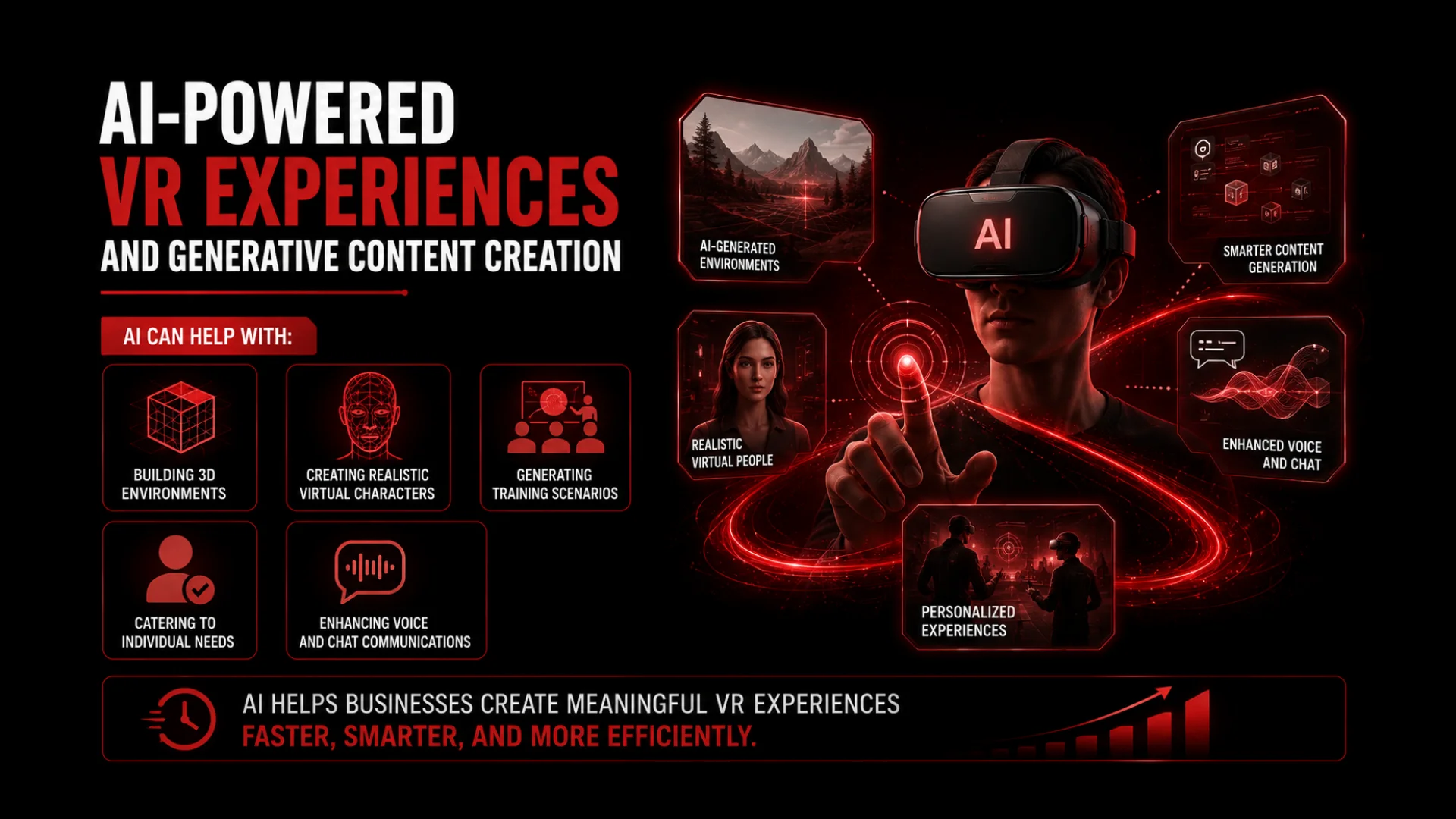
AI can help with:
Building 3D environments
Realistic virtual characters
Generating training scenarios
Catering to individual needs
Enhancing voice and chat communications
This translates to businesses being able to build meaningful experiences more quickly without having to manually build each and every detail.
Spatial Computing and Mixed Reality Environments
Spatial computing is the ability to bring digital content to life through understanding and reacting to the physical environment.
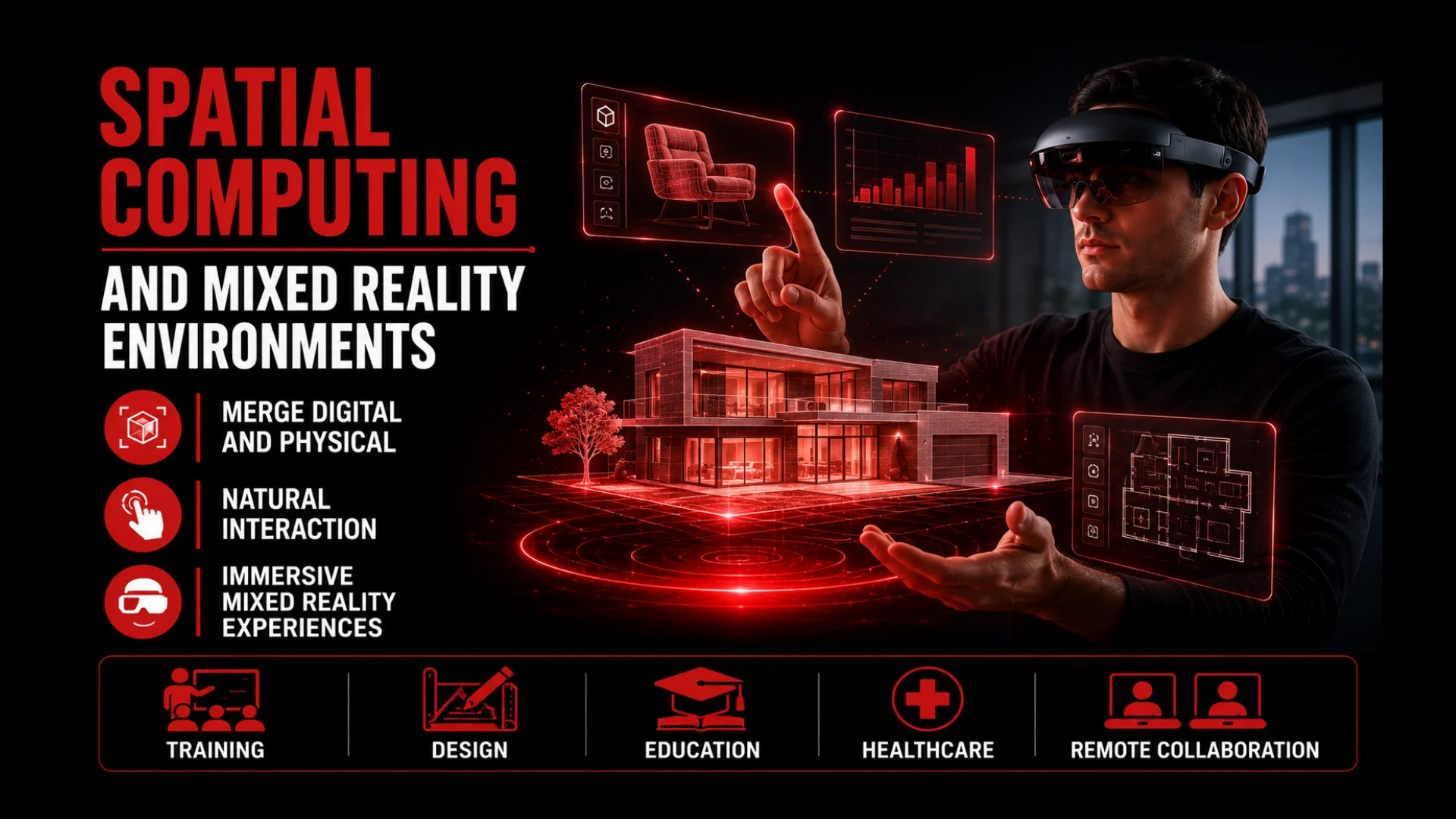
Spatial computing merges digital objects with physical environments as opposed to simply putting users in a fully virtual environment. This enables Mixed Reality experiences with natural interactions between the person and virtual content.
This field is significant in the fields of education, design, healthcare, and remote collaboration.
Hyper-realistic graphics and immersive virtual worlds
VR worlds are getting more realistic. A combination of more sophisticated graphics engines, quicker processor speeds, and innovative rendering technology now creates virtual environments that are more real.
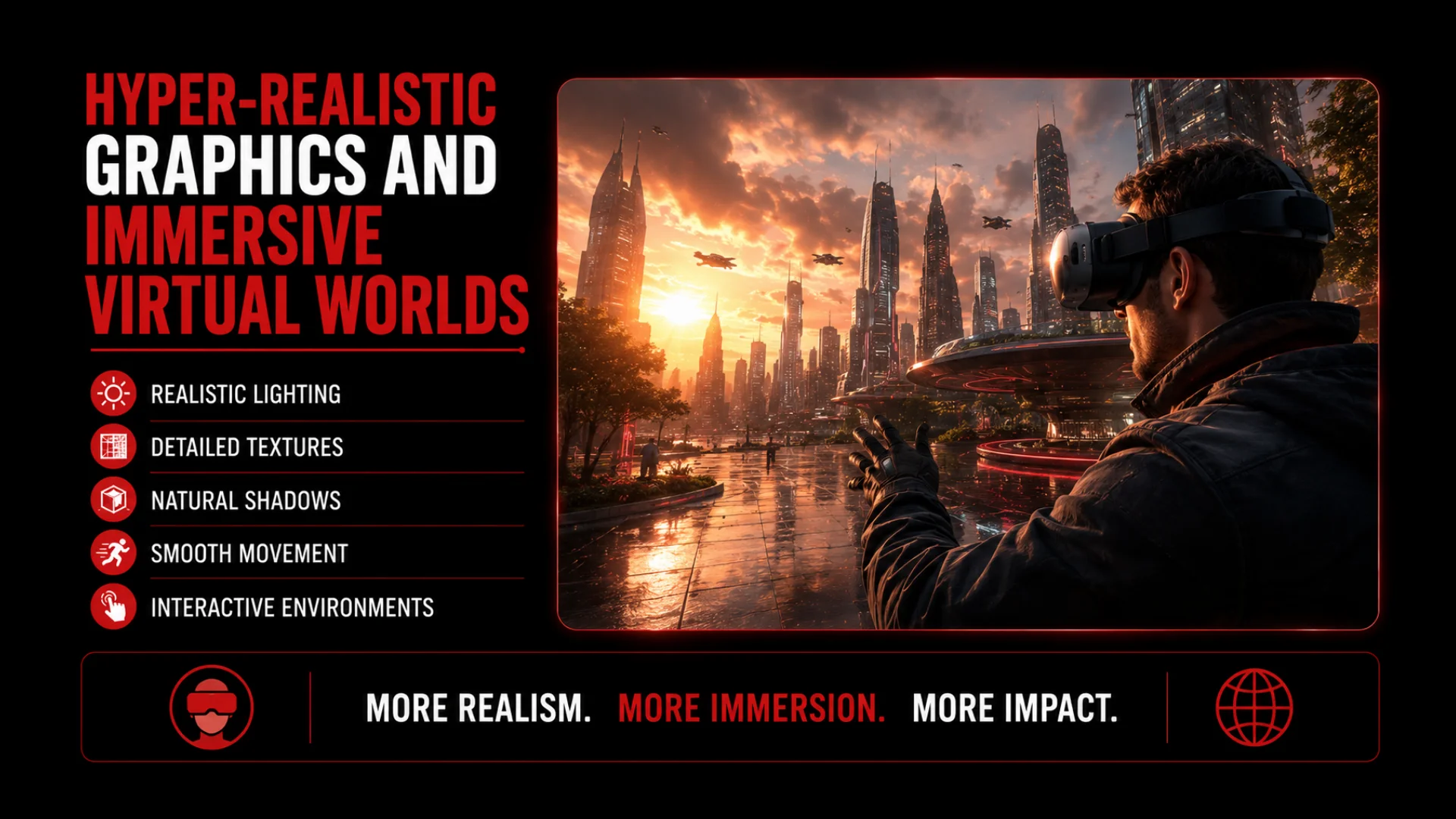
Examples of modern VR experiences can consist of:
Realistic lighting
Detailed textures
Natural shadows
Smooth movement
Interactive environments
This makes the user feel more in the moment within the experience.
Multi-sensory VR with haptics, motion, and biometrics
VR technology will not be just about what’s on the screen. Multi-sensory VR involves touch, body feedback, and motion.
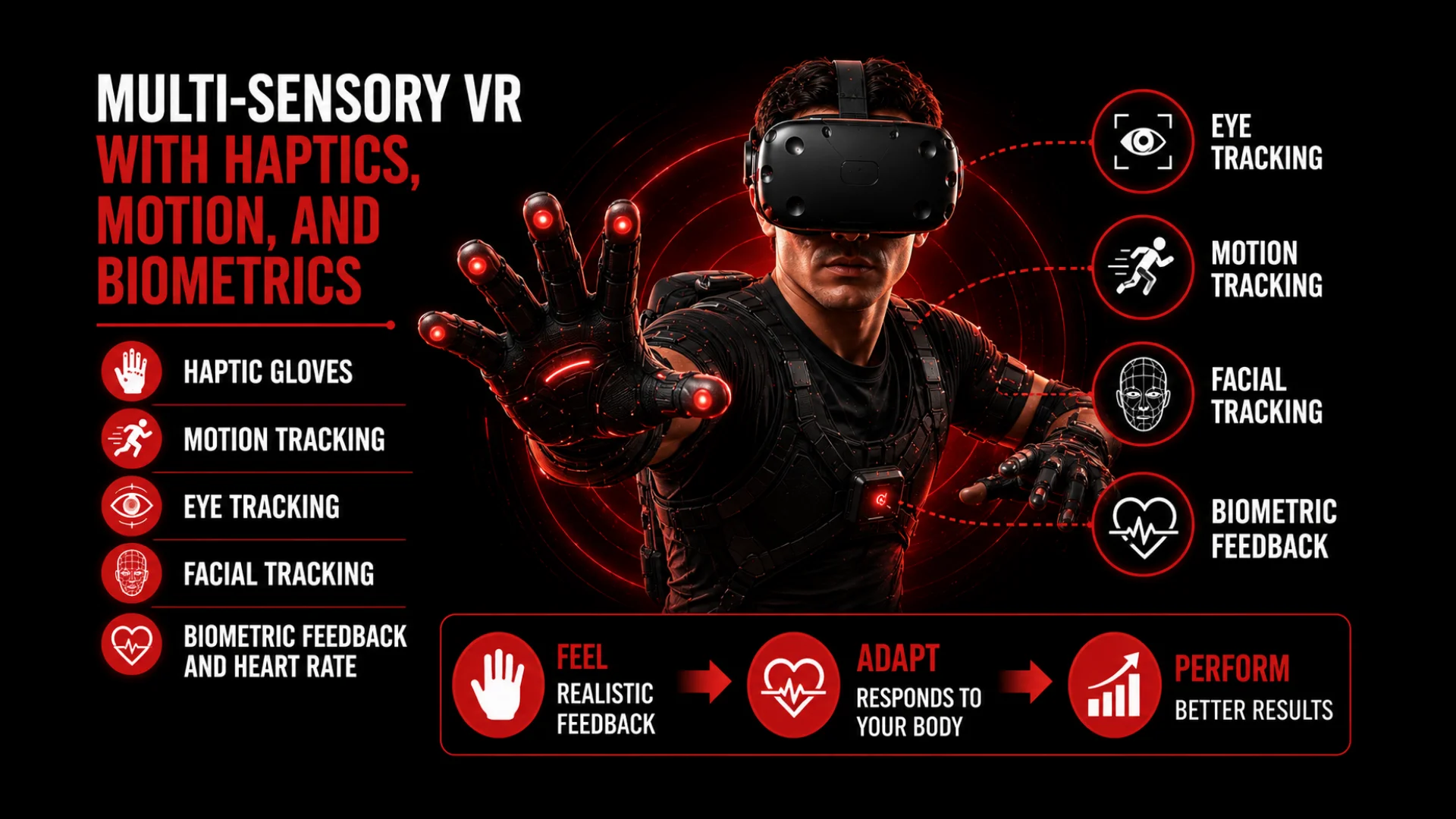
This can include:
For instance, resistance can be experienced while using the virtual tool, or a fitness application can alter according to the body’s actions and heartbeat.
Digital humans, avatars, and virtual identity systems
In today’s digital age, digital humans and avatars are getting more lifelike. They can be a user, instructor, assistant, or a customer service agent in virtual environments.
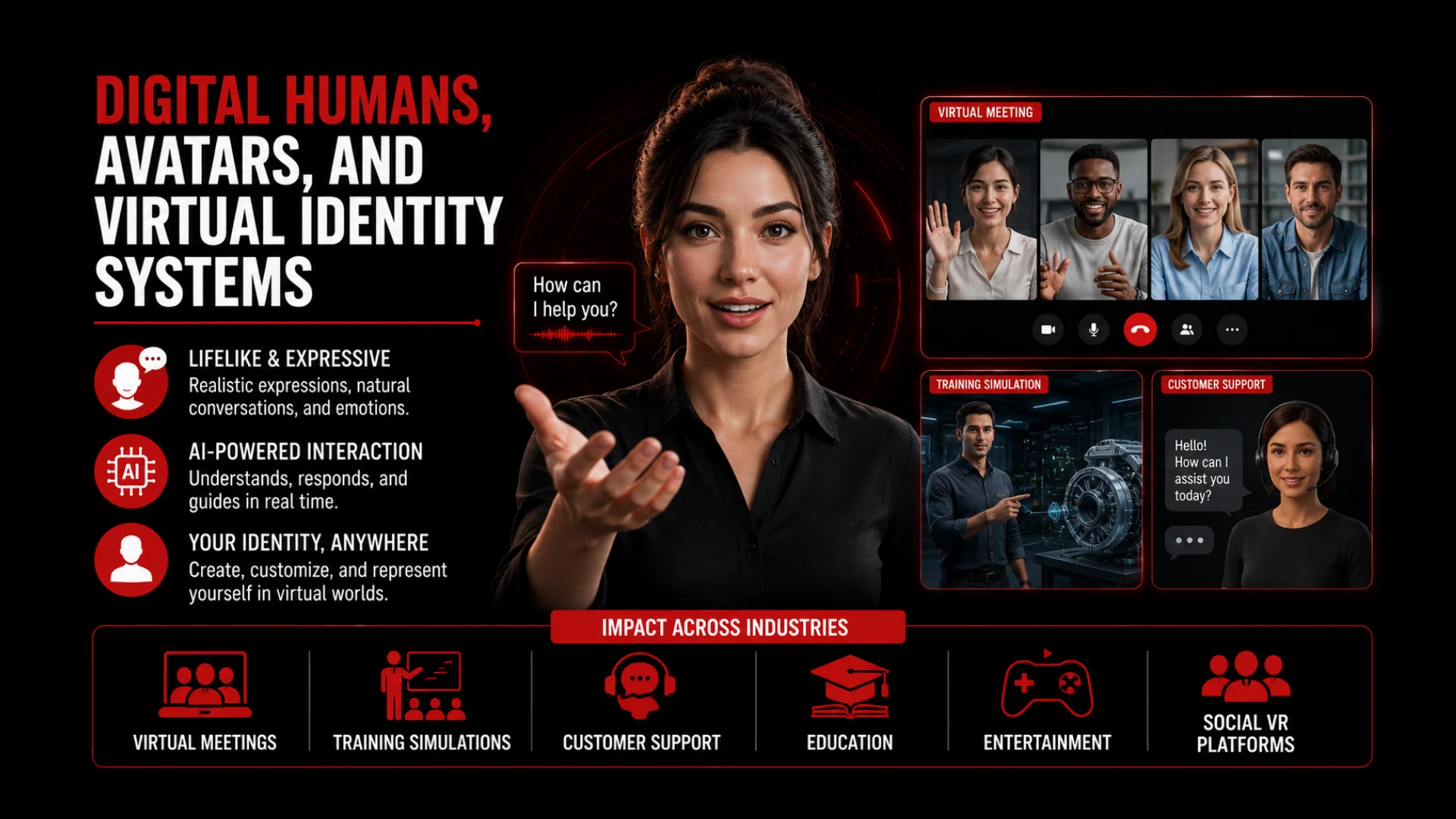
AI-powered avatars can now express emotions, respond, and speak in a more natural way, and direct the user.
This trend will have an impact on:
Virtual meetings
Training simulations
Customer support
Education
Entertainment
Social VR platforms
WebVR and cross-platform immersive experiences
WebVR permits immersive content to be effortlessly accessible through an internet browser. Users don’t always need to download large applications or have to rely on complicated systems.
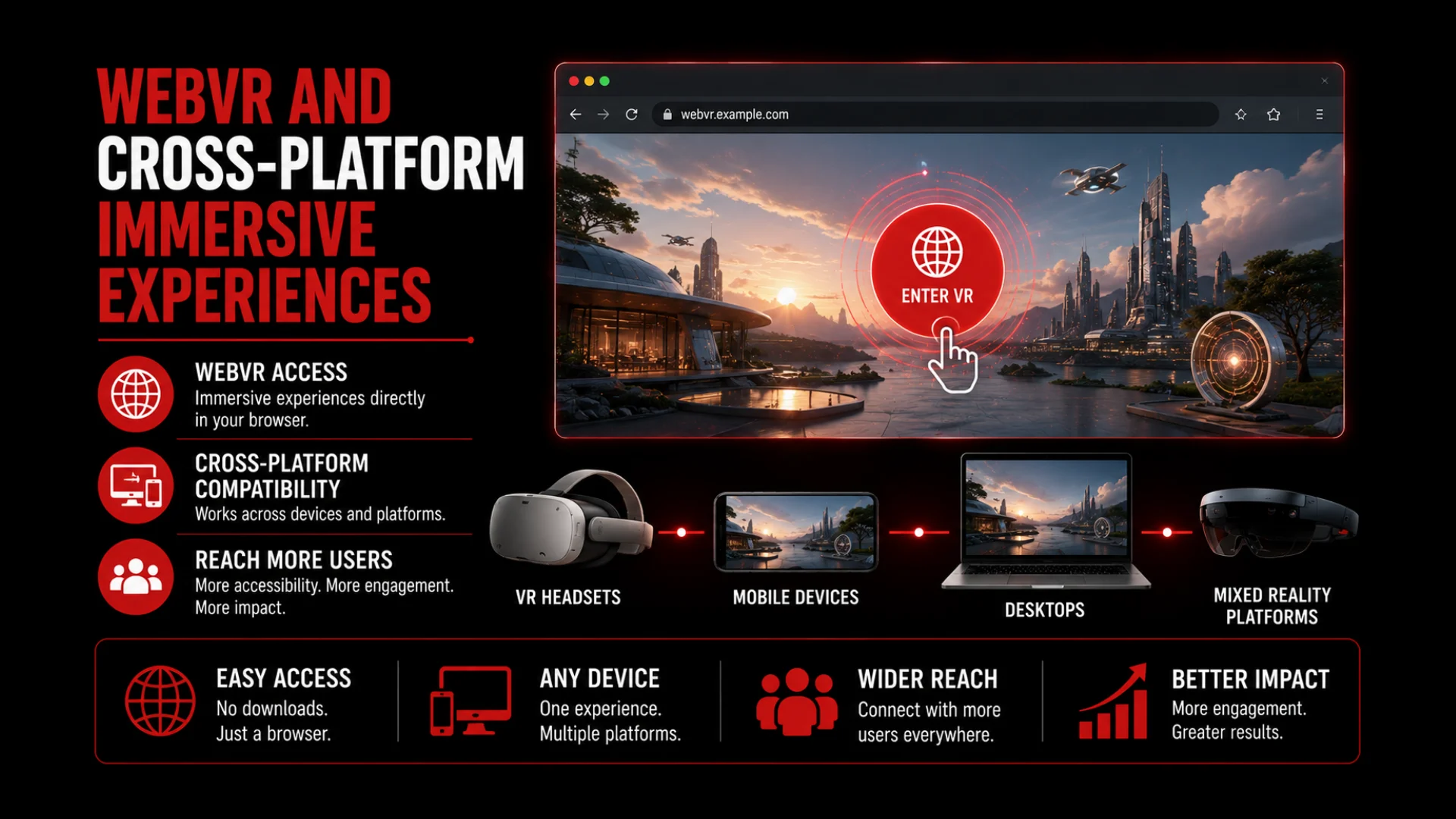
Cross-platform VR also allows for walk-through experiences on diverse platforms, which include VR headsets, mobile devices, computers, and mixed reality systems.
It permits businesses to connect to more customers without needing to overcome too many technical hurdles.
VR collaboration and remote work environments
With the transition to remote working, there is a need for improved digital collaboration. There are times when it is useful to have a video call, but it becomes mundane.
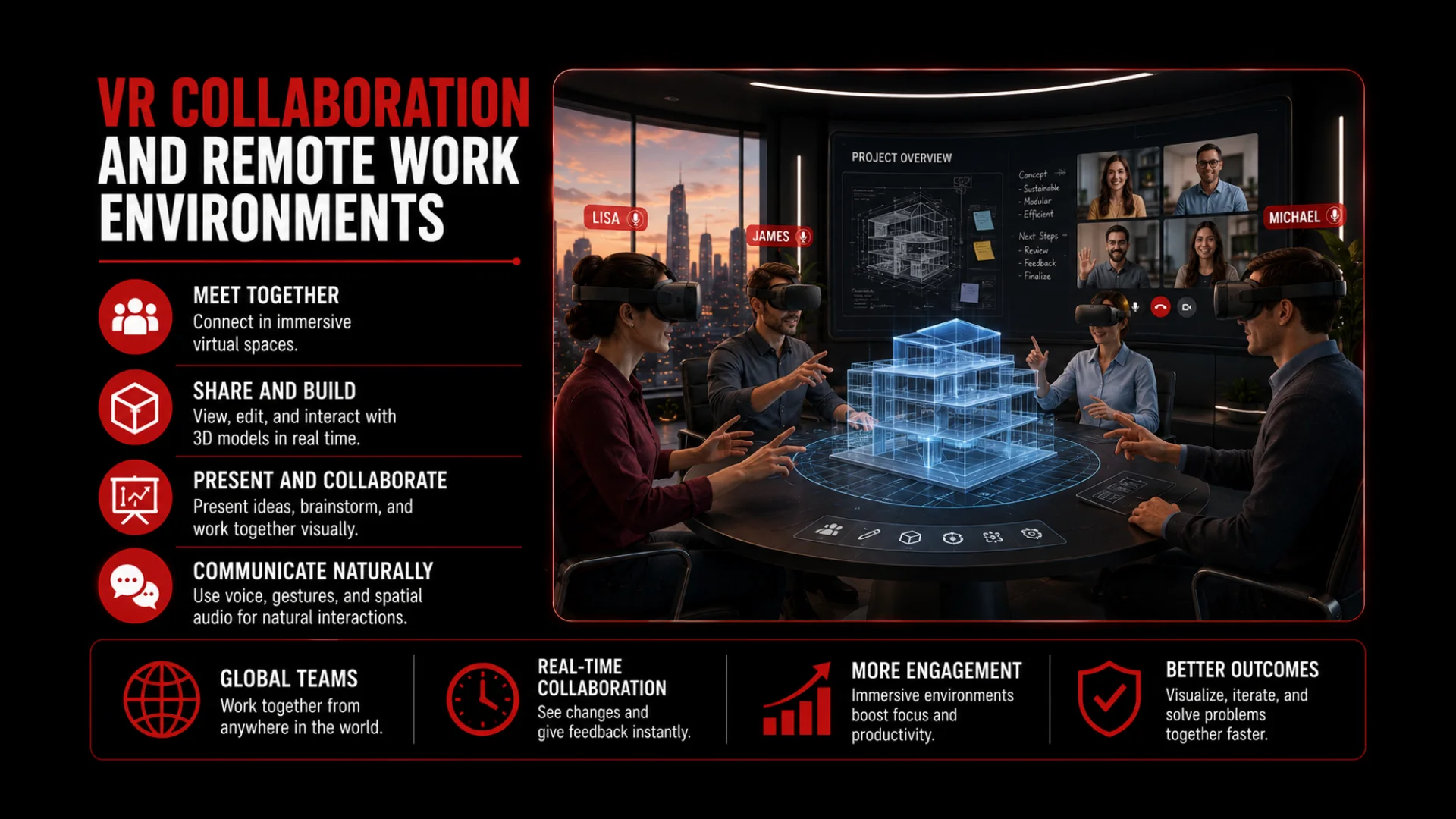
VR collaboration spaces enable teams to come together in virtual shared spaces. They can view designs, practice jointly, showcase concepts, and interact with digital objects in real-time.
This allows for more interesting and useful remote working efforts.
VR fitness, wellness, and mental health applications
VR is gaining popularity inside the fitness and well-being industry because of its interactive nature.
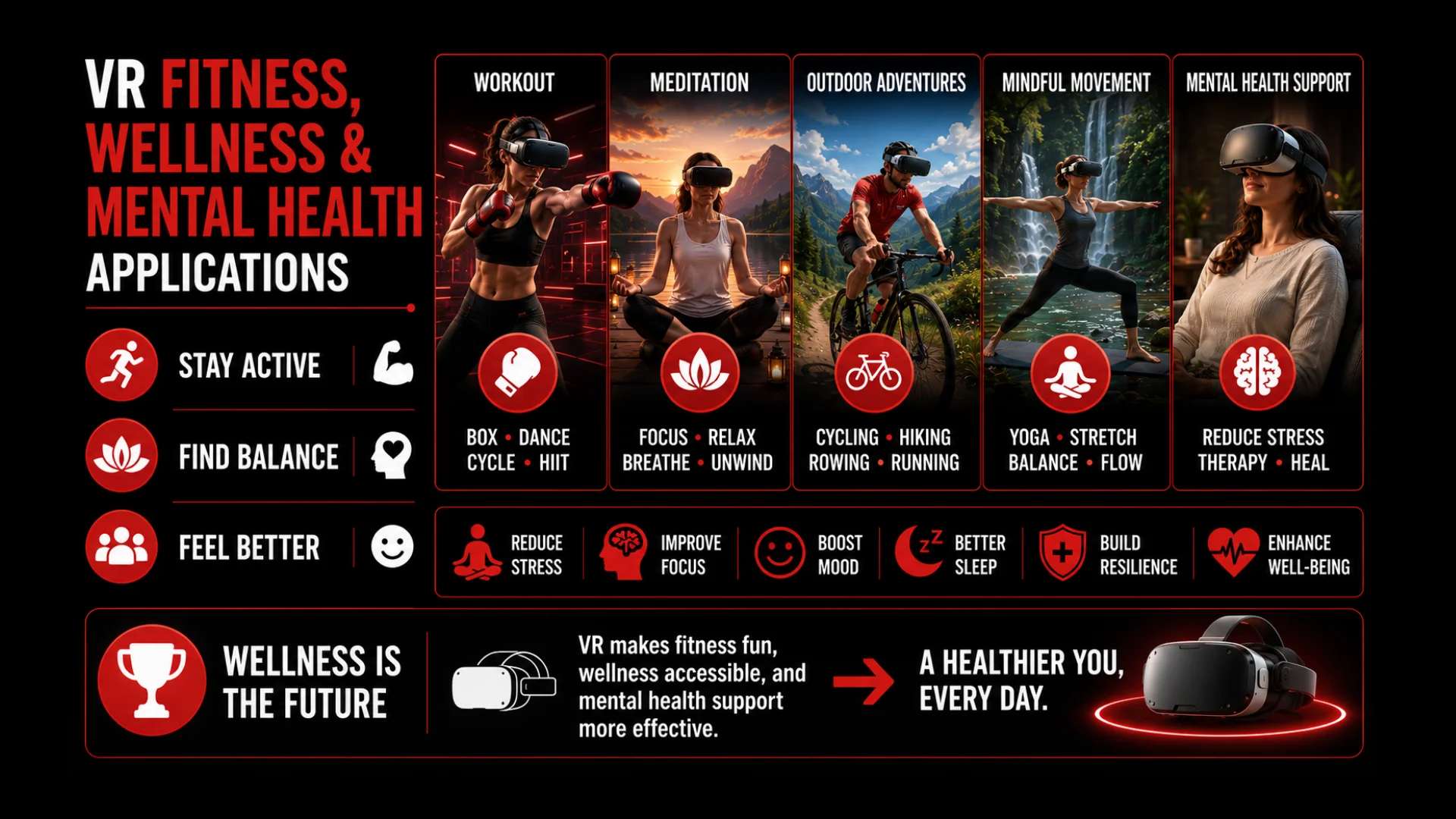
Users can box, dance, meditate, cycle, or do a guided exercising interior a digital area.
VR is also being trialled for mental health, which includes relaxation, exposure therapy, lowering stress, and guided breathing.
This will make wellness one of the most promising VR trends for 2026.
Enterprise VR training and simulation platforms
One of the best applications of VR technology in the business world is enterprise VR training.
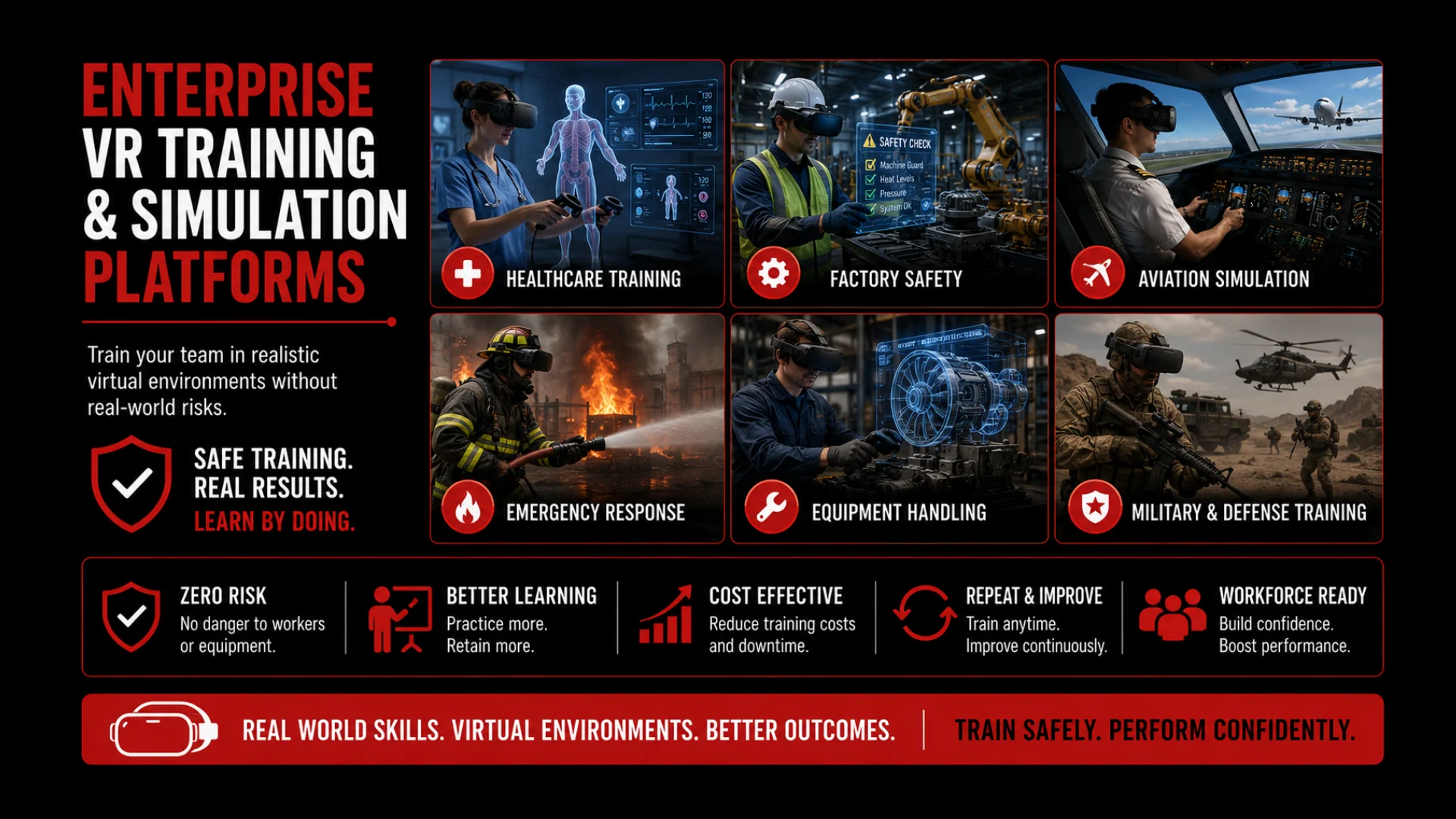
Companies can train workers with scenarios in virtual environments without the risk of real-world situations.
This is useful for:
It’s the primary advantage that is easy. No harm to workers in the real world; they can learn by doing.
Wearable VR and smart immersive devices
VR wearables are getting more sophisticated. Future devices will be more comfortable, mobile, and naturalistic.
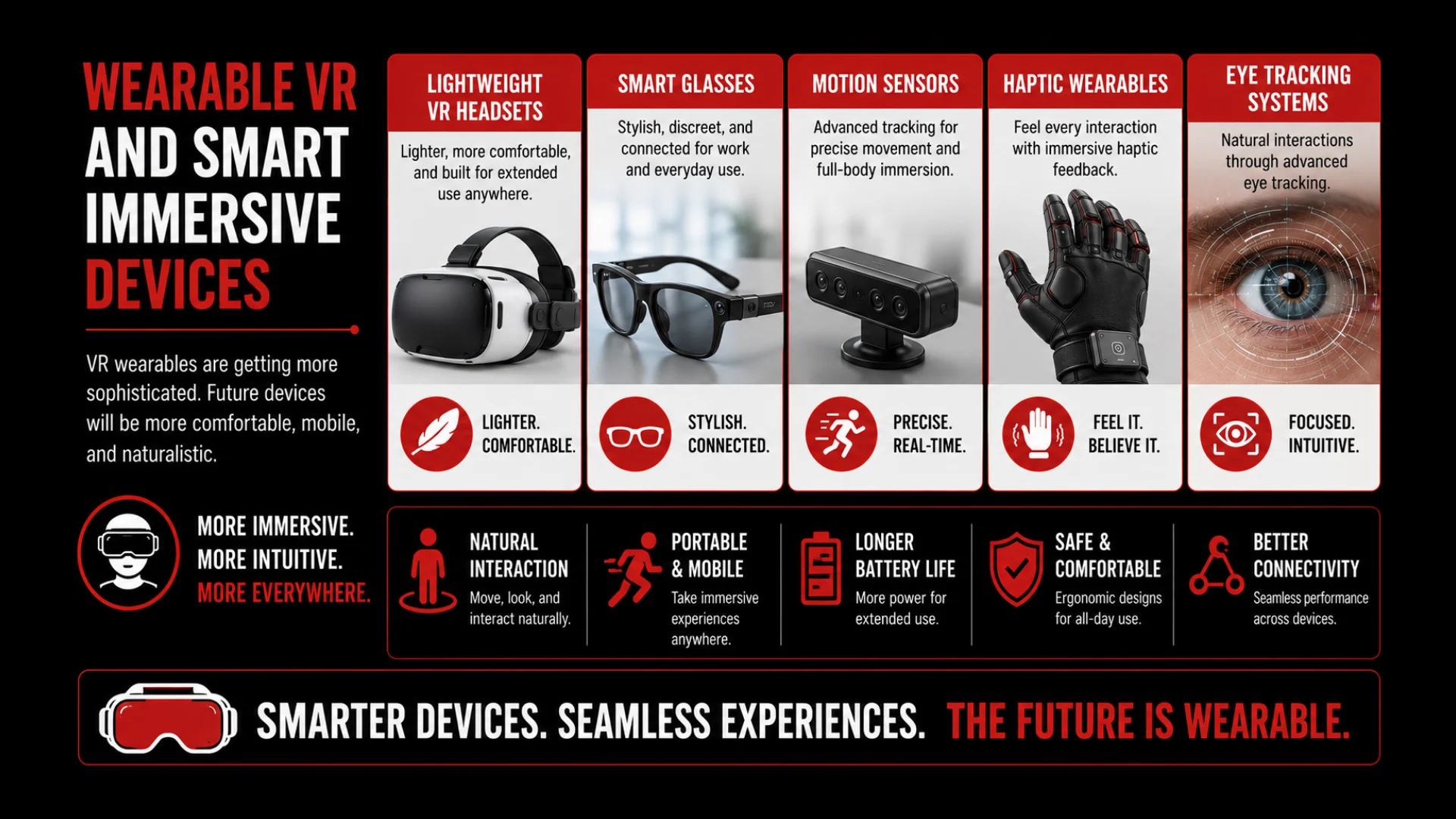
This covers lightweight headsets, smart glasses, motion sensors, haptic wearables, and eye tracking systems.
With the enhancements of these devices, VR technology will make it easier to use in everyday life and business.
Gamification and interactive immersive engagement
Gamification employs game-like attributes to sustain users’ engagement.
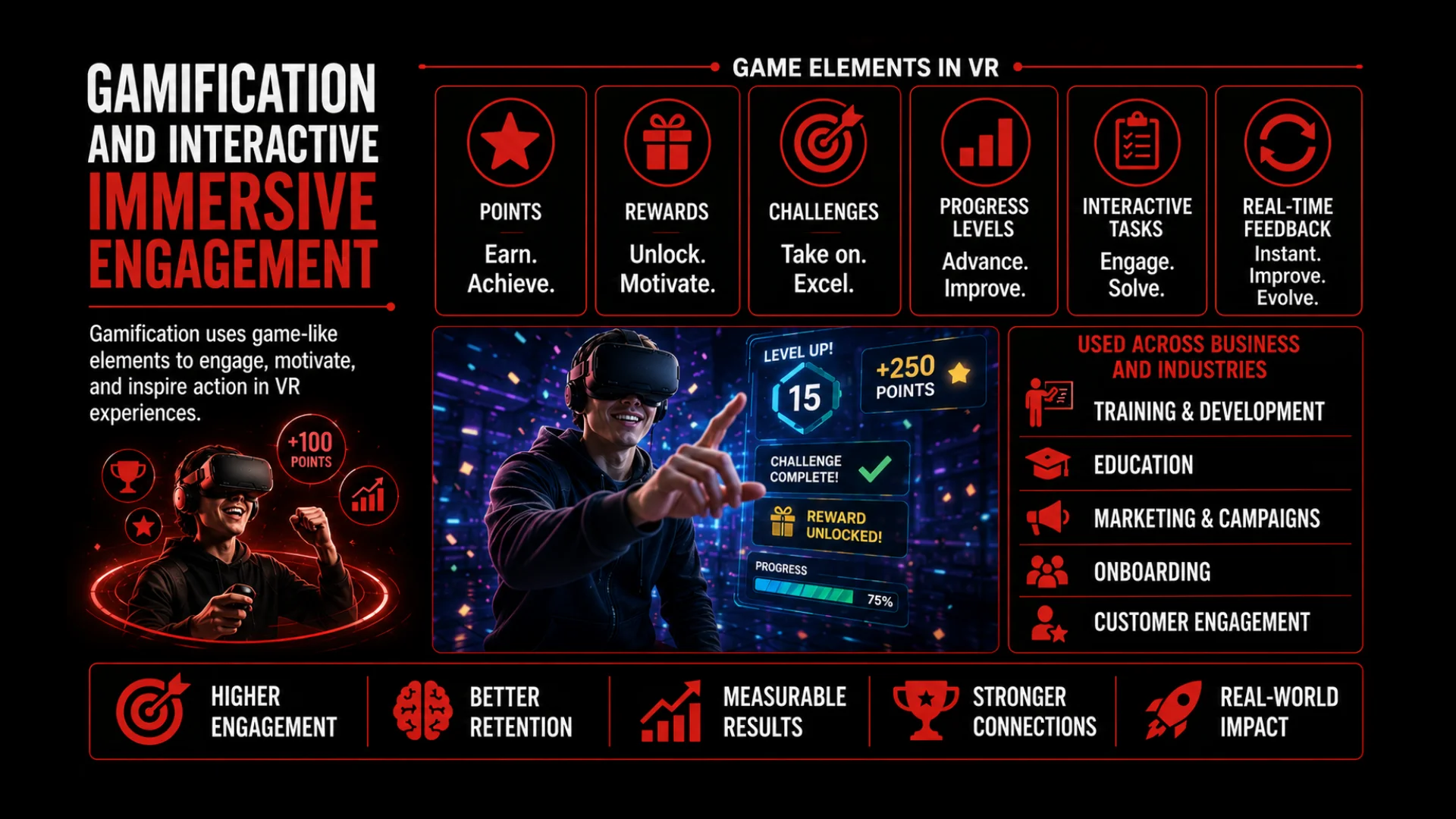
This can be accomplished in VR as:
Points
Rewards
Challenges
Progress levels
Interactive tasks
Real-time feedback
Companies have implemented VR in their operations as a game-based training tool, educational mediums, marketing campaigns, onboarding, and customer engagement.
It enhances learning and participation activities to be more active.
Autonomous AI agents inside VR environments
Autonomous AI agents are virtual assistants that can operate independently in virtual environments.
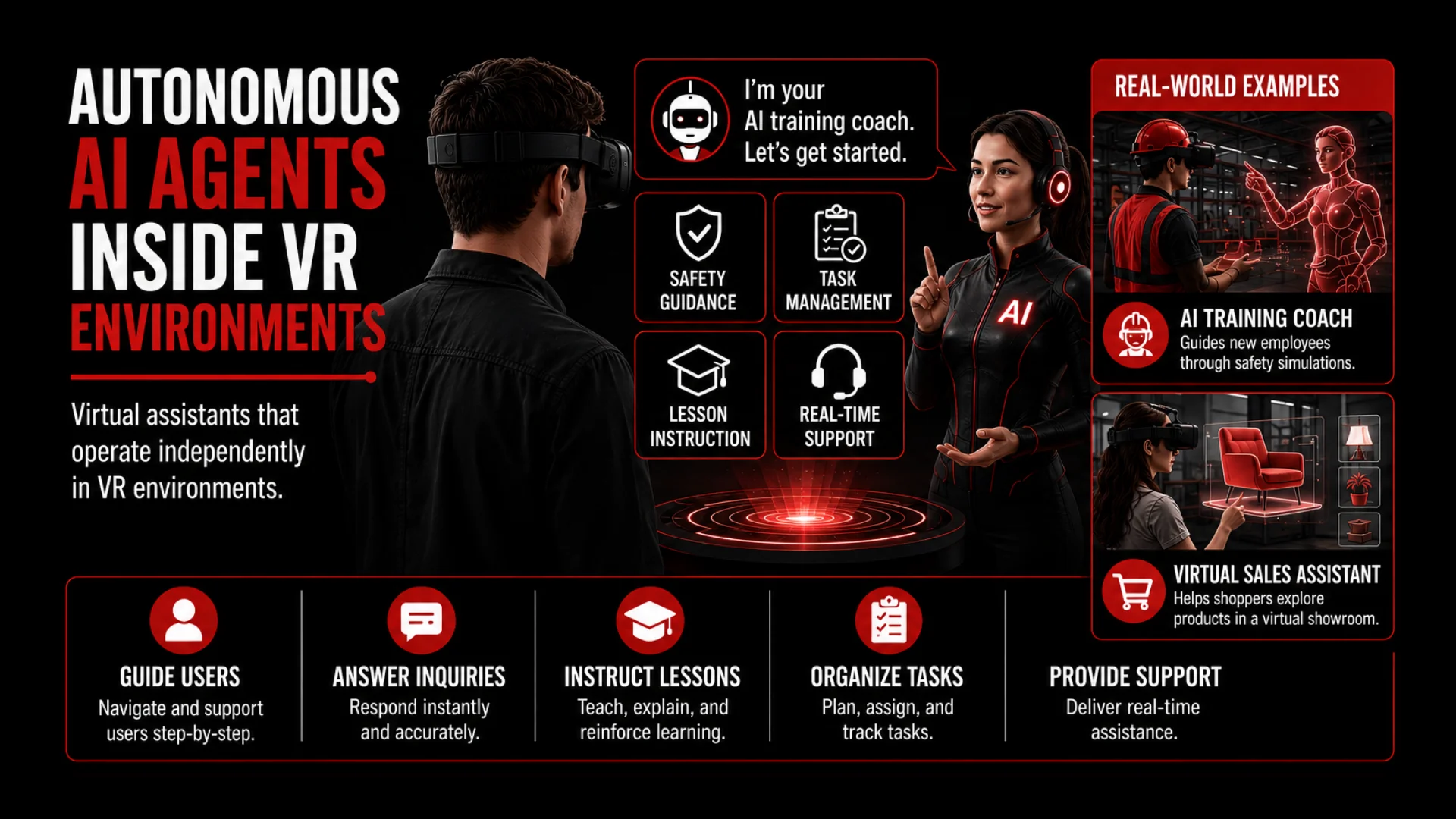
They can lead users, respond to inquiries, coach lessons, arrange tasks, or deal with customer service.
In this instance, an AI training coach may take a new employee through a safety simulation. A virtual sales assistant could help a shopper in a virtual showroom.
This is considered to be one of the most powerful VR destiny technology trends because of its fusion of AI, automation, and interactive stories.
AR and VR Convergence into Unified XR Ecosystems
AR and VR are becoming more interrelated. Companies are not considering them as individual technologies, but as part of a single XR ecosystem.
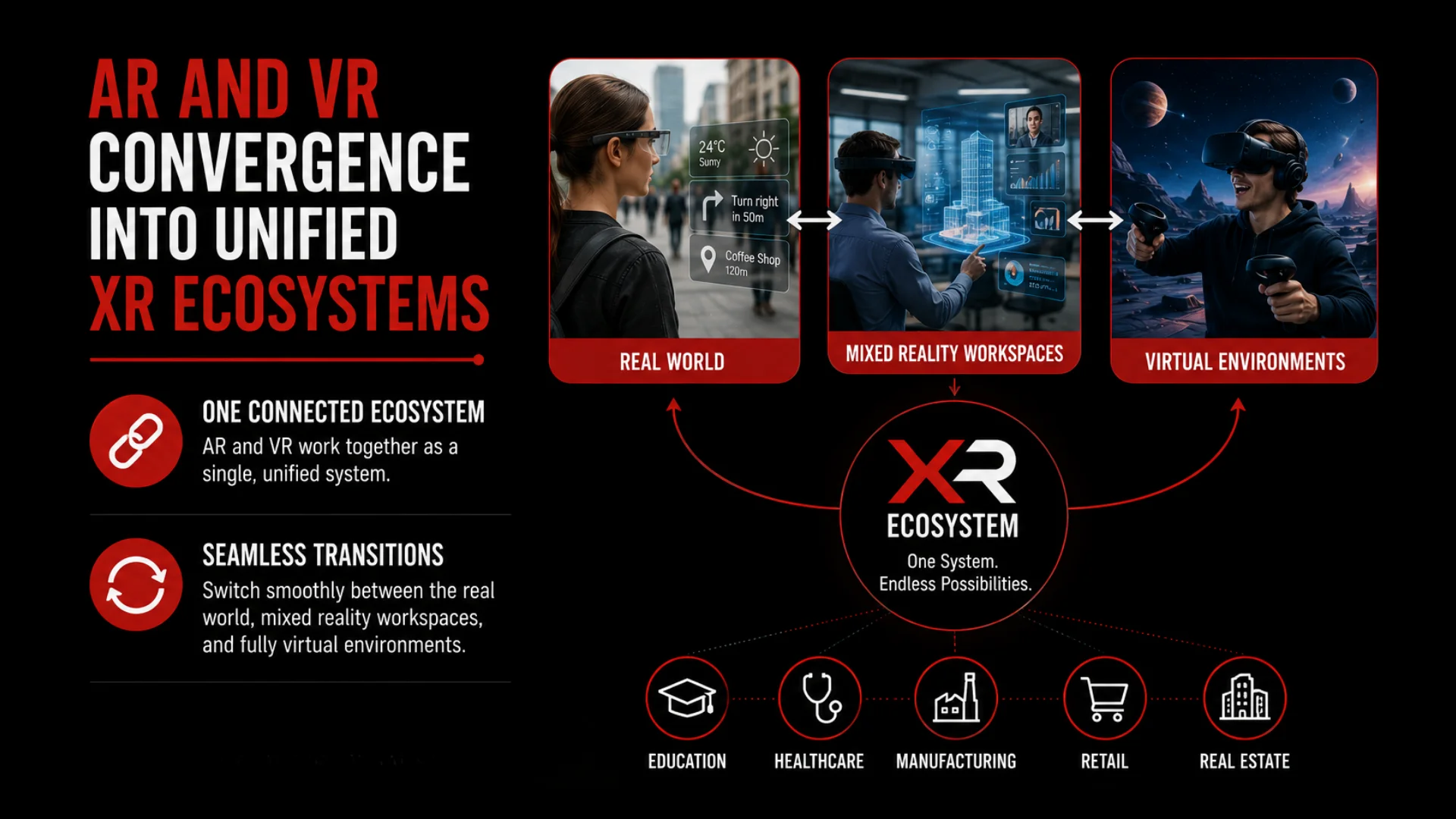
This way, customers can easily transfer between the real international, combined truth workspaces and all virtual environments from one connected system.
The merging of these two fields will impact the future of VR technology due to the fact that it will render experiences extra versatile, useful, and useful in numerous sectors.
How AI Is Transforming the Future of VR Technology?
AI is helping VR become smarter, faster, and more scalable. Virtual reality studies were very hard work, extensive to create beyond. All objects, characters, scenes, and interactions were designed and created by the developers and 3-d artists.
With AI, this system can be expanded. It can help grow digital worlds, enhance individual behavior, individualize user trips, and boost 3D asset production. That’s why AI is one of the most important developments in VR as a way to shape the destiny of immersive technology.
Generative AI for immersive world creation
Teams can use generative AI to build VR environments in less time. Generative AI can assist teams in the creation of VR environments more quickly. Developers can save the time and effort of creating each scene individually by leveraging AI to create rooms, landscapes, objects, textures, and ideas for experiences.
This can be beneficial to businesses when they are developing:
But this will make it easier for brands to explore VR future tech without prolonged development times.
AI-powered NPCs and intelligent interactions
AI-controlled NPCs are crucial for developing a more practical experience. These characters can reply to users in real-time in place of scripted responses.
They can:
Answer questions
Help users to complete tasks
Respond to users’ actions
Give feedback
Hold realistic conversations
Support training roleplay
For instance, a medical student can have a conversation with a virtual patient. A sales trainee is able to go through with an AI customer. A virtual instructor can be used in a safety simulation to teach a new employee.
Real-time personalization in virtual environments
With AI, VR can adapt in real-time to how users interact with the virtual environment. This allows for the enjoyment of what is applicable and useful.
In the case of a learner who is not progressing well, a VR training system can adjust the difficulty level. An app that changes the environment as per stress levels can alter the condition. The retail VR showroom can suggest products according to what a customer explores.
This is not the case with VR technology providing the same experience for every user.
AI-assisted 3D asset generation and animation
3D Assets are possibly one of the most time-consuming aspects of VR development. AI can assist in this process to accelerate the creation of models, animation, textures, and optimization of scenes.
AI can help with:
3D object generation
Character animation
Texture creation
Scene building
Motion cleanup
Asset optimization
This can boost the richness of VR experiences and speed up production, while minimizing repetitive production activities for VR teams.
Key Industries Using VR Technology in 2026
The VR era is now being adopted in an extensive range of industries, as it could help in getting to know, testing, exploring, and experiencing things in a secure environment. VR is not just giving the user an explanation of an idea, but allows them to enter into the idea.
This is why today’s VR trends are going beyond gaming and into real business, healthcare, educational, retail, and training use cases.
Healthcare and advanced therapy applications
The healthcare industry is one of the most promising sectors for VR use. VR can be used by medical teams to practice complex procedures, train safely, and to aid in patient treatment.
Common applications for healthcare are:
Surgical training
Pain management
Exposure therapy
Physical rehabilitation
Mental wellness support
Medical education
This makes healthcare training safer and provides patients with less guidance.
Education and immersive learning
VR will make learning more non-traditional, thus simplifying the understanding of the lessons that are learned.
Students can learn about space, take a virtual walk through ancient cities, learn about the human body, or do science experiments in a virtual lab, for instance.
VR for Education can be used to aid in the following:
That’s why immersive learning is emerging as one of the most realistic applications of VR technology.
Gaming and entertainment experiences
Gaming continues to be one of the largest VR markets. VR allows players to immerse themselves in the game environment, move in a natural manner, and interact with the objects in real-time.
There are also other ways the entertainment industry is leveraging VR:
Virtual concerts
Immersive films
Live events
Interactive storytelling
Social VR experiences
Branded fan experiences
This maintains the focus on gaming and entertainment for VR innovation.
Architecture, engineering, and real estate visualization
VR is a great tool for architects, engineers, and real estate professionals to be able to visualize spaces before they’re constructed.
Home, office, hotel, or commercial spaces can be walked through in 3D. This will help to get a feel for layout, size, design, lighting, and flow.
It also assists teams to:
Retail and virtual commerce experiences
VR is a tool for brands to make their shopping more interactive.VR is a way brands can make shopping more interactive. Whereas customers would normally only be able to view pictures of products, they can now explore products in 3D or even visit a virtual store.
VR retail experiences can consist of:
This will make customers more confident before purchase.
Travel and tourism simulations
VR aids individuals in exploring locations before making a booking. Virtual experience can be utilized for hotels, resorts, tourism boards, and travel agencies to demonstrate sites in a more emotional and visual manner.
Customers can preview:
Hotel rooms
Resorts
Tourist attractions
Cultural sites
Event venues
Guided destination tours
This allows for more interesting travel planning and assists people in making better choices.
Manufacturing, logistics, and industrial training
VR is being used in manufacturing and logistics to train employees without putting them in dangerous environments.VR is being leveraged in manufacturing and logistics to train employees without exposing them to dangerous environments.
Employees can practice:
Machine operation
Warehouse workflows
Safety steps
Emergency response
Equipment handling
Process training
This minimises risk, heightens confidence, and aids workers in learning in a safe environment before their first time in a live situation.
Automotive and product prototyping
VR is employed by automotive companies to create, test, and show cars prior to the production of physical models.
VR can support:
This saves the time and expense of teams and strengthens design decisions.
Defense, aerospace, and simulation training
VR in defense and aerospace is used for high-risk training due to the fact that a user can go through complex situations safely.
VR is used for:
Flight training
Mission planning
Equipment handling
Emergency response
Tactical simulations
Maintenance training
This is one of the most obvious applications of VR tech to eliminate real-world risks for training real-world problems.
Business Benefits of Modern VR Technology
Modern VR technology is not only about the creation of exciting digital experiences. It provides practical solutions to train teams, lower costs, explain products, and better engage customers.
Improved training efficiency and knowledge retention
VR is about “learning by doing. Users can not just watch a video and read instructions, but can practice in a safe virtual environment.
This is useful for:
Employee onboarding
Safety training
Medical training
Equipment handling
Emergency response
Soft skills training
Since this experience is active, learners absorb tasks faster, and their memory is enhanced.
Reduced operational and prototyping costs
Expensive physical prototypes, live training setups, and real-world testing are all options. VR technology can help to lower these costs by bringing early testing and practice to virtual environments.
VR can be used in the business world to:
Before developing a product idea, test it out.
Provide employee training without disrupting business.
Minimize travel for demos and meetings
Reduce the potential for costly errors
Check designs before production.
This is why VR future technology is important for businesses to plan more quickly, with less wasted time.
Enhanced customer engagement and brand experiences
VR offers customers an experience rather than just a view.
A client can step through a digital showroom, visit a product in 3D, be a part of an immersive release, and experience a branded world.
This makes it less difficult to create a more potent emotional connection, as the users are a part of the revelry.
Faster product visualization and collaboration
VR helps to simplify complex concepts. In 3D, teams can enter a design, check out a product, test a layout, or describe a concept.
This can be particularly helpful for:
Architecture
Automotive
Real estate
Product design
Engineering
Manufacturing
Event planning
Different teams from the same corporation can also work in equal virtual surroundings, whether they are inside the same town or in different countries.
Competitive advantage through immersive innovation
VR trends are precursors of how companies can differentiate themselves from others.
They can provide better training, more interesting demos, better customer experiences, and smarter product development processes.
VR technology, in simple words, can make a business look more modern and efficient, and make it difficult to ignore the experience.
How Businesses Can Prepare for Emerging VR Trends?
The best results come from VR when it’s connected to a clearly defined business objective. If a company feels new, it does not mean that it should use VR. It ought to be utilized when it addresses an actual issue.
With the right approach, it is possible to create immersive experiences that can be developed over time, while avoiding the use of a budget that is wasted.
Choosing the right VR development strategy
The first is to establish the goal of the VR experience.
It is important to ask a business:
Is that for training?
For engagement with the customer?
Is this for product visualization?
Is this for sales or marketing?
Is this for remote working?
Is this for learning or practice?
With a clear goal in mind, it will be less complicated to pick an era, platform, features, and content style.
Building scalable immersive experiences
A robust VR solution should be designed for the future. Companies should not go through one-time experiences that are not scalable or adaptable.
A scalable VR experience can be used for:
New content modules
More users
Multiple devices
Analytics and reporting
AI upgrades
Cross-platform access
This enables companies to derive more long-term value from their investment.
Selecting the right VR hardware and platforms
Not all VR projects require the highest-powered VR headset. For the use case, the right hardware is required.
A high-end training simulation might require advanced tracking and graphics, for instance. A straightforward product demo might be possible on more user-friendly, standalone headsets.
Businesses should consider:
Budget
User comfort
Device availability
Tracking needs
Graphics quality
Portability
Platform support
The first-rate setup ensures that the mission remains possible and user-friendly.
Integrating AI, XR, and cloud technologies
VR will not function in isolation in the future. It will be integrated with AI, XR, cloud systems, analytics, and business systems.
This can be used to make businesses smarter when creating immersive experiences.
For example:
AI can tailor training sessions to individuals’ needs.
XR can combine real and virtual spaces.
Cloud tools can be used to facilitate remote access.
User performance can be measured by analytics.
VR data can be integrated into the business systems and real workflows.
These partnerships will enable VR to be more useful, measurable, and future-proof.
Partner With EuphoriaXR for Future-Ready VR Solutions
EuphoriaXR empowers companies to make VR trends truly immersive. Whether it’s strategy or development, the team can help companies create VR experiences that are both practical and scalable, and that are also engaging and interesting.
EuphoriaXR can help with:
Custom VR application development
VR training simulations for enterprises.
Immersive experiences driven by AI.
Solutions for AR, VR, and XR.
Spatial computing experiences
Cross-platform immersive applications
Interactive brand activations
From education to product visualization, from clients to immersive storytelling, EuphoriaXR can assist companies in advancing VR technology for the next step in digital innovation.
Challenges Shaping the Future of Virtual Reality
The VR era is advancing rapidly, but faces hurdles that can impede uptake. It has to become less difficult, safer, more affordable, and more scalable to be part of the daily existence of businesses and customers.
Hardware limitations and device accessibility
Headsets are becoming more comfortable and better, but they’re expensive and uncomfortable for long wearing. Additionally, a few users will need computer systems that might be capable of high performance, extra sensors, and/or fast internet connections to enjoy the full potential of the product. VR adoption will continue to increase as headsets become lighter, cheaper, and less complicated to install.
Performance, latency, and connectivity concerns
Smooth performance is vital for VR studies. It would not take long for the immersion or pain to be interrupted. That’s why brief processing time, stable internet, low latency, low costs, and dependable monitoring are essential. These are even more critical in healthcare scenarios, enterprise training, remote co-working, and multiplayer VR settings.
Privacy and data security risks in immersive environments
VR systems can accumulate private data on customers, which includes their eye actions, hand gestures, voice, location, body movements, and behaviour within virtual environments.
As VR technology continues to evolve, businesses will need stronger privacy regulations, secure data storage, transparent consumer consent protocols, and more desirable biometric protection measures. In the future, businesses will want to put in place more comprehensive privacy rules, data storage protection, consumer consent protocols, and safety measures for biometric data as the VR era advances.
Health concerns and prolonged wearable usage
After extended VR sessions, a few customers may experience soreness. This may include eye strain, dizziness, motion sickness, exhaustion, or neck strain because of the headset. Improved headset design, new, greater fluid moves, comfort settings, and periodic break reminders will help make VR more user-friendly and more secure to use for longer.
Content development complexity and scalability
Creating first-rate VR content is a time-consuming, planning, and technical assignment. Professionals like UX designers, animators, sound designers, three-D artists, and even contributors of the enterprise are regularly required to work on a team alongside developers. This can lead to costly and difficult VR projects and scaling. With time, this barrier can be decreased with the assistance of AI tools, 3-D reusables, and improved platforms.
The Future of VR Technology Beyond 2026
VR experiences and headsets will not be restricted to personal use. It will be more connected, smarter, and functional in the real world. VR will likely collaborate with AI, AR, spatial computing, cloud systems, digital twins, and wearable devices to bring about more immersive spaces that are more natural and practical.
Fully connected spatial ecosystems
VR systems will integrate physical and digital environments more seamlessly in the future.
Users can seamlessly switch between the actual environment, blended fact (MR) overlays, and complete digital environments without experiencing a sudden disconnect between each environment. It can permit a smart lecture room, virtual office, a digital health center, a business management room, a remote collaboration space, an interactive retail setting, and more.
AI-driven immersive virtual environments
In virtual environments, AI will create an extra responsive experience. VR worlds might be dynamic in place of fixed, changing based on what users do, want, or need. This will bring about smart digital assistants, adaptive mastering spaces, personalized mastering routes, natural voice manipulation, and wise virtual characters, making VR more humane and beneficial.
Persistent virtual economies and digital lifestyles
With the virtual spaces expanding, individuals may be doing more work, learning, shopping, and socializing inside immersive spaces. It may lead to long-term virtual economies, such as virtual spaces, avatar identities, long-term virtual events, and virtual products. But these digital worlds won’t update the actual world; they’ll just be a way of interacting with manufacturers, teams, and groups more regularly.
How VR could reshape work, education, healthcare, and entertainment?
VR future technology is ready to transform a great aspect of ordinary lifestyles. VR can create a more intuitive remote-working experience in the workplace. Students can experience education in education rather than just read or watch. Doctors can practice without being put at risk, patients can use VR for pain relief, mental wellness, and rehabilitation, and therapists can support patients in a controlled environment. VR technology can enhance the gaming experience, make movies more interactive, provide an immersive live-action experience for concerts, and so on in entertainment.
Conclusion
VR is making the leap from the future to the present, with AI-driven experiences, spatial computing, low-weight headsets, corporate schooling, and combined fact ecosystems being the drivers of change in the next five years. Despite all the constraints of hardware pricing, privacy, overall performance, comfort, and content scalability, the VR era has developed to be smarter, easier to access, and more useful for agencies looking to teach their personnel better, engage their users more profoundly, and prepare for the future of immersive innovation.