
This is one advantage of the ability to develop 3D games. It’s more than just for fun.
Essential Tools for 3D Game Development
Having the appropriate tools can make creating a 3D game a much easier and simpler task. These are used to build a game world, play the game, make 3D shapes, make the game logic, test game features, and manage game files.
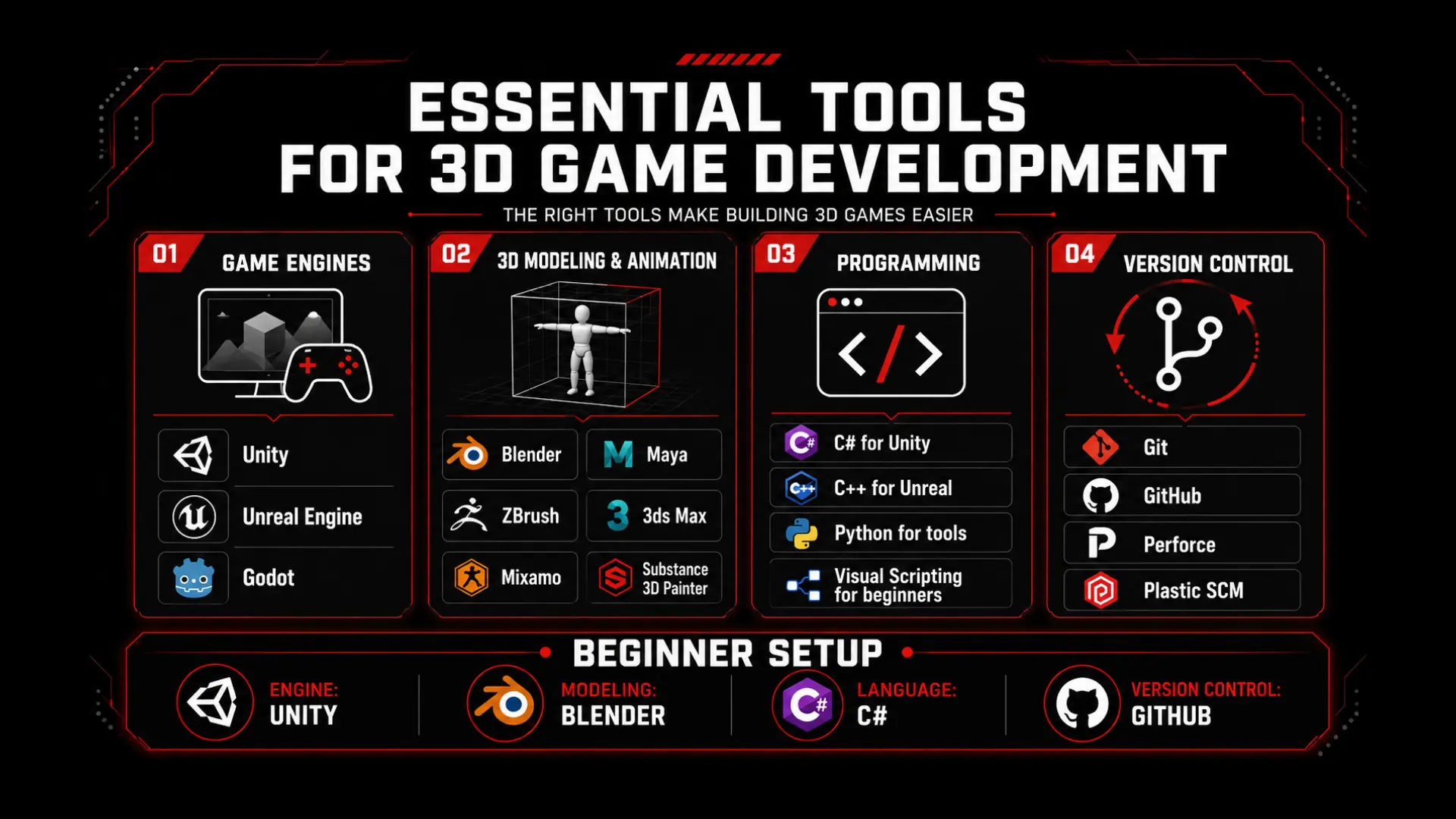
The first time around, it’s not about using all of the tools. Use one game engine, modeling tool, programming language, and version control system. It makes learning easy and simple.
Game Engines for 3D Game Development
The primary software to create a 3D game is a game engine. It provides pre-designed graphics, physics, sound, animation, lighting, controls, and publishing systems for developers.
Commonly-used game engines include:
Key Roles in 3D Game Development
In growing a 3D recreation, it is quite not unusual to have a couple of man or woman concerned, and every may additionally have one of a kind abilties. A small project may have a number of different roles performed by the same person. If the roles are performed in a large studio, then each role can be played by a team.
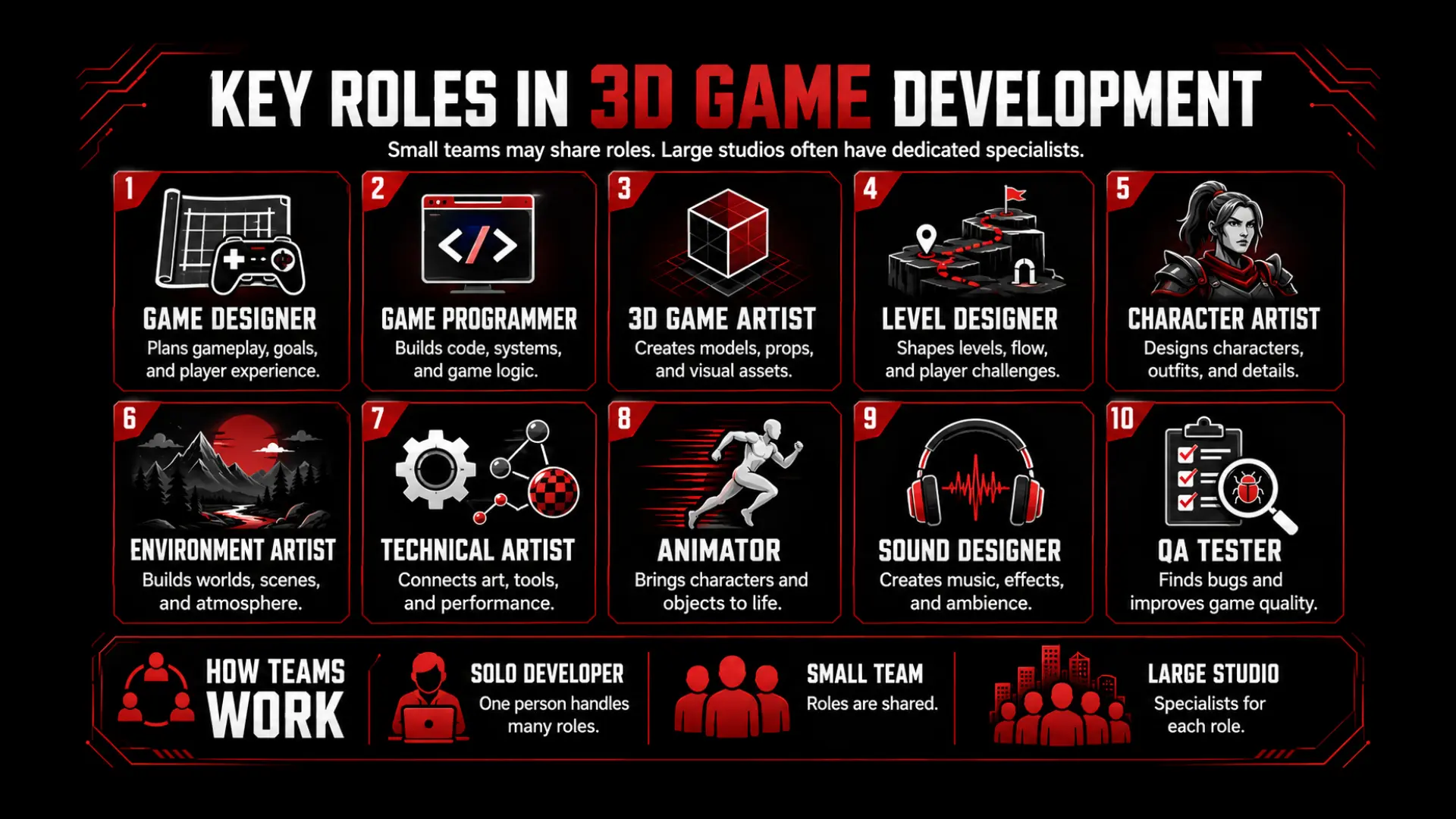
Beginners can better appreciate how a 3D game is constructed when they know the roles of each of the components.
Game Designer
A game designer is someone who designs the game. They are concerned with rules and objectives, challenges, rewards, and player experience.
The game designer determines:
What does the player do?
How does the player win?
What is the reason for the fun in the game?
The difficulty of the game
What is going on in each step?
How does the player move on?
The key to being an excellent game designer is to constantly consider the player’s perspective. The intention is to make sure the game is comprehensible, fair, and enjoyable.
Game Programmer
A game programmer programs the game.
They create systems such as:
Player movement
Enemy behavior
Camera control
Health systems
Score systems
Menus
Inventory
Physics interactions
Save and load systems
The programmer, for instance, would ensure that the character would jump at the correct time and height when the player pressed the jump button.
It is the logic of the game that is programmed.
3D Game Artist
A 3D game artist is responsible for producing the visual elements that make up the game. This can be anything from props and weapons to vehicles, buildings, furnishings, rocks, timber, and extra 3D models.
They are tasked with making it look complete and presentable in the game world.
A 3D game artist can engage in the following jobs:
Modeling
Texturing
Materials
Asset cleanup
Exporting models
Visual style consistency
To make it simple, they make what they see and interact with.
Level Designer
A level designer creates the space in which the player will move.
They decide the area of gadgets, paths, enemies, rewards, and challenges.
A level designer’s job is to concentrate on:
Player movement
Level flow
Difficulty
Exploration
Obstacles
Hidden areas
Checkpoints
Enemy placement
A good level design that leads the player but doesn’t make it too easy to complete. Supports smooth and natural gameplay.
Character Artist
A character artist is responsible for the creation of humans, creatures, or playable characters in the game.
This includes:
Body shape
Face design
Clothes
Armor
Hair
Skin details
Character textures
Character artists are responsible for creating the characters and giving them personality and the story. In many 3D games, the characters are the thing that players will recall the most.
Environment Artist
An environment artist creates the world that the player is going to be placed in.
They develop locations like:
Cities
Forests
Rooms
Roads
Mountains
Castles
Shops
Battle arenas
Sci-fi worlds
Their work contributes to growing the mood and environment.
For instance, if someone is in a dark room with damaged lighting, it can seem scary. A vibrant forest with smooth colorations may be a peaceful scene.
Technical Artist
A technical artist bridges art and programming. This role is critical as 3D games need to be visually appealing and perform well.
Technical artists work in such places as:
Shaders
Materials
Visual effects
Rigging support
Animation tools
Asset optimization
Lighting setup
Art pipelines
They assist in the collaboration between artists and programmers. They also have to solve visual issues that require technical know-how.
Animator
An animator animates characters and objects.
Animation can include:
Walking
Running
Jumping
Attacking
Falling
Climbing
Opening doors
Moving platforms
Facial expressions
The animation is a very important aspect of a game that makes it appear alive. Even the finest of games can be stilted by bad animation.
Sound Designer
A sound designer is responsible for the sound design of the game.
They work on:
Footsteps
Weapon sounds
Button clicks
Background music
Ambient sounds
Character voices
Warning sounds
Impact effects
The sound assists players in comprehending what is happening. It also adds emotion.
Quality Assurance Tester
A QA (quality assurance) tester is a person who tests the game to ensure that there are no issues.
They test:
Bugs
Crashes
Controls
Menus
Game balance
Level issues
Performance
Broken features
QA testers play an important role in making sure the quality of the final product is high and that it is easy and a laugh to play.
Player loyalty is essential to their work, as they will leave if there are too many glitches in the game.
Key Concepts Every Beginner Should Master
Before moving on to creating complex 3D games, there are a few fundamentals that need to be known. They’re used in nearly every 3D game development project and help make learning much easier.
3D Space and Coordinates
The guidelines of the 3D game are left/proper, up/down, and ahead/backward. They are called the X-axis, Y-axis, and Z-axis. Inside this area, each object in a 3D game has a position, rotation, and length.
Game Physics
Game Physics is the physics used to move and react objects. It aids in gravity, jumping, falling, collision, and speed. The game is more natural and believable because of the physics.
Cameras and Player Controls
The participant controls the camera, the camera controls the player’s view, the player controls the person, and the person controls the player. Both should be smooth and simple. The camera and controls may be confusing; the entire game would be difficult to enjoy.
Lighting and Shadows
The appearance and experience of the sport is prompted via lighting. Bright lighting can be a secure lighting; dark lighting can be an aggravating lighting. Shadows can help create depth and give a 3D object realness.
Materials and Textures
Surface appearance of 3D objects is managed by means of materials and textures. A texture will provide the visual element, and a material will dictate the way the object will interact with the light. That’s why wood, metal, glass, or stone have an exceptional appearance.
Collision Detection
Collision detection is used to decide while gadgets collide with each other. It is used to make the participant stand on the floor, pick up cash, hit enemies, open doorways, or keep away from walls. If there were no collisions, the game world would not function effectively.
Animation Systems
Characters and objects can move by using animation systems. They regulate activities along with taking walks, running, jumping, attacking, falling, opening doors, and so on. Smooth animation adds to a more active feel to the game.
Optimization and Performance
Optimization is to make the game run smoothly. It has a few features, such as minimizing heavy files, employing simple models if required, optimizing loading speed, and testing the frame rate. Players can enjoy the game without lagging or crashing due to accurate performance.
Beginner-Friendly 3D Game Ideas
The perfect first projects may be small, easy, and fun. They are wonderful ideas for new builders to get a grip on game development in 3D without getting overwhelmed.
Simple Obstacle Course Game
The simplest obstacle course game is a good starting project. The player navigates through systems, avoids boundaries, and gets to the other side of the finish line. Teaches motion, jumping, collision & stage layout.
First-Person Maze Game
An interactive maze game to teach the beginning player how to control the camera and how to move the player. The player walks through a maze and discovers paths and exits. Easy but helpful to learn about 3D spaces.
3D Platformer Game
A 3D platformer is a game wherein the player jumps among systems, climbs up objects, and does not fall. In this project, the students will learn how to move the camera, physics, timing, and the basics of the flow of the game.
Basic Racing Game
The basics of speed, controls, checkpoints, and track design are taught via a basic racing game. The beginning player can begin with one car, one track, and one finish line, and then add more features.
Survival Prototype
Collecting, avoiding enemies, and health management are some of the things that can be included in a survival prototype. It is a great way to master basics such as resources, enemy movement, and player damage.
Puzzle Adventure Game
A puzzle adventure game is a game that has small puzzles that are solved by the player in order to proceed with the game. This can be anything from doors, switches, keys, and hidden paths. This will aid beginners in learning to interact and implement level design.
Common Challenges in 3D Game Development
The development of a 3D game can be thrilling; however, it likewise has its obstacles. Beginners have issues with performance, design, making a project plan, and testing. The main thing to consider is to identify these problems as early as possible, as they can hamper the entire project subsequently.
Technical Challenges
Technical issues typically have to do with the operation, performance, and interoperability of a game.
Handling Hardware Limitations
Not all of the players have a strong device. Extra weight, high detail, and effects can cause the game to take longer.
The developers have to ensure that their assets, scenes, and effects are not too heavy and keep the game clean enough to perform well on more devices.
Adapting Games for Multiple Platforms
The different platforms of PC, mobile, console, and VR all behave differently. The various platforms feature unique controls and performance limits, and have different screen sizes.
As the target platforms are already planned when the game is being developed, this allows the developers to make the decision on target platforms at a much earlier stage of 3D game development.
Optimizing Game Performance
The 3D recreation needs to be responsive and not have lag, freezing, or lengthy loading times. If players aren’t performing well, the player experience may be ruined in no time.
The developers could work on optimizing performance by optimizing asset sizes, making scenes simpler, cutting down on heavy effects, and often testing the frame rate.
Creating a Unified Experience Across Devices
The experience needs to be steady throughout all devices supported. Players should not assume that one version is better or worse than the other.
All the controls, UI, visuals, and gameplay ought to be in line and running seamlessly throughout all systems to present an experience that looks and feels polished.
Design Challenges
Design challenges occur when the game is technically a hit, but it doesn’t feel amusing, clean, or enjoyable to play. These issues impact gamers’ comprehension of the game and whether or not they desire to keep playing.
Designing Engaging Gameplay
To make a game a success, one has to have appropriate graphics. The participant must have a clean intention, a fair challenge, and a motive to keep.
The gameplay presents players with beneficial information, small rewards, and a constant progression.
Building Player-Centric Game Mechanics
The mechanics are player-centric; that means they are designed around what the player reviews, sees, and feels during the game. In the first short while, the game ought to be easily understood.
Rewards, issues, controls, and goals ought to be used to guide the player instead of causing confusion or leaving them feeling misplaced.
Perfecting Controls and Camera Movement
The lack of good controls or erratic camera movements can make any good game idea go wrong. Movement in three-D games and the way the camera actions have to be natural.
Before adding too many, developers need to take a look at the controls and make adjustments to the rate, sensitivity, angles, and camera settings.
Maintaining Visual Consistency
A 3D game must present itself as one unified world. Using distinct sorts of characters, environments, lights, and UI could make a game appear messy.
The visual consistency adds to the game’s polish, professionalism, and trustworthiness.
Production Challenges
Production issues include mission management, resource management, collaboration, and testing to decorate the game. These issues have a tendency to crop up as the challenge scales up.
Managing the Game Development Project
Without a plan, a project can fast get messy. Developers must be familiar with what they need to broaden first, check, and what they ought to go away for last.
Development is kept easy and not too large by simple timelines, task lists, and priorities.
Organizing Game Assets Properly
There are numerous files used in three-D video games, along with models, textures, sounds, scripts, scenes, animations, and substances. When the documents are not well organized, it’s tough to find the document.
Simple file names and correctly using folders create a speedier development and prevent confusion as the project expands.
Using Version Control for Team Collaboration
Version control saves progress, keeps track of adjustments, and recovers to previous versions if something breaks. It’s very convenient even for an individual developer.
It also assists multiple humans in taking part at the same project without overwriting each other’s work for teams.
Testing and Iterating for Quality
Testing uncovers bugs, poor gameplay, incorrect controls, and performance problems. It should take place while they’re still in development, not just at the end.
Iteration is continually testing, receiving feedback from players, and applying patch after patch for improvement.
Building a Strong Iteration Process
Most games aren’t smooth in the initial version. They get better with retesting, fixing, and polishing.
The iteration method is helpful to transform a hard prototype into a higher, cleaner, and more exciting game.
Best Practices for Efficient 3D Game Development
Efficient 3D game development is about doing the whole lot necessary. Simple but effective tips to help novice users complete projects with speed and without common pitfalls.
Keep Your First Game Simple
Choose a small project that you can complete. To help you understand the full process, a simple game is used to help the beginner.
A small game is well worth extra as soon as finished than a big one that in no way gets completed.
Use Ready-Made Assets When Needed
Pre-built assets can assist in saving time within the learning and prototyping process. They help gamers who are new to the game focus on gameplay instead of creating custom art.
Custom assets can be added on as the game idea, mechanics, and direction are better defined later on.
Optimize Early, But Do Not Overcomplicate
The performance should be tested as early as possible, but for the beginner, it is advisable not to consider every little detail. The aim is to maintain the project clean, with the potential for improvement.
Do not do advanced optimisation for complex scenes, heavy assets, and frequent testing.
Test Gameplay Frequently
Testing the following important changes allows issues to be identified at an early stage. Also indicates if the game is fun, clear, and easy to operate.
Regular testing enhances the player experience and allows for small issues to be identified and solved before it becomes a big problems.
Keep Files and Assets Organized
Simple folder names and file names make it easier to manage the project. This is even more relevant as the game progresses.
Good organization makes it easy for developers to locate, update, and replace assets in a timely fashion.
Build a Playable Prototype First
A prototype is an initial game that demonstrates the concept of the game. It no longer requires the best visuals, music, or effects.
It basically serves to indicate if the game itself is enjoyable enough to continue.
Learn From Existing 3D Games
There are valuable lessons to be learned from existing games, which include controls, levels, camera movement, feedback, and difficulty. Any new player ought to learn how to be guided by good games.
Best Resources to Learn 3D Game Development
Official learning paths combined with tutorials, practice projects, and communities help to make learning 3D game development easier for beginners. The idea is to get enough resources so you don’t get too many. The idea is to choose a couple that are reliable and practiced frequently.
Useful sources consist of:
Unity Learn: Best for mastering the fundamentals of Unity, C# scripting, 3-d scenes, physics, and for newbie tasks.
Unreal Engine Documentation: For Unreal Engine, Blueprints, lights, materials, and advanced 3D visuals.
Godot Docs: Good for beginners who’re searching for a lightweight open-source game engine.
Blender Tutorials: Perfect for 3-d modeling, animation, texturing, and asset introduction.
Game Jams: Useful for quick development of small video games and growing problem-solving competencies.
Developer Communities: Can be beneficial for comments, troubleshooting, and learning from other game developers.
YouTube Courses: Good for visual newbies who want to follow three-D recreation improvement step-by means of-step.
Future of 3D Game Development
The future of 3D game development is all about faster tools, smarter workflows, and more immersive experiences. Games are evolving with the assistance of AI, real-time rendering, VR and AR, cross-platform systems, and cloud gaming.
This provides more opportunities for beginners. Testing, prototyping, using a pre-existing tool, or publishing games are getting increasingly easy across various platforms.
AI in 3D Game Development
In the realm of 3D games, AI is rising as a treasured best friend for automating repetitive duties and enhancing the general game experience. It can aid developers in designing levels, creating dialogues, play-testing levels, enhancing animations, and coming up with concepts for assets.
AI has a range of applications, such as:
Helping to build level concepts more quickly
Providing support to character dialogue and story drafts
Finding bugs by automated testing
Helping with animation and motion
Speeding up asset planning and prototyping
Real-Time Rendering Improvements
Real-time rendering permits 3D pics to come into view in real time during the game. Games rendered with higher quality will show smoother lighting, shadows, reflections, textures, and visual effects.
Important improvements include:
More realistic lighting
More efficient shadows and reflections.
Smoother visual effects
Higher-quality materials
Improved responsiveness on multiple devices.
Improved, more realistic game environments.
VR and AR Game Development
VR and AR are opening up the possibilities of what 3-d games can accomplish. VR immerses players right into a virtual environment, and AR superimposes digital objects onto real life.
VR and AR require 3D game development skills, as each application requires:
Strong understanding of 3D space
Smooth gameplay and player interactions.
Good performance optimization
Simple user interface design.
Real-time object tracking
Ease of movement and controls.
Cross-Platform 3D Games
Cross-platform 3D games are video games that may be played on multiple platforms. A unmarried recreation can be played on PC, mobile, console, VR, and within the cloud.
The following points need to be taken into consideration by the developers:
Different screen sizes
Different control systems
Device performance limits
The rules and requirements of the platform.
Designed with a constant visible aesthetic and gameplay.
Provide a smooth user experience on all devices.
Cloud Gaming and Interactive Worlds
With cloud gaming, gamers can play without the need for high-performance hardware. This can be beneficial in making 3D video games greater handy for many.
Interactive worlds are now on the rise, too. Online environments where players can discover, create, converse, compete, and interact live.
This trend supports:
Larger online environments
Real-time multiplayer experiences
More high-quality games are available at a lower cost.
Shared Virtual Spaces/Social Spaces
The worlds of the games will be even more interconnected.