
The evolution of Virtual Reality is still going on at a fast rate, and the year 2025 is already becoming one of the most definitive years in the industry to date. Writing about major headset announcements and enterprise use, breakthroughs in immersive experiences, and news about virtual reality in 2025 indicates a technology that is not only maturing but growing and finding its way into people and businesses through even more immersive uses.
This paper is the compilation of the most significant virtual reality news, trends, updates, and announcements that would influence the world of VR in 2025.
Virtual Reality Hardware News (2025)
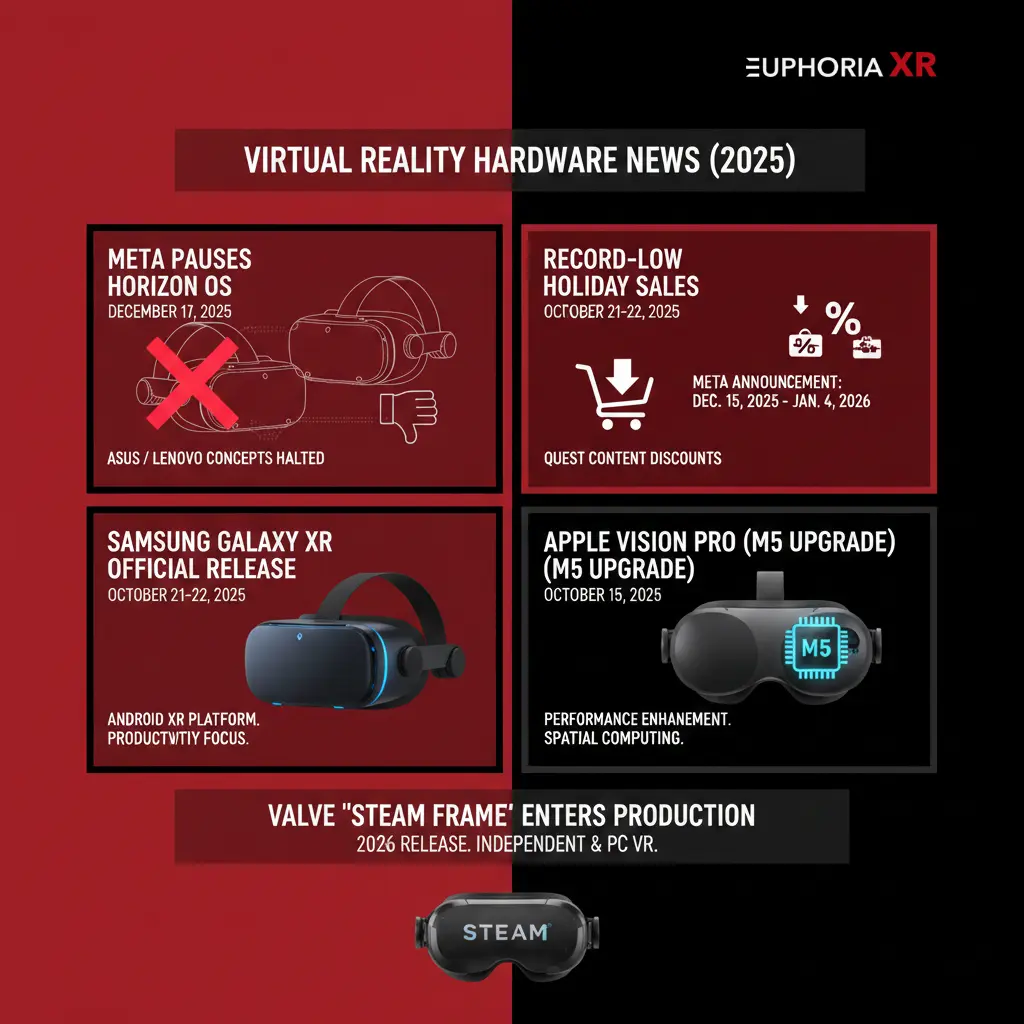
Meta pauses third-party Horizon OS VR headset program
Announcement date: December 17, 2025
Meta affirmed that it has delayed its project to allow third-party manufacturers to sell headsets with Horizon OS (previously Quest OS). This practically halts/thumbs down the already flaunted partner devices (ASUS/Lenovo concepts featured in the case above), especially earlier on in the lifecycle of the program. The rationale that was provided by Metacuria is that it dedicates resources to first-party hardware and software in order to push the category of VR forward, and that it would consider third-party alliances at a later time as the market matures.
Prediction 2025 VR Implication:
More control over the ecosystem, less hardware diversity in the short term of the Quest-like, and a more articulated prioritization of the roadmap through which Meta succeeds.
Major VR headset holiday sales hit record-low prices
Date of official sale announcement (Meta): December 15, 2025.
Meta has planned Holiday Sale 25 to Quest experiences with the end time of the sale set as January 4, 2026 (1159pm PT). The promotion presents itself as an annual seasonal window of a discount on the content in Quest with massive price cuts and a big selection.
The actual sense of record-low: in December retail cycles, discounting of hardware and content increases; this particular mark is usually all relative (by retailer, region, etc.), but Meta is explicit about its window and scope with the Holiday Sale 2 5.
Samsung Galaxy XR Official Release
Release Window: October 21-22, 2025
This was followed by the official launch of Galaxy XR, a high-end mixed-reality headset based on the Android XR platform that took place in October 2025. Galaxy XR was established as a premium but more affordable option in the spatial computing universe, where it focuses on productivity, business processes, and use cases of mixed reality. The release cemented Android XR as a competitive platform along with visionOS and indicated its long-term investment in immersive hardware by Samsung.
Apple Vision Pro (M5 Upgrade Announcement)
Announcement Date: October 15, 2025
In October 2025, Apple declared a revised Vision Pro with the M5 chip. This upgrade centered on performance enhancement, efficiency, and greater spatial computing opportunities as opposed to form-factor redesign. This announcement solidified the high-end positioning of Apple within the VR and spatial computing market and further informed the market concerning high-end immersive devices.
Valve’s next VR headset (Steam Frame) enters production
Valve announced that it would have a next-generation VR headset, called Steam Frame, the first VR product it had made since the Index. It has been reported that the device has entered production planning ahead of a 2026 release date. Steam Frame will be able to operate independently and maintain close connections with the Steam ecosystem, including PC VR streaming. The re-entry of Valve indicates the presence of fresh competition within the high-performance VR hardware and supports further investment in the PC VR market.
Virtual Reality Software, Platforms & Ecosystem News (2025)
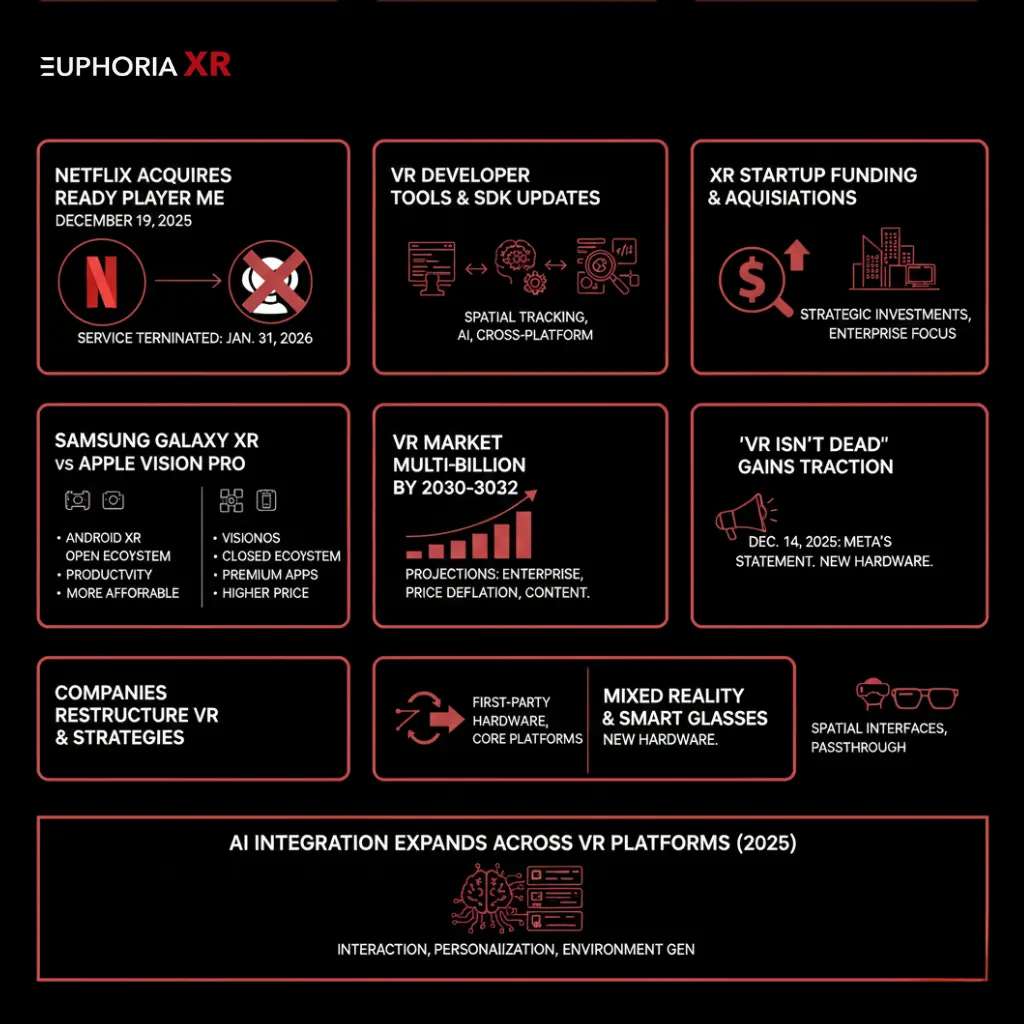
Netflix acquires Ready Player Me
Date of announcement of deals (widely announced): December 19, 2025.
Netflix has confirmed that it is buying Ready Player Me (cross-game avatar platform). The purchase is directly linked to Netflix expanding into gaming, as the avatars will be placed as a means to transfer identity between the games and others. A confirmation was made as well that the current services of Ready Player Me would be terminated, and a closure date would be published.
Service wind-down date (established): January 31, 2026.
VR developer tools and SDK updates released
In 2025, more developer tools were launched, suitable and more mature VR platforms, and production-ready. SDKs concentrated on better spatial tracking, hand interaction, mixed reality support, and optimization. The process of AI integration became widespread, allowing the creation of content more quickly and smarter user interactions. The compatibility between cross-platforms became better, and developers could now roll out the applications on various VR and XR devices more easily.
XR startup funding rounds and acquisitions
The XR investment activity in 2025 has moved towards strategic acquisition and specific investments. Capital focused on startups in enterprise VR, avatar systems, simulation platforms, as well as developer infrastructure. The major cause of acquisitions by larger companies involved obtaining proven technology and talent, but not through speculative growth. This was a more sophisticated and discriminating XR funding landscape.
Samsung Galaxy XR vs Apple Vision Pro comparisons
VR market projected to reach multi-billion-dollar valuation by 2030–2032
Current Framing Standard (example): 2024-2025 baselines are compiled by various research houses and projected out to 2032 (also used as a traditional baseline); in some projections there is a VR market of holding a base of billions in the mid-teens currently that will continue to grow to well over 100B in 2032 (that is the common 2032 base year).
The right way to reflect this in your blog in terms of wording is to state it as explicitly as possible, market projections (not as being guaranteed or guaranteed outcomes), and attach the projections to the assumptions that such firms refer to (enterprise adoption, hardware price deflation, content ecosystem growth).
“VR isn’t dead” narratives gain traction in 2025
Cover date (public statement): December 14, 2025.
A significant driving force behind this plot twist was public opinion that has blamed Meta leadership for commenting VR as continuing instead of zero-sum relative to other investments in response to frequent VR is dead articles. This proved to be a repetition in the VR press in late 2025.
The way to address it as news: manage it as a narrative wave, where there is an identifiable trigger statement (dated), as well as follow-up indicators (continued hardware releases, platform releases, incentives by the developer).
Companies restructure or pivot VR strategies
By 2025, the refined strategies of companies were to shift towards strengthening focus and redirection of resources to VR models. Most had conferred more importance on first-party hardware, core platforms, and enterprise applications with less focus on experimentation or partner-led ventures. The pivots were intended to enhance platform stability, adoption in the long run, and long-term growth instead of high growth.
Mixed Reality and Smart Glasses Platform Development
In 2025, VR software became more capable of computing in mixed reality and form factor smart glasses. Convergence of VR, AR, and mixed reality ecosystems applications Software. It focused on the spatial interfaces, passthrough experiences, and compatibility across multiple devices. This trend reflected the wider move towards platforms of spatially coherent computing.
VR Content Delivery and Immersive Media Production Advances
In 2025, it was reported that advancements were achieved in VR content delivery and production of immersive media. The advances in distribution pipelines to make them efficient and the improvement of production tools made it possible to deliver higher-quality VR experiences on a large scale. Such inventions favored enterprise training, immersive entertainment, and large-scale virtual events.
AI Integration Expands Across VR Platforms (2025)
In 2025, the artificial intelligence turned into a fundamental layer in VR platforms, and it boosted interaction, personalization and environment generation, and real-time feedback. The use of AI to make the behavior of avatars, the world, content, and user analytics more advanced placed AI as a core element of VR software ecosystems in the future.
Virtual Reality Trends Shaping 2025
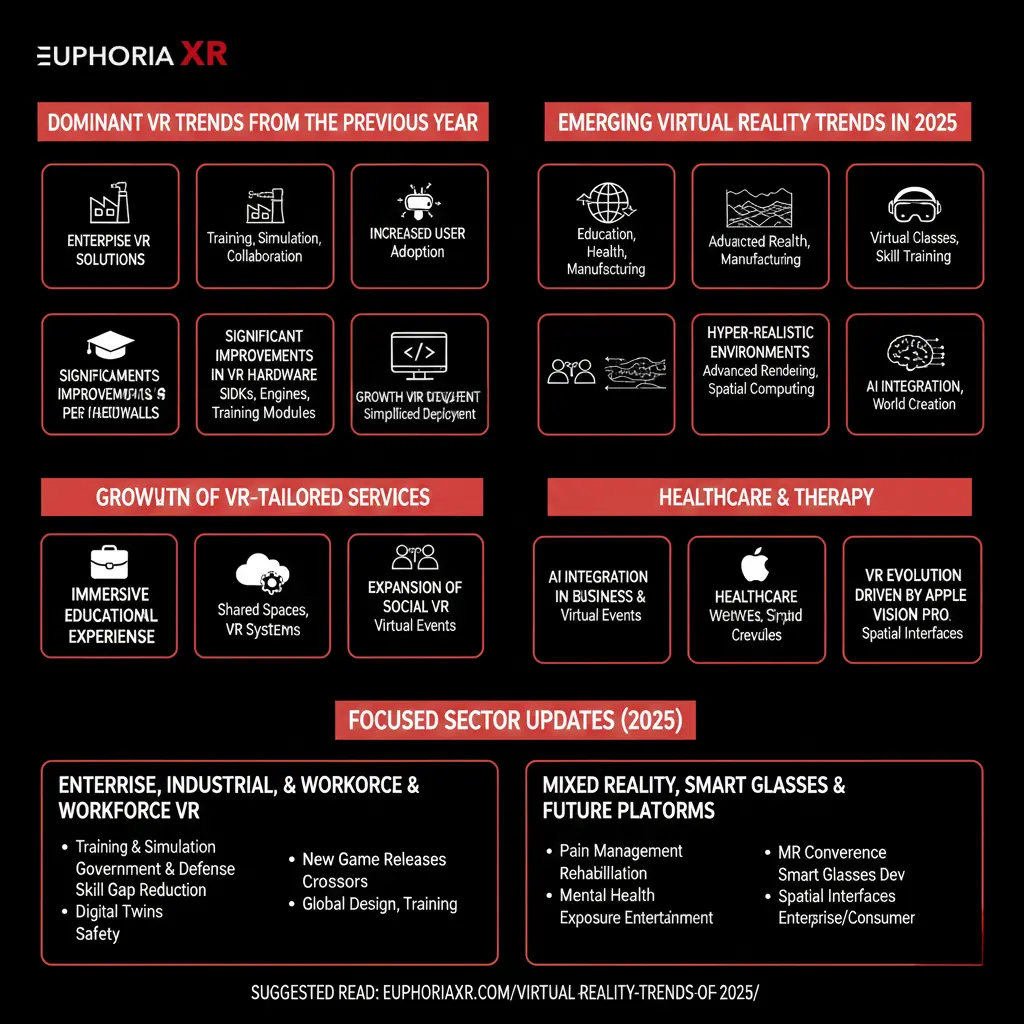
Dominant VR Trends from the Previous Year
Rise of enterprise VR solutions: Businesses started embracing the use of VR to train workforces, simulate, collaborate, and be more efficient in their operations, taking pilot projects into mass adoption.
Increased user adoption across industries: Wider usage was seen when VR devices became more affordable, more comfortable, and less cumbersome, with a spread to more sectors like education, the health sector, manufacturing, and entertainment.
Significant improvements in VR hardware: There were improved display resolution, tracking accuracy, lighter headsets, increased passthrough, and increased device lifetime.
Easier VR development workflows: Creations and businesses were made easier, with better SDKs, enhanced engines, simplified deployment systems, and enhanced documentation.
Growth of VR-tailored services: In addition to customer services customized to VR platforms, such as enterprise software, immersive content platforms, training modules, and platform-native applications, were built.
Emerging Virtual Reality Trends in 2025
Immersive educational experiences: VR is already applied to provide practical learning, virtual classes, simulation of skills, as well as training environments.
Hyper-realistic virtual reality environments: The developments in rendering, display, and spatial computing technology are allowing the creation of increasingly real, visually rich, and reactive virtual environments.
Expansion of social VR platforms: Social VR is a constantly developing sphere with a focus such as collaboration, shared space, virtual events, and persistent social environments.
AI integration in virtual reality systems: VR applications are being applied with the incorporation of artificial intelligence to enhance interaction, personalization, world creation, and live user feedback into the virtual space.
Wider adoption of VR in business and enterprise: Companies are integrating VR into their daily operations by training, designing, and collaborating, as well as operating, not as something new, but as an experimental tool.
Virtual reality evolution driven by Apple Vision Pro: Apple Vision Pro-influenced platforms are getting spatial computing, interface design, and a blend of VR, AR, and mixed realities experiences expectations higher.
Suggested Read: https://sample.noumanmahmood.net/virtual-reality-trends-of-2025/
Enterprise, Industrial, and Workforce Virtual Reality Updates
In 2025, the adoption of VR in enterprises and industries is characterized by feasible use and magnitude. Key updates include:
The scope of enterprise VR usage in workforce training is growing with the adoption of immersive simulation usage in companies in their onboarding, upskilling, and operational training.
VR training is contracted to the government and defense to aid mission rehearsal, logistics planning, and risk-free simulations.
XR training addresses the shortage of skills in the manufacturing workforce by facilitating the process of learning between the old and new employees.
Virtual reality can be used in industrial automation and factory processes to test, optimize, and validate processes prior to physical deployment.
Digital twins combined with AR and VR can enable monitoring and predictive maintenance as well as visualization in real-time, in manufacturing.
The concept of the use of immersive technologies in industrial safety training to enhance preparedness and minimize real-world risk is applied.
Virtual Reality in Healthcare and Therapy
Virtual reality is still gaining acceptance as a medical device and not a research technology.
Healthcare treatment programs can use VR to help deal with pain and patient engagement, as well as therapeutic care.
Rehabilitation and virtual reality-based therapy solutions are used to support physical recovery through the guidance of exercises, progress monitoring, and motivation.
The VR implementation in clinical and mental health is growing as healthcare professionals embrace immersive technology to use exposure therapy, reduce stress, and deliver cognitive treatment.
Virtual Reality Gaming & Experiences
VR expansion among consumers is still content-based and experience-oriented:
The VR gaming releases and large-scale updates are used to enhance immersion, as well as graphics and game performance.
Crossovers and collaborations of VR games are announced as a means of prolonging popular titles and establishing new audiences.
VR experiences can be experienced worldwide, where geographical locations can be integrated with large-scale immersive entertainment.
Mixed Reality, Smart Glasses & Future Platforms
In the future, VR is more and more converged with other immersive technologies:
Mixed reality is also on the increase with VR, where virtual and real worlds combine.
Development of smart glasses is hastened, and companies concentrate on a light form factor and daily usage.
The place of spatial interfaces in future computing platforms is becoming clearer with the maturity of virtual reality.
Trends of VR convergence between enterprises and consumers are forming, and the gap between business applications and consumer experiences is decreasing.
Virtual Reality Announcements to Watch
The mainstream announcements that are likely to influence the next stage of immersive technology will include:
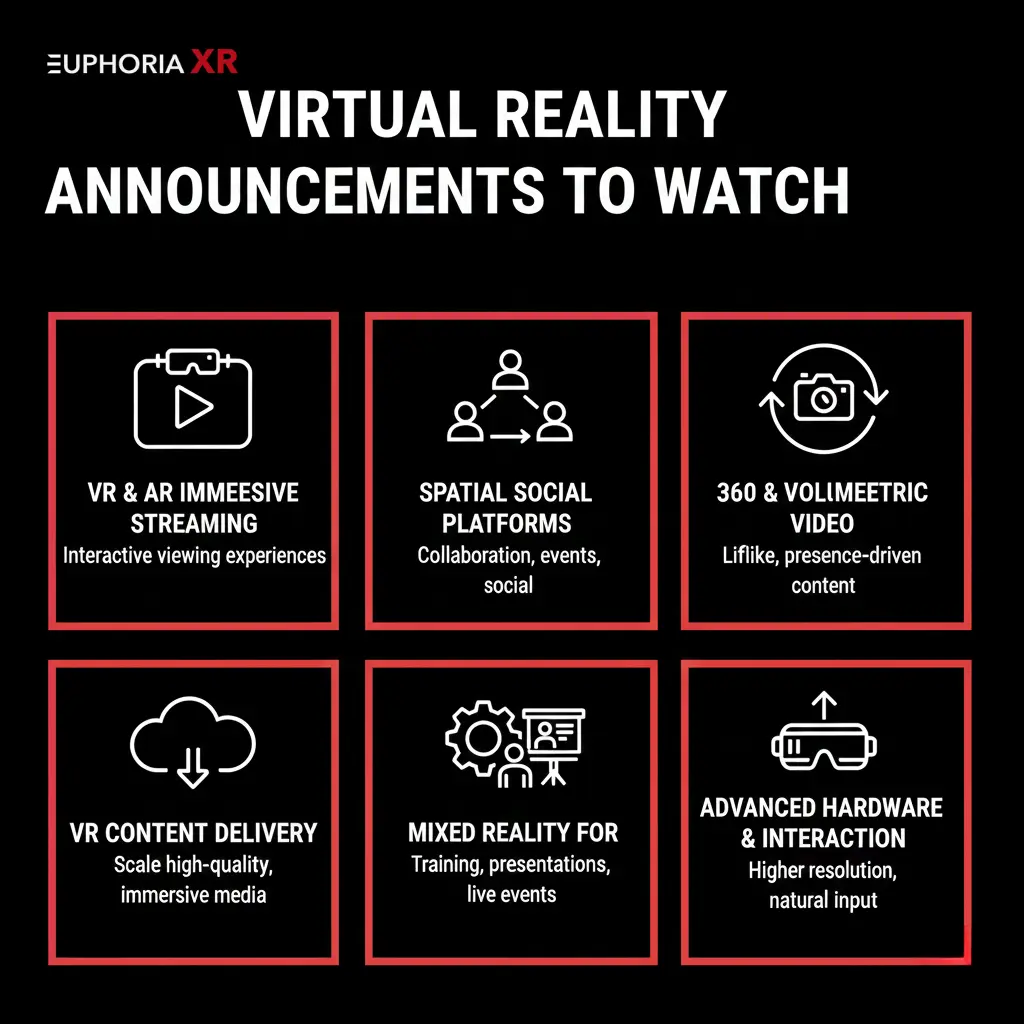
VR and AR adoption in immersive video streaming
VR and AR are becoming increasingly popular technologies in streaming in order to provide interactive and immersive viewing experiences.
Spatial social computing platforms using VR
New platforms are directed at common virtual spaces that are intended for collaboration, events, and social interaction.
360-degree and volumetric video experiences
The volumetric capture and 360-degree video are still developing, and they can provide more lifelike and presence-driven content.
VR content delivery and immersive media production
Advances in the distribution pipelines and production tools assist in increasing the quality of immersive media on scale.
Mixed reality video experiences for enterprise and events
Companies use mixed reality video to train, make presentations, hold conferences, and broadcast live events.
Advances in immersive VR hardware and interaction technologies
The new technological advances in hardware are aimed at enhancing displays, input enhancement, and more natural interaction.
What Virtual Reality Development Services EuphoriaXR offers?
EuphoriaXR is a provider of end-to-end virtual reality development solutions to serve efficaciously, extensively, and business-ready applications. Such services assist organizations in implementing immersive VR services in training, simulation, content creation, and experiential learning within sectors of enterprise, education, healthcare, manufacturing, and entertainment.
Virtual Reality Training
EuphoriaXR is a developer of immersive VR Training Programs that enable a team to learn, practice, and repeat complicated work in a risk-free virtual reality setting. They are applied to onboarding, safety training, operational workflow, and skills development, and assist organisations to achieve better retention, decrease error rates, and standardize training at scale.
Virtual Reality Simulators
EuphoriaXR created VR Simulators that are highly accurate recreations of real-life scenarios and allow complex or hazardous environments to be practiced in a real-world setting. These simulators find usability in the industrial processes, healthcare processes, technical training, and decision-making processes, wherein real-world training would be either too expensive or hazardous and too impractical.
VR 360° Video Production
EuphoriaXR creates quality VR 360° Videos, which position the users into fully immersive worlds. Virtual tours, storytelling, training demonstrations, and marketing are some of the examples of uses of the experiences where the audience can navigate spaces and scenarios in a first-person view across VR headsets and other platforms that support the experiences.
Conclusion
Virtual reality in 2025 will represent a technology that is no longer an experiment but a technology that is being scaled in its application. In the domain of enterprise, in the fields of healthcare, gaming, and entertainment, VR keeps developing with better hardware, smarter software, accompanied by enhanced integration with mixed reality, as well as enhanced integration with AI. With new announcements coming at the original platforms becoming more mature, virtual reality stands to take center stage in the future of digital interaction, learning, and computing.