
Envision learning how to do any complicated medical procedure without risking serious harm to the patient. If medical students could practice a difficult surgery before stepping into an operating room, what would that be like?
VR medical training can do just that.
It has been a challenge to educate the health care field. It takes “showing” to gain clinical skills, which can be hard to find in real life. No additional risks can be imposed on patients, and the health care institution needs to balance education and patient care.
Virtual Reality has upended that equation.
VR Medical Training involves performing virtual scenarios, procedures, and patient interactions that simulate medical situations. A VR system equipped with a VR headset allows learners to immerse themselves in a realistic clinical environment to view anatomy, perform procedures, and explore and make decisions without risk of harm.
With healthcare systems changing rapidly, VR continues to be a valuable asset for medical schools, hospitals, and training organizations all over the world.
What is VR Medical Training?
VR medical training refers to using immersive virtual reality systems to create a medical environment, training procedures, and bodies for medical practitioners and students to practice and learn safely.
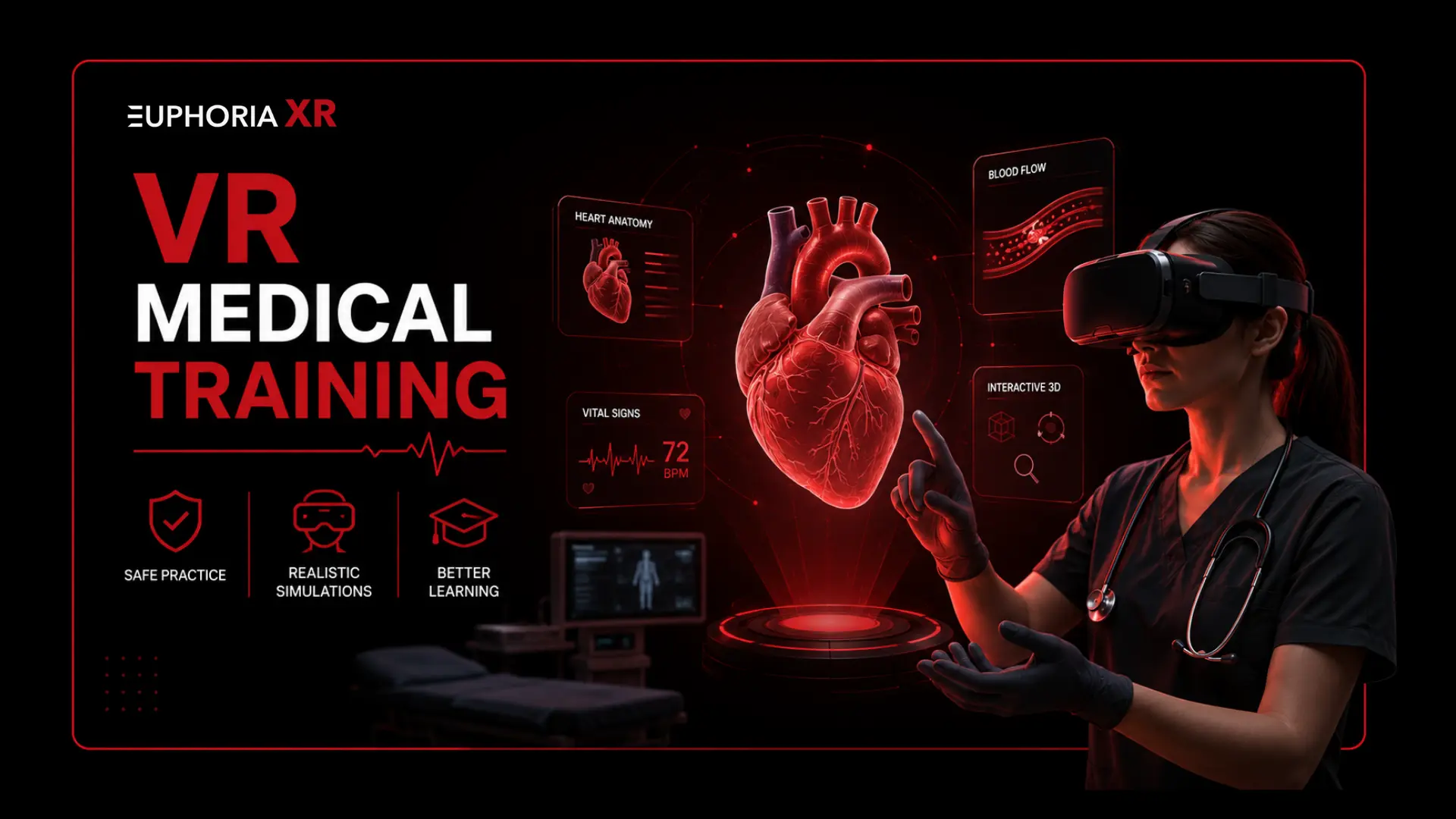
The Role of Virtual Reality in Healthcare Education
Unlike traditional educational methods, which can be passive and passive again, VR technology allows for interactive learning experiences.
Students do not just have to learn from textbooks, diagrams, or videos; they can learn by interacting with virtual patients, patients and medical equipment, and complex anatomical structures.
VR healthcare education can assist learners in the following ways:
Know about human structure in 3 dimensions.
Repeat clinical procedures to gain practice
Learn through real-life patient scenarios
Develop confidence before practice in real-world situations
Develop decision-making abilities
This kind of involvement can allow for a more immersive and memorable learning experience.
Why Medical Institutions Are Adopting VR Training?
Medical institutions are increasingly making investments in VR, as it has addressed several issues that are prevalent in training.
Several factors are enabling everyone to adopt it:
| Driver | Impact |
|---|---|
| Patient Safety | Allows Risk-Free Practice |
| Training Efficiency | Enables Repeated Skill Development |
| Cost Reduction | Reduces Dependence on Physical Resources |
| Accessibility | Provides Consistent Training Experiences |
| Technology Advancement | Supports Modern Healthcare Education |
Medical schools, hospitals, and health care organizations are seeing that VR can be an effective adjunct to conventional education, but it can also enhance the learning experience.
How VR Enhances Medical Learning Outcomes?
Recent studies have proven that a cognitively immersive learning environment facilitates retention and engagement.
Research by the National Library of Medicine has shown that, of some traditional teaching methods, VR-based learning affords better knowledge acquisition and a higher level of satisfaction among the learners.
VR helps to improve learning by:
Active participation instead of passive viewing and listening
Offering immediate feedback
Allowing repeated practice
Improving spatial understanding
Supporting experiential learning
Interested in creating authentic VR training solutions for the medical field?
Challenges in Traditional Medical Training
Although healthcare education has been successful in creating generations of healthcare professionals, there are a variety of drawbacks.
These are becoming more evident as procedures become more complex and demand more from the healthcare system.
Limited Access to Clinical Practice
Health care workers need experience in the field.
But it may be difficult to see or do some procedures.
Rare conditions may be experienced from time to time by students. Some complex procedures are not done often, minimizing exposure and opportunities for practice.
Therefore, the learning output might be different, resulting in different levels of experience at graduation.
Patient Safety and Risk Concerns
First and foremost, patient safety is paramount in health care.
Complex procedures performed on real patients are always risky if not conducted by an experienced learner.
Balancing educational components with patient care is a key consideration in traditional training.
This can be addressed by virtual reality, which allows learners to practice in virtual environments without fear of injury to themselves or others if they make a mistake.
High Training Costs and Resource Limitations
It is expensive to pursue healthcare training.
Many institutions have many large capital expenditures for:
Cadaver labs
Physical simulation equipment
Training facilities
Specialized instructors
Medical devices
The costs of maintenance, operation, and upkeep are needed for these resources.
VR medical training offers an easily adaptable solution that can complement existing educational materials.
Complex Anatomy and Procedure Visualization
The anatomy of humans can be very complicated.
When viewing the structures of the heart, blood vessels, and internal organs, etc., in a flat image, knowing it may be challenging.
The following issues are common among students:
Spatial relationships
Anatomical orientation
Dynamic physiological processes
Complex procedural pathways
The advantage of virtual reality is that it enables learners to enter into the beauty of anatomy from all angles.
Market Overview of VR Medical Training
VR Medical Training’s market impact is growing worldwide, as healthcare institutions look for innovative training methods.
There are several growth factors:
Increasingly using simulation for learning
Improvements in virtual reality technology.
Growing demand for healthcare workers
Increasing importance placed on patient safety.
Expansion of digital health education.
The virtual reality healthcare market is projected to show impressive growth over the next decade and beyond, with hospitals and universities investing in VR simulation technologies designed to revolutionize patient care. As hospitals, universities, and healthcare systems keep investing in immersive technologies, the virtual reality healthcare market is expected to witness significant growth in the next decade and beyond, according to industry reports.
Key Growth Drivers
| Growth Factor | Why It Matters |
|---|---|
| Medical Workforce Demand | More Professionals Require Training |
| Technological Innovation | Better VR Experiences Improve Adoption |
| Healthcare Digitization | Supports Modern Learning Environments |
| Cost Efficiency | Reduces Reliance on Expensive Resources |
| Simulation-Based Learning | Improves Training Consistency |
VR is increasingly seen as a practical education tool that can yield measurable results in healthcare organizations, and is viewed more as a tool than an experiment.
This change is opening new possibilities for innovative learning at all levels of medical training.
How Does VR Medical Training Simulate Real Clinical Environments?
VR medical training allows students to explore anatomical structures, simulate real clinical environments, practice procedures, and interact with virtual patients while giving them feedback based on their performance, without the risks that are involved in real-world clinical environments.
Interactive 3D Anatomy Exploration
Typically, the teaching of anatomy includes textbooks, diagram figures, and real three-dimensional objects
Although these tools are useful, they can’t always give a complete picture of the spatial relationships of the human body.
VR alters that by enabling students to:
Discuss organs from different perspectives
Use Zoom to get a closer look at human organs.
Body systems are split into different parts and separated one at a time
Investigate the links in the structure and function of tissues and organs.
Real-time visualization of physiological functions.
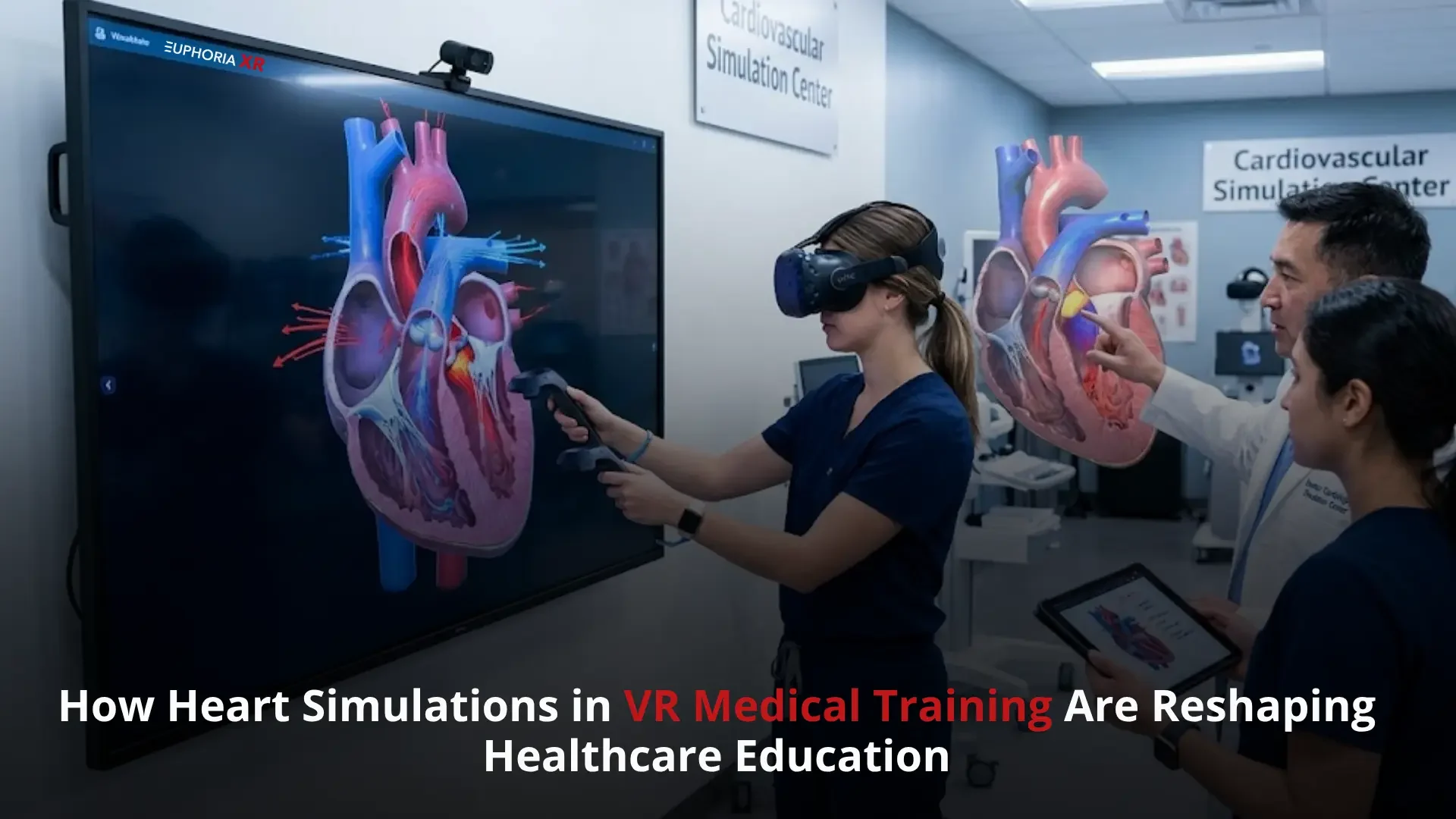
This can be particularly beneficial when examining an organ like a person’s heart.
Students will be able to move the student heart about, examine the various chambers, valves, arteries, and blood vessels, and know how each part works with the whole heart.
Realistic Procedure Simulations
Medicine is a practical science which needs knowledge and technical skill.
VR medical training sessions give learners a chance to practice repeatedly in a “safe” environment.
Examples include:
| Procedure Type | VR Training Applications |
|---|---|
| Surgery | Surgical Planning and Procedural Rehearsal |
| Cardiology | Catheter Navigation and Heart Procedure Simulations |
| Emergency Care | Trauma Response and Patient Stabilization |
| Nursing | Medication Administration and Patient Care |
| Radiology | Imaging Interpretation and Diagnostics |
Practice with learners helps build confidence prior to real patients being seen.
Scenario-Based Clinical Training
Healthcare professionals are required to make decisions in their response to stress.
Through VR simulations, learners can experience realistic clinical situations and recreate them in the following ways:
Assess patient conditions
Interpret symptoms
Choose appropriate interventions
Respond to emergencies
Become responsive to the situation changing
It is an experiential learning that enhances clinical reasoning and decision-making skills.
Performance Evaluation and Feedback
Objective feedback is one of the most impactful aspects of VR medical training.
Unlike conventional observation-based evaluations, VR can monitor:
Procedure completion times
Accuracy rates
Decision pathways
Technical errors
Learning progress
This information allows instructors to see the strengths and improvements.
Related: https://sample.noumanmahmood.net/vr-in-healthcare/
VR Heart Simulations: Advancing Cardiology Education
The human heart is one of the most complicated organs of the body.
It has complex anatomical features, components of active blood circulation, active electrical pathways, physiological processes, etc., which are not easy to understand in traditional ways of learning.
That’s where the healthcare line of business is getting revolutionized by heart simulations.
VR heart simulations provide learners with an immersive visualization experience that makes it easier to understand cardiac anatomy and physiology through an interactive learning approach.
Visualizing Cardiac Anatomy in 3D
Students of medicine have great difficulty in comprehending the 3D structure of the heart.
Sometimes textbook illustrations only show the relationship between the chambers, vessels, and valves.
VR gets around these drawbacks.
Students can:
Study comes in many forms and at any angle.
Explore internal structures
Visualize anatomical relationships
Understand spatial orientation
Identify the ways structures work collaboratively
This helps you to record and understand.
Understanding Heart Function and Blood Flow
Anatomy isn’t the only aspect of a cardiologist’s training.
The student needs to know the flow of blood in the cardiovascular system as well.
VR heart simulations show:
Blood circulation pathways
Oxygen exchange processes
Valve functions
Cardiac pumping mechanisms
Changes in pressure in Chambers
Being able to see the processes happen in real-time for the learners allows them to see theory put into practice.
Simulating Cardiac Conditions and Procedures
Heart models can even be used to model a variety of clinical scenarios.
Examples include:
| Simulation Type | Educational Value |
|---|---|
| Coronary Artery Disease | Disease Recognition |
| Valve Disorders | Structural Understanding |
| Arrhythmias | Cardiac Rhythm Analysis |
| Heart Failure | Physiological Changes |
| Surgical Procedures | Procedural Planning |
Pupils can gain an understanding of the formation of the conditions and see how this affects the function of the heart.
This fosters greater learning than simply static learning materials.
Improving Clinical Understanding Through Immersion
Multiple learning senses embrace immersed.
Learners don’t have to read about something, just read it; rather, they should experience it.
Indeed, research on immersive learning environments has indicated that active learning is more likely to lead to increased engagement, retention, and understanding compared to passive learning.
This might be equated with:
Improved mastery of complicated ideas
Improved clinical reasoning
Faster skill acquisition
Greater learner confidence
Case Study: Inner Voyage VR Heart Simulation Transforming Medical Education
With the changing nature of health care education, institutions strive to find novel means to simplify complex medical concepts for easier understanding.
The Inner Voyage VR Heart Simulation created by EuphoriaXR is an example.
This project illustrates the concepts of how to make medical learning easier and more interactive with an immersive experience.
Training Objectives
The main purpose of the VR heart simulation was to get the learners to grasp a better understanding of heart anatomy and cardiovascular function.
Key objectives included:
Simplicity of complicated heart designs
Improving anatomical comprehension
Enhancing learner engagement
Yielding to in-residence medical students who study.
Ensuring effective learning experiences that stick with the students.
The design of this project was created to help bridge the gap between theory and practice.
Key Features of VR Heart Simulation
The Inner Voyage experience has a number of interactive learning elements.
Interactive 3D Heart Exploration
Users are able to view a virtual heart model from any perspective in detail.
This helps to understand the cardiac structures and their relationship in a deeper way.
Immersive Learning Environment
The simulation deeply places the learner in a virtual space, created specifically for pedagogical engagement.
This will allow for a concentrated and distraction-free learning experience.
Anatomical Visualization
Dynamic visualization helps to understand the more complex structures.
Learners can examine parts that are unlikely to be visualised by conventional materials.
Enhanced User Interaction
Users don’t just take in info; they are involved in learning.
This boosts engagement and retention of knowledge.
Educational Outcomes and Impact
The Inner Voyage VR Heart Simulation paints a picture of the immersive experience of learning and how that can enhance health care education.
Some of the important educational advantages are:
Improved understanding of cardiac anatomy
Increased learner engagement
Nonintrusive demonstration of the cardiovascular system
Stronger knowledge retention
Enhanced educational accessibility
The project emphasizes the emerging potential of employing VR medical training to better grasp by health-related learners the intricate mechanisms and complex systems of the human body.
Why This Matters
Cardiology is one of the most difficult fields of medical teaching.
With the help of heart simulations, abstract concepts are made interactive by converting them into life-sized simulations.
Benefits of VR Medical Training
VR medical training allows medical learners to practice, understand, and improve their skills while not solely relying on actual clinical experiences.
Improved Knowledge Retention
VR adds a sense of engagement to learning. Students see, interact with, and can repeat medical concepts to remember complex topics.
Risk-Free Clinical Practice
The procedures can be practised in a virtual environment. They can make mistakes, learn from them, and make better without putting actual patients at risk.
Enhanced Procedural Accuracy
VR provides multiple opportunities for practice with feedback. This assists students in developing technique, timing, and confidence before actual procedures.
Faster Skill Development
Students are able to make the simulations as many times as necessary. This assists them in developing skills quicker than when they have few chances to train in the real world.
Greater Learner Engagement
Immersive simulations are more interactive than ebooks or videos. This helps to keep the learners’ attention and to make the learning of healthcare more interesting.
Real-World Applications of VR Medical Training
VR medical training is a powerful solution that allows healthcare education systems to provide more impactful, engaging, and scalable medical training experiences, in a variety of medical specialist fields.
Surgical Training
VR allows surgeons to practice procedures more times, makes procedures more precise, and allows them to simulate complex procedures before surgery. It builds confidence and decreases the risk of training.
Cardiology Education
The interactive heart simulations allow users to learn about the structure of the heart, the blood flow, and the different cardiovascular diseases through a very visual and engaging experience.
Emergency Medicine Training
Realistic digital simulations can be used to teach healthcare specialists for high-stress situations, like cardiac arrest, trauma, and emergency medicine.
Nursing Education
In the VR environment, nursing students can experience a safe learning environment for acquiring skills in clinicals, patient evaluation, medications, and responding to emergencies.
Radiology Training
A storehouse of radiological data and the use of 3D visualisation encouraged understanding of the anatomical structures, enhanced skills in interpreting radiological images, and improved the ability to make medical diagnoses more easily.
Why Healthcare Organizations Choose EuphoriaXR for VR Medical Training?
By permitting healthcare organizations to shift from traditional getting to know to immersive and interactive education, EuphoriaXR empowers them to enhance patient care, foster innovation, and meet enterprise requirements. We unite scientific visualization, simulation development, and XR know-how to construct scalable solutions that deliver enhanced engagement, retention, and clinical readiness.
Specific VR medical training solutions custom-made for specific learning goals
Interactive heart simulations and in-depth anatomy visualization.Advanced heart visualization and simulations.
Experiences reflecting the real clinical setting, procedures-based training.
Scalable training programs for medical schools, hospitals, and healthcare institutions.
End-to-end development from concept and design to deployment and support
Talented and experienced teaching and learning in healthcare, medical simulation and/or immersive technologies
The Future of Healthcare Education With VR
VR is already making a difference in healthcare education, but it’s still a developing technology.
The medical education of the future will include more realistic experiences and innovative technology that will enhance the learning process even more.
AI-Powered Medical Simulations
AI is helping to develop smarter training spaces.
Future simulations will be able to:
Understand the learner’s performance and make adjustments
Generating personalized scenarios
Providing deeper feedback
Simulate more realistic patient behaviours
This will lead to increased responsiveness and individualization of training.
Multi-User Collaborative Training
Teamwork is essential for healthcare.
In the future, the VR environments will enable several learners to experience the same virtual clinical scenario, without any restriction on location.
Benefits include:
Remote collaboration
Team-based learning
Interdisciplinary training
Improved communication practice
This provides the possibility of more realistic healthcare simulations.
Personalized Learning Pathways
There are different speeds at which learners learn.
For advanced VR platforms, there is an opportunity to customize for each trainer.
Learners may receive:
Customized modules
Adaptive difficulty levels
Targeted feedback
Personalized learning plans
This increases the chances of maximising learning.
Next-Generation Medical Education
The future of healthcare education will most likely include a mix of:
These technologies will work together to provide better and more available healthcare training systems.
Whether it’s a heart simulation or healthcare education platforms, EuphoriaXR creates personalized VR medical training environments to enhance engagement and learning outcomes.
Closing Note
VR medical training is transforming the way healthcare experts research, work, and get ready for real-life scenarios. Immersive technology is being utilized in numerous applications to assist beginners learn complex anatomy, enhance decision-making, and benefit self-confidence in a safe surroundings, starting from heart simulations to surgical training. VR will continue to play a essential role in improving the schooling, capabilities, and protection of patients in the development of superior healthcare training.
Frequently Asked Questions (FAQs)
How long does it take to build an AI app for a business?
The timeline depends on the app’s complexity, capabilities, integrations, and AI necessities. A simple AI app may take a few weeks, whereas a more superior enterprise-level solution can take numerous months.
What data does a business need before starting AI app development?
The required data depends on the use case. Businesses may additionally want customer data, sales data, aid history, workflow data, product data, financial data, or operational records.
Can an AI app integrate with existing CRM, ERP, or business software?
Yes. A custom AI app can integrate with CRM systems, ERP systems, databases, advertising equipment, support software, payment systems, and other enterprise programs through APIs or custom integrations.
Do AI apps need regular updates after launch?
Yes. AI apps need updates to improve accuracy, fix bugs, improve protection, optimize overall performance, and adapt to changing business needs.
How can a business measure ROI from an AI app?
ROI can be measured through saved time, reduced prices, higher sales, improved lead conversion, quicker reaction times, higher productivity, extended customer retention, and improved decision-making.